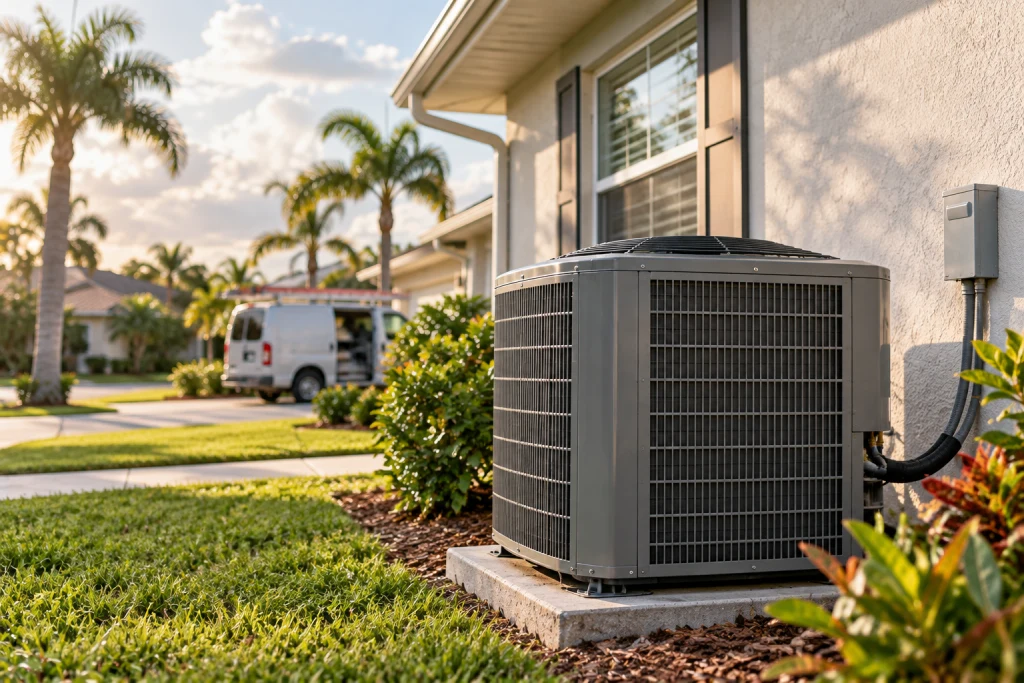
Should you repair or replace AC in Florida this fall? It usually starts with one simple screening test: the 50 percent rule. If a repair quote comes in at more than half of what a full replacement would cost, and your system is already past the 10-year mark, the math usually points toward replacing rather than repairing, though warranty coverage, repair history, and refrigerant type can still shift the answer.
By the ACPrices.com Editorial Team•✔ Checked against 2026 DOE SEER2 standards and current Florida repair and installation pricing•Updated: September 2026
That single rule will not cover every situation on its own, and Florida’s climate adds a few wrinkles that homeowners in milder states never have to think about. This guide walks through the 50 percent rule in detail, when system age matters more than whatever just broke, what repairs and replacements actually cost across Florida in 2026, the hidden costs of patching an old system one more time, and why homeowners who wait until fall to replace often come out ahead of the ones who panic-buy in July.
This is written for Florida homeowners staring at a broken or struggling AC right now, trying to decide whether to call a repair tech or start collecting replacement quotes before the next heat wave hits. If you are still not sure whether what you are seeing counts as a real failure or an early warning sign, our late-summer AC warning signs guide is a good place to check first. Everything below reflects Florida-specific pricing, SEER2 rules, and refrigerant realities as of September 2026, not a generic national repair-or-replace calculator with Florida’s name pasted on top.
For most of the country, an AC breakdown in September is an inconvenience. In Florida, where the cooling season runs nearly year-round and highs regularly clear 90 degrees well into October, a failed system is closer to an emergency, and that pressure is exactly what pushes a lot of homeowners into a rushed, overpriced decision they would not have made with a clear head.
What Is the 50% Rule for AC Repair vs Replacement?
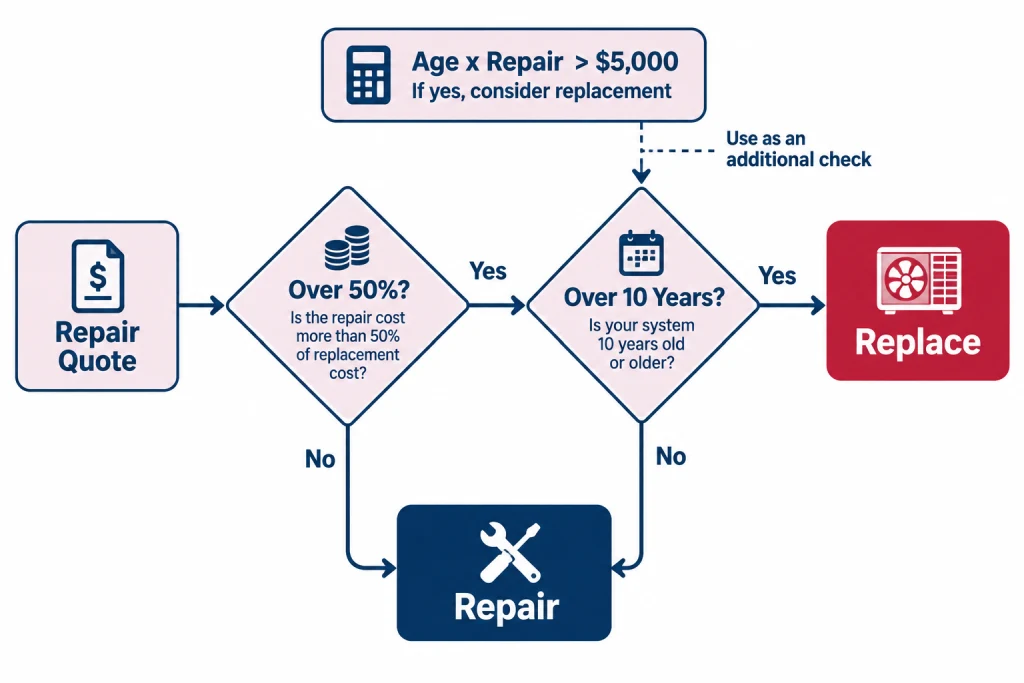
The 50 percent rule is the fastest gut check for a Florida AC decision, and it works best as a screening tool rather than a standalone financial formula: if the repair estimate is more than 50 percent of what a comparable new system would cost installed, and the unit is more than 10 years old, replacement generally makes more financial sense. Both conditions matter here, not just one. A cheap repair on an old unit is still just a cheap repair. An expensive repair on a nearly new system is usually still worth doing. Warranty coverage, repair history, and refrigerant type, all covered later in this guide, can still shift the answer even when the rule points one way.
The 10-year mark is not arbitrary. As we cover in more depth in why Florida’s climate shortens typical AC lifespan, the state’s heat and humidity generally push AC systems here into the back half of their useful life sooner than the same equipment would see in a milder climate. That is part of why this rule holds up especially well in Florida specifically, and less reliably as a one-size-fits-all standard elsewhere.
Here is how that plays out with real Florida numbers.
Example 1, repair wins. A 6-year-old 2.5-ton system in Orlando needs a new capacitor and contactor. The repair quote is $380. A comparable 2.5 to 3-ton mid-efficiency replacement in the Orlando market runs $7,500 to $10,800. $380 is roughly 4 percent of replacement cost, and the system is nowhere near 10 years old. Repair, without hesitation.
Example 2, replace wins. A 13-year-old 3.5-ton system in Fort Lauderdale needs a new compressor and a leak repair on the evaporator coil. The combined quote comes in at $5,400. A comparable 3.5 to 4-ton mid-efficiency replacement in Broward County runs $9,000 to $12,500. $5,400 sits at roughly 43 to 60 percent of that range, and the unit is well past 10 years old. Both conditions of the rule are met, and this is a replace.
Example 3, repair still wins despite the high dollar amount. A 3-year-old 4-ton system in Tampa needs a full coil replacement after a manufacturing defect, quoted at $3,200. A comparable 3.5 to 4-ton mid-efficiency replacement in the Tampa market runs $9,000 to $12,500. $3,200 is roughly 26 to 36 percent of that range, well under the 50 percent line, and the system is only 3 years old. Repair here, and check whether the coil itself is still covered under the manufacturer’s parts warranty before paying out of pocket.
System Size (Tonnage)
Code-Minimum Replacement (Low End)
Repair Cost That Crosses 50%
1.5–2 ton
$4,500
$2,250+
2.5–3 ton
$6,000
$3,000+
3.5–4 ton
$7,500
$3,750+
4.5–5 ton
$9,000
$4,500+
The $5,000 Rule: A Second Check
A second, simpler heuristic some contractors use alongside the 50 percent rule: multiply the system’s age in years by the repair estimate in dollars. If that number comes out above roughly $5,000, it is commonly treated as a signal to compare replacement more seriously. This is a rule of thumb, not an industry standard or a substitute for an actual diagnosis, but it catches cases the 50 percent rule alone can miss.
Take a 9-year-old system with a $600 repair quote. 9 times $600 is $5,400, over the threshold, even though $600 is nowhere near 50 percent of any realistic Florida replacement cost. On its own, this rule would flag the system for a closer look. Compare that to Example 1 above, a 6-year-old system with a $380 repair: 6 times $380 is $2,280, well under $5,000. Running both checks together, rather than relying on either one alone, gives a fuller picture than either check gives by itself.
Based on the low end of Florida’s code-minimum 14.3 SEER2 installed pricing. A quote measured against the mid or high-efficiency columns pushes the 50 percent line higher, so treat this table as a conservative starting point, not a final answer.
A repair quote that lands right around the 50 percent line, on a system between 8 and 12 years old, is the genuinely hard case. That is where the age question below carries more weight than the invoice sitting in front of you.
🧮 Run Your Own Numbers
See Exactly Where Your System Falls
Plug your tonnage and efficiency tier into our free calculators to get a real repair estimate and a real replacement estimate side by side, then apply the 50 percent rule to your own numbers instead of a general table.
Free tools · No obligation · Built for Florida homeowners
Does the Age of Your System Matter More Than the Problem Itself?
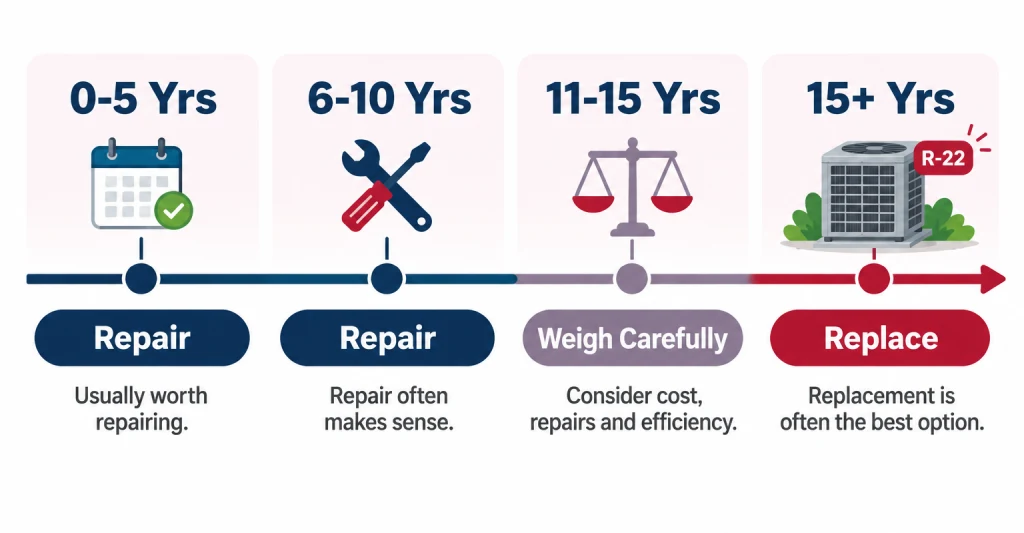
In our experience working with Florida homeowners, yes, age usually matters more than the specific part that failed. A compressor failure on a 4-year-old system and a compressor failure on a 14-year-old system are not the same decision, even at an identical repair price, because age tells you what else is likely wrong or about to go wrong.
System Age
General Guidance
0–5 years
Repair almost always makes sense, and the part may still be under manufacturer parts warranty
6–10 years
Repair unless the quote crosses roughly 40–50% of replacement cost, or this is the system’s second or third repair this year
11–15 years
Weigh carefully; efficiency has often dropped below the original rating due to normal wear, and a major component failure usually tips toward replacement
15+ years
Replace in most cases, especially if the system still runs on R-22
That last row deserves its own explanation. If your outdoor unit still uses R-22 refrigerant, it was almost certainly manufactured before 2010, since U.S. manufacturers stopped building new R-22 equipment that year ahead of the EPA’s refrigerant phase-out schedule. That alone puts the system well past 15 years old in 2026, before anyone even looks at what broke. R-22 is no longer produced or imported in the United States, and existing systems now run on reclaimed and stockpiled supply only, which is a shrinking, increasingly expensive pool.
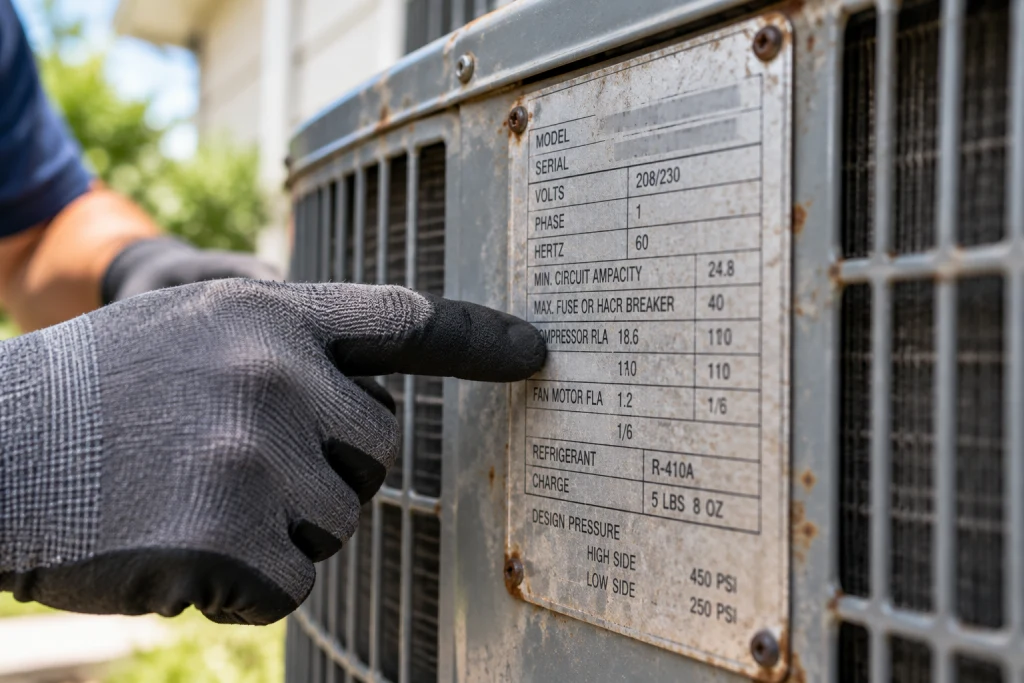
💡 Check the Nameplate First: Before you approve any repair on an older system, look at the data plate on the outdoor unit. If it lists R-22, R-410A, or R-454B, that single detail changes the whole conversation, since R-22 recharges and repairs cost meaningfully more than equivalent work on modern refrigerant.
Coastal exposure adds one more wrinkle to the age conversation. Outdoor units facing direct salt air, whether in Miami-Dade and Broward’s High Velocity Hurricane Zone or in other coastal counties without HVHZ rules, tend to corrode faster than the same equipment installed further inland, which can shorten realistic service life. A technician can usually tell within a few minutes whether visible corrosion on the coil or cabinet is cosmetic or structural, and that assessment is worth asking for before approving a repair on a coastal system already past the 8 to 10-year mark.
Florida Region
What Can Affect the Repair-or-Replace Math
Miami-Dade & Broward
Falls under HVHZ rules, so outdoor equipment needs product-approved hardware, and salt-air corrosion can shorten equipment life
Other coastal counties (Tampa Bay, Southwest Florida, etc.)
Salt-air exposure without full HVHZ requirements; a corrosion-resistant coil coating is often worth the extra cost
Inland Florida
Less direct salt exposure, but heat and humidity still drive the same general 12 to 15-year typical lifespan
Statewide
Florida’s DOE Southeast-region SEER2 floor and the R-22 phase-out timeline apply the same way everywhere
Check Your Warranty Before Paying for a Major Repair
A $3,000 repair quote is not really a $3,000 decision if the failed part is still covered under a manufacturer’s parts warranty. Most residential systems carry a 5 to 10-year parts warranty from the manufacturer, separate from whatever labor warranty the original installing contractor offered, and separate again from any extended warranty purchased at the time of install.
Before approving a major repair, ask the contractor to check three things: whether the failed component is still within its manufacturer parts warranty period, whether that warranty is still valid for this specific unit (some manufacturer warranties require product registration within a set window after installation, and can lapse if that step was skipped), and whether labor to install the covered part is itself covered or billed separately. A compressor or coil that turns out to be fully covered under parts warranty can turn what looks like a clear replace decision into an easy repair, since you may only be paying for labor rather than the full repair quote.
It also helps to keep the refrigerant categories separate rather than treating them as one issue, since a contractor casually mentioning a refrigerant is “being phased out” can mean very different things. R-22, the legacy refrigerant discussed above, is generally found in equipment manufactured before 2010. R-410A is the refrigerant in most systems installed roughly between 2010 and 2024, and it remains fully serviceable with no supply restriction like R-22’s. New residential systems manufactured for 2025 and beyond have shifted to lower-GWP refrigerants such as R-454B under EPA’s technology transition rules, which is why current replacement quotes increasingly list R-454B rather than R-410A. None of this changes the repair-or-replace math directly, but it is worth confirming which of the three you actually have.
Repair history matters just as much as the calendar. A single $300 repair means very little on its own. A third $300 repair inside 18 months on the same system is a different signal, even though no individual invoice ever crossed the 50 percent line. A single major failure, compressor, coil, or a refrigerant leak that needs a full recharge, on a system already carrying R-22 is usually the clearest replace signal in this entire guide, regardless of what that one repair invoice says.
What Do Repairs vs Replacement Typically Cost in Florida?
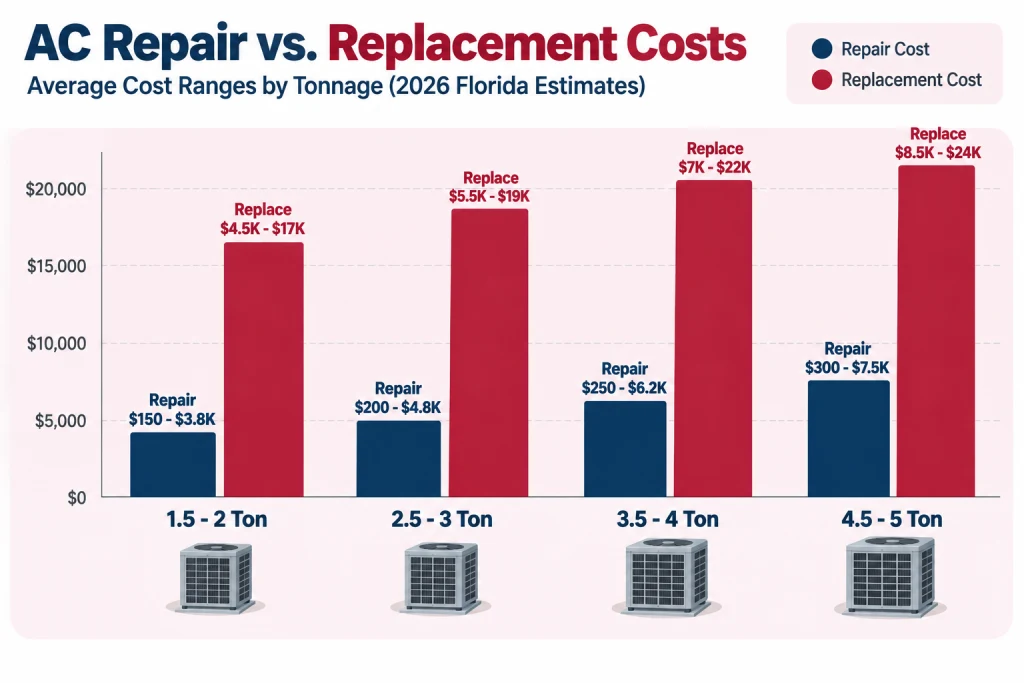
Repair costs vary by which component failed and whether your system still needs R-22. Replacement costs vary by tonnage and SEER2 tier, the same two factors that drive every installation quote across the state. Here is a realistic 2026 breakdown of both, so you can compare your specific quote against a real benchmark instead of guessing.
General Florida benchmark ranges, not a quote. Exact pricing depends on your specific brand, unit access, and local labor rates, and can run higher in Miami-Dade and Broward due to HVHZ-related labor demand.
Repair pricing shifts by region for the same reasons installation pricing does. Miami-Dade and Broward technicians often charge more for the same repair simply because of higher regional labor demand and HVHZ-related mounting hardware requirements, while Orlando’s more competitive contractor market tends to keep repair quotes closer to the lower end of these ranges.
System Size (Tonnage)
Code-Minimum 14.3 SEER2
Mid-Efficiency 16–17 SEER2
High-Efficiency 18+ SEER2
1.5–2 ton
$4,500 – $7,800
$6,200 – $9,000
$8,000 – $11,000
2.5–3 ton
$6,000 – $9,200
$7,500 – $10,800
$9,500 – $13,000
3.5–4 ton
$7,500 – $10,800
$9,000 – $12,500
$11,000 – $15,000
4.5–5 ton
$9,000 – $12,500
$10,800 – $14,500
$13,000 – $17,000+
For a full breakdown of what drives those replacement numbers city by city, see our complete AC installation cost guide for Florida. And before you sign off on either a repair or a replacement quote, it is worth a quick read through how to avoid AC installation scams in Florida, since a suspiciously low number on either side of this decision deserves the same scrutiny.
Rather than eyeballing where your specific system and repair quote land, run both numbers through the calculators below side by side. One tells you what your repair should realistically cost, the other tells you what a full replacement runs for your exact tonnage and efficiency tier.
🔧 Repair Cost
What Should This Repair Cost?
Enter what’s wrong with your system to get a fair Florida repair cost estimate before you approve any invoice.
Step 1 of 160%
🔧
A/C Repair Cost Calculator
How much will repairing your existing A/C cost? Answer a few questions about what you're experiencing and get a repair cost estimate.
How well has your A/C been cooling your home lately?
Have you noticed large indoor temperature fluctuations?
Is the thermostat on and appears to be functioning properly?
Have you noticed reduced airflow from vents even though the A/C is on?
Have you noticed air coming from vents feels warm?
Is the fan spinning very slowly or not at all on outdoor unit?
Does the air conditioner fan appear to never shut off (outdoor unit)?
Have you noticed strange odours coming from vents or near your furnace?
Have you noticed any unusual noises?
What best describes the unusual noise(s)?
Does your A/C turn on but shuts off soon after?
Does the breaker regularly trip or fuses repeatedly blow?
Have you noticed water damage or water leaking or pooling near your furnace?
Have you noticed ice build up on the refrigerant lines, copper tubing, or coil?
Have your electrical bills been significantly higher than usual lately?
Would you like to receive a free no-obligation estimate from our local contractor partners as well?
Great! Almost done, your result is on the next page.
Please enter your contact details so our Certified contractors can provide estimates as well.
This field is required.
Please enter a valid email address.
Please enter your phone number.
Please enter your city or ZIP code.
By submitting this form, you are giving your consent to receive phone calls and text messages from our contractor partners.
You're almost done!
Please provide your details to see your results.
Name is required.
Email is required.
Please enter your city or ZIP code.
🔧 Diagnosis Complete
Your A/C Repair Estimate
Estimated Repair Range
—
Likely Issue
—
Get an Accurate Repair Quote
A certified HVAC technician can diagnose the exact issue and provide a firm quote. Many offer free diagnostics.
Once you have both numbers in front of you, the 50 percent rule from earlier stops being an abstract guideline and becomes a specific dollar comparison for your own house.
Don't Automatically Replace With the Same Tonnage
A common assumption is that replacing a 3-ton system means installing another 3-ton system. That is not always correct, and it is worth checking before you finalize a replacement quote.
The tonnage your home actually needs depends on a proper Manual J load calculation, which accounts for square footage, insulation, window count and orientation, ceiling height, duct condition, and any additions or renovations made since the last AC installation. A home that has added insulation, replaced windows, or finished an attic space since its system was last sized may genuinely need a different tonnage, in either direction. Our AC equipment sizing guide walks through what a proper load calculation actually accounts for.
Oversizing is the more common mistake, and it carries a real comfort cost. An oversized system cools the air quickly but shuts off before it has run long enough to properly dehumidify the space, a pattern called short cycling. The result is a home that reads the right temperature on the thermostat but still feels clammy, especially during Florida's humid summer months, since a Florida AC has two jobs, lowering temperature and removing moisture, and a mismatched system can do the first without doing the second. If your current system has always felt like this, a straight tonnage-for-tonnage replacement will likely repeat the same problem rather than solve it. Ask your contractor for the load calculation itself, not just a quote based on what is already installed.
What Are the Hidden Costs of "Just Repairing It Again"?
A repair invoice only shows one number. It does not show what an aging system costs you in the months after the repair, and that is where a lot of Florida homeowners end up spending more by trying to save money upfront.
Efficiency loss. A 12 to 15-year-old system, even freshly repaired, often runs less efficiently than its original SEER rating because of factors like coil wear, refrigerant charge drift, and duct leakage that accumulate over time. That can show up every month on your FPL, Duke Energy, or TECO bill, not on the repair invoice.
The repeat-repair spiral. Some contractors use a simpler back-of-napkin version of the math above: multiply the system's age in years by the repair cost, and if that number tops $5,000, lean toward replacement. A $600 repair on a 9-year-old system already clears that threshold on its own.
Cascading failures. A compressor, coil, and blower motor age together. A failure in one can be an early signal that the others are wearing out too, so a repair that looks isolated today is sometimes followed by a second repair bill within a year or two.
R-22 exposure. If your system still runs on R-22, every future refrigerant-related repair draws from a shrinking, reclaimed-only supply that costs meaningfully more per pound than modern refrigerant, and that gap tends to widen rather than shrink.
A warranty clock that never resets. Money spent extending an old system's life buys you months, not years, and does not build toward the roughly 10-year manufacturer parts warranty that a full replacement resets to zero.
Comfort you stop noticing. Uneven cooling, longer run times, and a noisier outdoor unit tend to creep in gradually enough that homeowners adjust to them rather than fixing them, right up until a full breakdown forces the issue anyway.
The sunk cost trap. Homeowners who have already spent $1,500 or $2,000 keeping an old system alive often feel pressure to keep going rather than "waste" that money on a new one. Money already spent is gone either way; the only question that matters going forward is what the next dollar buys, repair or replacement.
Resale friction. An aging or repeatedly patched AC system can become a negotiating point during a Florida home inspection, since buyers in this market often ask directly how old the system is and what has been repaired on it.
None of this means every older system should be replaced the moment something breaks. It means the true cost of "just fix it one more time" rarely shows up in the repair estimate itself.
🍂 Beat the Fall Rush
Compare Repair vs Replace Quotes Free
Tell us what's going on with your system and we'll connect you with licensed, background-checked Florida contractors who can quote both options side by side, so you're comparing real numbers instead of guessing.
🔒 Free · No obligation · Licensed Florida contractors only
Why Is Fall a Smart Time to Replace Instead of Repair?
If your system is already leaning toward the replace side of this guide, timing the decision for fall rather than mid-summer works in your favor for a few concrete reasons.
Contractor schedules open up. Florida's installers are booked solid through peak cooling season. By September and October, most crews have more flexibility, which often means a faster install date and more room to negotiate than during a July heat wave.
You get to compare quotes properly. Getting 2 to 3 detailed quotes takes time most homeowners do not have when the house is 88 degrees and climbing. A fall replacement lets you request quotes, verify licensing, and compare equipment specs without a same-week deadline pushing you toward the first offer.
The system breaks in before next summer. Any defect in a new install, a mis-set thermostat, a slightly under-tightened fitting, tends to surface in the first few weeks of real use. Discovering that in October under warranty and mild weather beats discovering it in June during the first 95-degree week.
You lock in current SEER2 minimums. The DOE reviews these standards on a recurring cycle. Replacing now means buying equipment built to the current 14.3 SEER2 floor (under 45,000 Btu/h) or 13.8 SEER2 (45,000 Btu/h and up), or higher, rather than sourcing compliant equipment mid-transition later.
Rebate budgets can run thin by year-end. FPL, TECO, Duke Energy Florida, and OUC fund their AC rebate programs annually, and some categories fill up before December.
⚠️ One Caveat: Florida's hurricane season runs through the end of November and typically peaks in September, so confirm your install window with your contractor rather than assuming coastal risk is fully behind you the moment October arrives.
Florida does not get the natural pause that a real winter gives northern homeowners, when the AC sits idle for months and a failure carries no real urgency. Fall is the closest thing Florida gets to that breathing room, which is exactly why it works so well as a planning window rather than an emergency one.
Whether you are leaning toward repair or replacement, walking into the conversation with the right questions protects you either way.
What exactly failed, and can you show me the part? A contractor should be able to point to the specific failed component, not just describe symptoms.
Is this part covered under manufacturer parts warranty? Confirm this before agreeing to pay for the part itself.
What is the labor warranty on this repair? A repair with no labor warranty at all is worth a second opinion.
What is the total cost including refrigerant, if any is needed? Refrigerant, especially R-22, can end up being the largest line item on a repair invoice.
If I replaced instead, what would that cost for my tonnage and SEER2 preference? A contractor quoting a repair should be able to give you this comparison number too.
What SEER2 rating and refrigerant does a replacement system use? Confirm it meets Florida's current DOE floor for your system's capacity.
Has a load calculation been done for my home, or is this based on the existing system's size? This matters most on a replacement quote.
Does the installation price include the permit? This applies to replacement, not repair.
Are disposal and haul-away of the old equipment included? Ask for this in writing on a replacement quote.
Can I get this in writing before you start work? A verbal quote that changes once work begins is a red flag on either a repair or a replacement.
None of these questions require confrontation. A contractor who answers them clearly and without hesitation is generally the one worth working with, on either side of this decision.
Bottom Line: Should You Repair or Replace AC in Florida?
Repair vs Replace Decision Matrix
Factor
Leans Toward Repair
Leans Toward Replace
Age
Under 10 years
Over 10 to 15 years
Repair cost
Under 50% of replacement
Over 50% of replacement
Warranty
Part still covered
Warranty expired
Repair history
First or isolated repair
Repeated failures in a short window
Refrigerant
R-410A or R-454B
R-22
Comfort
Cools and dehumidifies evenly
Uneven cooling, clammy air, short cycling
Efficiency
Bills roughly stable
Noticeably rising energy bills
Sizing
Confirmed correct via load calculation
Known oversizing or undersizing
No single row decides the outcome by itself. The more rows that land in one column, the clearer the decision usually is.
Deciding whether to repair or replace AC in Florida usually comes down to four checks. Run through them in order:
Is the system under 5 years old? Repair. It is very likely still under manufacturer warranty, and age is not working against you yet.
Is the repair quote under 50 percent of replacement cost, and is the system under 10 years old? Repair. Both conditions of the rule point the same direction.
Is the repair quote over 50 percent of replacement cost, or is the system over 10 to 15 years old with a major component failure, repeat repairs, or R-22 refrigerant? Replace. The math and the age both point the same direction here too.
Still landing right on the line? Get 2 to 3 quotes from our network of licensed Florida HVAC contractors before you decide anything, and run both the repair and cost calculators above against your actual numbers rather than the general ranges in this guide.
A failing AC before fall is genuinely stressful in Florida, but it is also one of the more mechanically simple decisions in home ownership once you have real numbers in front of you instead of a single scary invoice.
What to have ready before you call: system age, model number if visible, tonnage, current refrigerant type, and a copy of the repair diagnosis if you already have one. Having these on hand gets you an accurate quote instead of a ballpark guess.
🇺🇸 Still Unsure? Compare Both Options
Get a Repair Quote and a Replacement Quote, Side by Side
Tell us a bit about your system and we'll connect you with licensed contractors in your city who can walk you through repair and replacement options together. There's no obligation to replace your system just because you asked for a quote.
🔒 Free · No pressure · Florida-licensed contractors only
Frequently Asked Questions
Is R-22 refrigerant being phased out?
Yes. U.S. production and import of R-22 ended January 1, 2020. Existing systems can still legally run on R-22, but only reclaimed or stockpiled supply is available now, and that supply is shrinking and getting more expensive every year.
What SEER2 minimum applies if I replace now?
In Florida's DOE Southeast region, systems under 45,000 Btu/h, roughly 3.5 tons and below, must meet 14.3 SEER2. Systems 45,000 Btu/h and up carry a 13.8 SEER2 floor. Many contractors default to 14.3 or higher across the board regardless of size.
Can I finance a replacement instead of paying upfront?
Yes. Most Florida contractors offer financing plans, and manufacturers regularly run promotional 0 percent periods, though deferred interest can apply if the balance is not paid in full. Some counties also offer PACE financing, repaid through your property tax bill and transferable at resale, though availability and lender terms vary.
How much does it cost to repair or replace AC in Florida?
Common repairs run $150 to $3,800 depending on the part. A full replacement runs $4,500 to $17,000 depending on tonnage and SEER2 tier. The 50 percent rule compares your specific repair quote against your specific replacement range, not these totals directly.
Is a 10-year-old AC worth repairing in Florida?
It depends on the repair cost and what else is aging alongside it. A minor, inexpensive repair on a 10-year-old system is usually still worth doing. A major component failure, or a system already on R-22, usually is not.
Does homeowners insurance ever cover AC replacement in Florida?
Generally, no. Ordinary mechanical wear and age-related failure is treated as a maintenance issue, not a covered peril, under most Florida homeowners policies. Coverage typically only applies when the damage stems from a covered event like a storm. Check your specific policy for exact terms.