Hurricane AC prep in Florida is not a same day task. It is a sequence: cut power to the outdoor unit before the outer bands arrive, anchor and shield it from wind driven debris, protect the electrical components from horizontal rain, and photograph the system before anything changes. Skip a step and a $200 repair can turn into a $4,000 replacement.
By the ACPrices.com Editorial Team•✔ Checked against Florida Building Code wind load rules and FEMA flood elevation guidance•Updated: September 2026
This guide is built for homeowners anywhere in Florida, from Gulf Coast storm surge zones around Tampa, St. Petersburg, and Cape Coral, to the wind heavy Atlantic corridor running through Miami, Fort Lauderdale, and Hialeah, to inland cities like Orlando and Jacksonville that see less surge but plenty of downed trees and multi day outages. You’ll get the exact prep checklist, what to do with the system once the storm hits, what to check the moment it’s safe to go back outside, and how to tell ordinary wear from damage serious enough to file a claim over.
The guidance below draws on Florida Building Code wind provisions, FEMA and Ready.gov storm prep guidance, and the Florida-specific failure points that show up every hurricane season, not generic advice written for a national audience. Here’s the checklist to run through first.
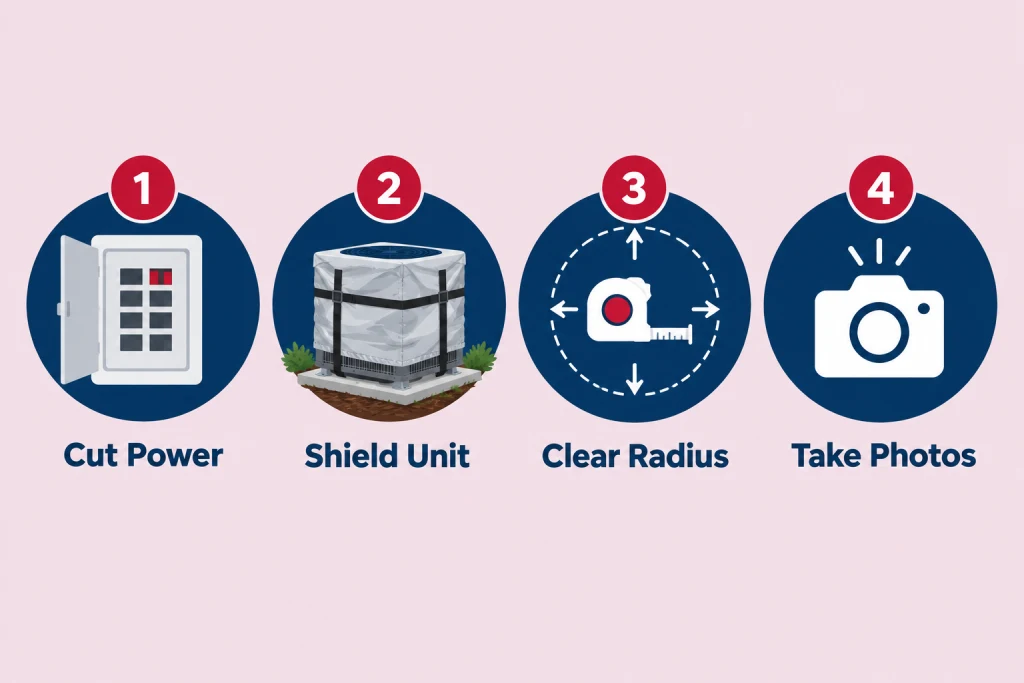
If a hurricane warning has been issued for your county, work through these four steps in order. Each one takes fifteen minutes or less, and skipping any of them is what turns a minor repair into a full system replacement.
Cut power at the breaker, not just the thermostat. Flip the dedicated 240V breaker for the outdoor unit off before winds pick up. A powered unit sitting in standing water or struck by wind driven debris is far more likely to short out than one that’s fully de-energized.
Anchor and shield the outdoor unit. Confirm the condenser is still bolted to its pad, older installs sometimes aren’t, and add a breathable hurricane cover or plywood shield around the sides only, never over the top, to block flying debris without trapping heat and moisture.
Clear a 10-foot radius. Trim any overhanging branches, move patio furniture and planters indoors, and clear the condensate drain line so it doesn’t back up during the accompanying rainfall.
Photograph the unit from all four sides. Timestamped photos of the condenser, the disconnect box, and the refrigerant lines before the storm give you clear before-and-after documentation if you end up filing a claim.
Beyond those four photos, it’s worth keeping a folder, physical or digital, with your system’s model and serial numbers, the original installation invoice, and records of any recent service calls. Adjusters move faster when a homeowner can show the unit’s age and maintenance history alongside storm damage photos, rather than tracking that information down after the fact.
Why Are Florida AC Units Vulnerable During Hurricanes?
Florida’s outdoor condensers already run harder and longer than units almost anywhere else in the country, which means they arrive at hurricane season with less margin left. Add sustained tropical storm force wind, horizontal rain, and in coastal counties a real chance of storm surge, and the same four failure points show up year after year.
Wind driven rain intrusion — rain pushed sideways at 50 or more mph finds its way past the top louvers of a condenser cabinet and reaches the capacitor and contactor, components that fail from moisture long before there’s any visible flooding, especially on units mounted facing the prevailing storm direction.
Debris impact — a condenser’s coil fins are thin enough that a wind thrown palm frond, roof shingle, or a neighbor’s patio furniture can crush a section of coil, cutting airflow and refrigerant capacity even when the unit still powers on afterward.
Storm surge and standing water — pads set at or near grade in coastal zip codes can sit partially submerged for hours, one reason post-Irma updates to the Florida Building Code pushed new installs toward elevated pads or brackets in flood-prone areas.
Grid instability on restoration — when a utility re-energizes a neighborhood after an outage, the return surge or a stretch of low-voltage brownout is one of the more common ways a compressor’s start winding gets damaged, sometimes days after the storm itself has passed.
For homes in a FEMA-mapped Special Flood Hazard Area, the surge point above isn’t just a maintenance suggestion. FEMA’s National Flood Insurance Program guidance calls for outdoor HVAC equipment to sit above the home’s Base Flood Elevation or otherwise be flood-protected, which is why newer coastal Florida installs increasingly show up on raised platforms instead of ground-level pads. Your county property appraiser’s GIS map or your insurance agent can tell you your flood zone and BFE in a few minutes if you don’t already know it.
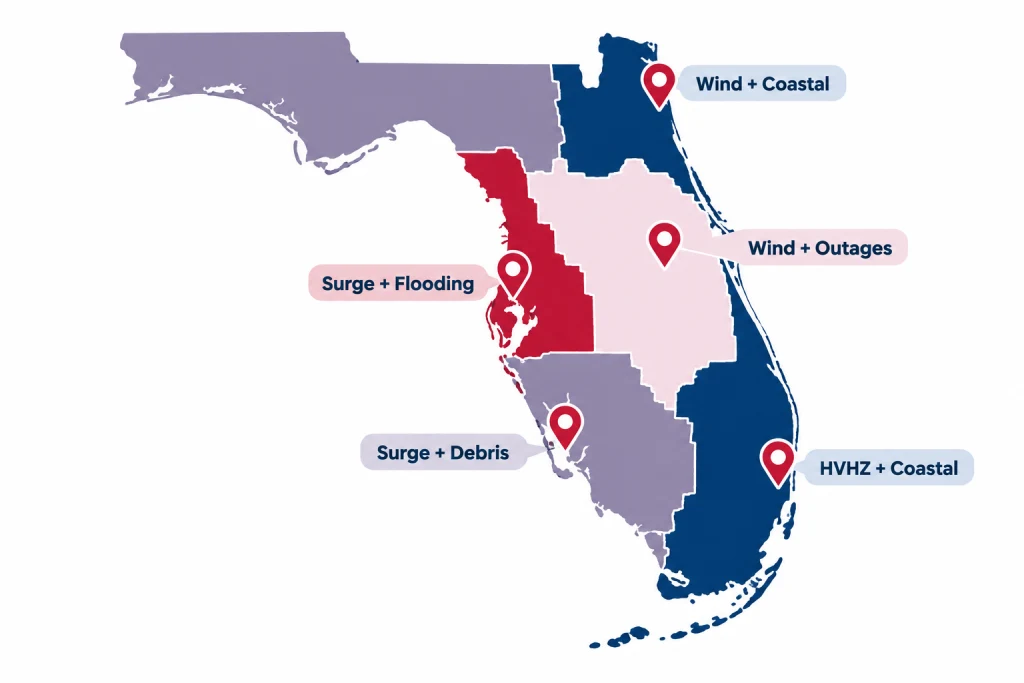
Not every part of Florida faces the same risk in the same order. Here’s the primary concern by region:
Florida Region
Primary AC Hurricane Concern
Miami-Dade & Broward (Miami, Fort Lauderdale, Hialeah)
Wind and debris, extended power outages, inland flooding
Northeast Florida (Jacksonville)
Wind and coastal exposure, multi-day outages
🔧 Know Your Numbers First
What Would Storm Damage Actually Cost to Fix?
Run a suspected fault through our free Repair Cost Calculator to get a realistic range before a technician even arrives, then compare it against a quote from our licensed Florida contractor network.
Free tools · No obligation · Built for Florida homeowners
What Should You Do Before the Storm Arrives?
None of this replaces a pre-season tune-up. A quick professional visit each spring, before the Atlantic season ramps up, typically covers:
Testing capacitor and contactor readiness rather than waiting for a storm to find the weak one
Confirming the condenser pad is still level and the unit is properly bolted
Clearing the condensate drain line before hurricane rainfall has a chance to back it up
Checking that a working surge protector is installed at the disconnect or panel
Reviewing your policy’s hurricane deductible so there are no surprises if you ever need to file a claim
Once a hurricane watch is upgraded to a warning for your county, the work shifts from planning to execution. Here’s what actually matters, broken into a rough timeline.
Timeframe
What to Do
72+ hours before landfall
Confirm the condenser pad is level and the unit is still bolted down. Order a hurricane AC cover or cut plywood to size if you don’t already own one. Clear gutters and downspouts near the unit.
24 hours before landfall
Trim any branches within falling distance of the unit. Secure or bring in loose yard items. Confirm the breaker panel is labeled clearly so you can find the AC disconnect fast.
Final hours before landfall
Cut power at the breaker. Fit the cover or plywood shield around the sides. Take the timestamped photos. Move any portable window units well away from windows.
⚠️ HVHZ Note: If you’re in Miami-Dade or Broward County, including Hialeah and Fort Lauderdale, the anchor bolts installed to meet High Velocity Hurricane Zone code already exceed the wind rating of an aftermarket tie-down strap kit sold at most hardware stores. Confirm the original mounting is intact rather than adding straps on top of it.
Homes outside HVHZ counties aren’t exempt from wind requirements either. Florida’s statewide building code still requires condensers to be rated and mounted for the basic wind speed listed on your county’s wind map, so confirm your installer used code-compliant hardware even in Orlando, Jacksonville, or Tampa.
Resist the urge to fully enclose the unit in plastic or an airtight tarp. A sealed top traps condensation against the cabinet and accelerates corrosion once the storm passes, which is exactly the failure mode you’re trying to avoid. A breathable cover or plywood panel around the sides, left open at the top, blocks debris without creating a new problem.
If your home doesn’t already have a whole-house surge protector at the main panel, this is worth installing before the season gets busy. A $200 to $400 device installed at the panel or disconnect is one of the more overlooked ways to protect the compressor’s control board from the grid restoration surge described above.
Should You Turn Off Your AC During a Hurricane?
Yes. Once you’ve cut power at the breaker ahead of the storm, leave it off until sustained winds have dropped well below tropical storm force and any standing water around the unit has fully drained, generally 24 to 48 hours depending on how the storm tracked through your area.
Running the system during the storm itself spins the fan blade into whatever debris is in the air, pulls rain into the cabinet through the same fan that would otherwise stay closed, and leaves the compressor exposed the moment grid power returns unevenly.
The same rule applies to window units and ductless mini-splits, common in older Florida homes and apartments. Unplug them, and where possible remove and store window units before landfall, since they sit directly in a wall or window opening with none of the cabinet protection a full outdoor condenser has.
How to Keep Your Home Cooler If the Power Goes Out
Once the system is off, a Florida home warms up fast. A few adjustments before the power even goes out make the difference between an uncomfortable few hours and a genuinely rough day:
Pre-cool the house to the low 70s in the hours before landfall, so the structure has a longer runway before indoor temperatures climb.
Close blinds, curtains, and shutters ahead of time to cut solar heat gain, especially on west-facing windows.
Limit how often exterior doors open once the storm arrives; every opening lets in humid outside air.
Use a battery or generator-powered fan to keep air moving without relying on the compressor.
Group the household into one or two interior rooms with the fewest windows rather than trying to hold the whole house at a comfortable temperature on backup power.
⚠️ Generator Warning: A typical portable inverter generator often can’t deliver the surge amperage a compressor needs to start. Instead of running smoothly, the unit hums, trips a breaker, or starts on marginal voltage that stresses the start winding every single time. Pair a generator with a properly sized hard-start kit, or better, use a whole-house standby generator with an automatic transfer switch. Never backfeed a household circuit with a portable generator. It can send live current back into utility lines and put repair crews at risk. Follow Ready.gov’s generator safety guidance on outdoor placement and carbon monoxide precautions as well.
What Should You Check Immediately After the Storm Passes?
Safety comes before the system. Don’t approach the unit if you can’t confirm the disconnect is off, and stay clear of any standing water near it until you’ve checked for downed power lines nearby.
Look for debris trapped in the coil or fan before doing anything else.
Check whether the pad has shifted, cracked, or tilted the unit off level.
Open the disconnect box only if it’s visibly dry, and never if there’s any standing water within reach of it.
If the unit was fully or partially submerged at any point, do not power it on, regardless of how it looks from the outside. Call a licensed technician for an inspection first.
A compressor that took on water and gets powered on anyway can suffer damage a simple call-before-power habit would have prevented entirely, and standing water can hide live electrical hazards a visual check alone won’t catch.
Homes with two systems, common in larger two-story Florida houses, need this same check on both units. One system taking on standing water while the other stayed dry is more common than homeowners expect, and it’s easy to assume both are fine after checking just one.
A shutdown lasting more than a day or two also invites a less obvious problem: insects or small wildlife nesting inside a dead disconnect box. Give the cabinet a visual check for nests or debris before restoring power, not just for water.
Extended outages also let indoor humidity climb, which is why some homeowners restore power to a musty smell or early mold growth on drywall and furniture, even without any water intrusion at all. If the outage ran more than two or three days during peak summer humidity, running a dehumidifier alongside the AC for the first day back helps knock that moisture down faster than the AC alone.
Once everything checks out dry and undamaged, restore breaker power, wait a few minutes before switching the thermostat on to let internal safety controls reset, and listen for the compressor. A hum with no start after five to ten seconds means shut it back off. Repeated failed starts are what turn a stuck component into a burned-out compressor.
If something sounds or feels off once the system restarts, our free AC Troubleshooting Wizard walks through the most common post-storm symptoms and points you toward what’s likely wrong before you call anyone.
🛠️ Free Diagnostic Tool
Not Sure What’s Wrong After the Storm?
Answer a few quick questions about what your AC is doing, or not doing, and get a likely cause before you pick up the phone.
Step 1 of 50%
🔍
AC Troubleshooting Wizard
Which AC issue are you having? Answer a few quick questions to help identify the most likely cause of your air conditioner problem and what to do next.
When you check your thermostat, what do you notice?
What sound do you hear from your AC unit?
How is the airflow from your vents?
When did you last have professional maintenance?
Would you like to receive a free no-obligation estimate from our local contractor partners as well?
Great! Almost done, your result is on the next page.
Please enter your contact details so our Certified contractors can provide estimates as well.
This field is required.
Please enter a valid email address.
Please enter your phone number.
Please enter your city or ZIP code.
By submitting this form, you are giving your consent to receive phone calls and text messages from our contractor partners.
You're almost done!
Please provide your details to see your results.
Name is required.
Email is required.
Please enter your city or ZIP code.
🔍 Diagnosis Ready
AC Troubleshooting Results
Most Likely Cause
—
Get a Certified Tech to Confirm
Our diagnosis is a starting point. A certified HVAC technician can confirm the issue and fix it right the first time.
How Do You Know If It's Storm Damage vs Normal Wear?
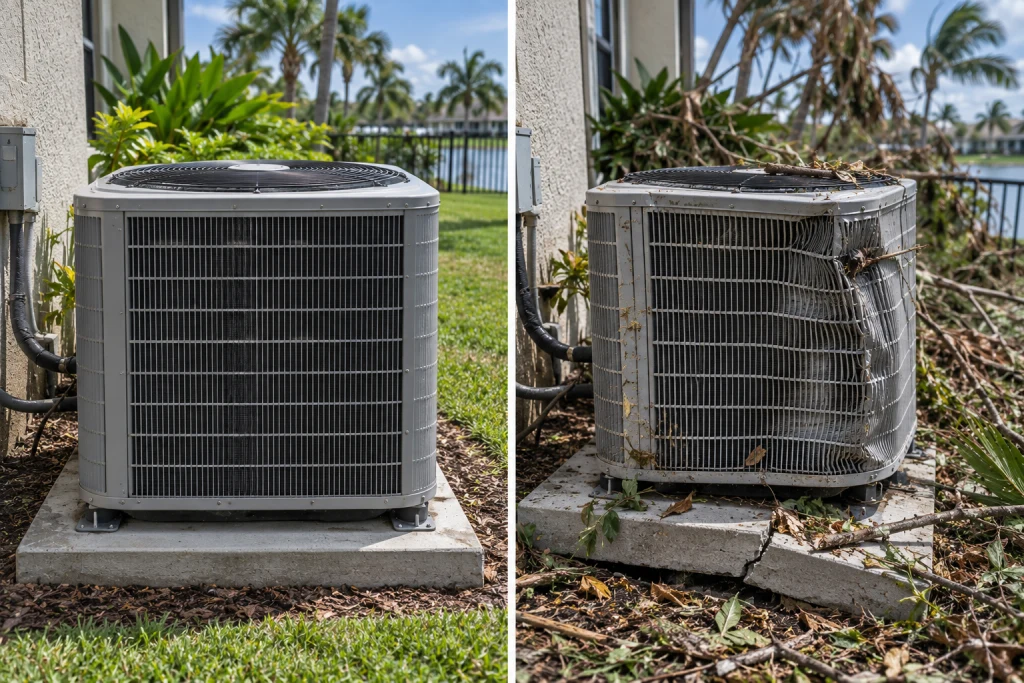
Timing is the biggest clue. Ordinary wear develops gradually across a cooling season. Storm damage shows up as a sudden before-and-after change, which happens to be exactly the kind of before-and-after an insurance adjuster wants documented.
Sign
Normal Wear
Storm Damage
Refrigerant lines
Minor insulation wear from years of UV exposure
Bent, kinked, or disconnected lines from debris impact or the unit shifting on its pad
Coil fins
Light dust buildup, easily brushed clean
Crushed or torn sections in a concentrated impact pattern
Electrical cabinet
Dust or minor corrosion on older units
Water staining, fresh rust bloom, or a burnt smell that wasn't there before the storm
Pad and mounting
Small hairline cracks from age or settling
Pad cracked or shifted, unit visibly tilted, anchor bolts pulled loose
Performance
Gradual decline in cooling across the season
Sudden loss of cooling or a tripped breaker immediately following the storm
General guidance only. Always have a licensed technician confirm before assuming either scenario, since some damage isn't visible from outside the cabinet.
When Storm Damage Means Repair vs Full Replacement
Repair makes sense when the damage is isolated, bent fins, a failed capacitor or contactor from moisture, or a cracked pad that can be releveled, and the unit was mid-life or newer going into the storm. Replacement becomes the better call when the compressor itself took on water, the system was already past 10 to 12 years old, or coil damage is extensive enough that repair costs would run past 40 to 50 percent of a new system's price.
One insurance detail catches a lot of homeowners off guard: under Florida law, insurers must offer a hurricane deductible structured as either a flat $500 or a percentage, typically 2, 5, or 10 percent of the home's insured value, according to the Florida Department of Financial Services. That can make a full HVAC replacement claim look very different on paper than a standard deductible would suggest. Get the repair-versus-replace number in writing from a licensed contractor before filing, so your insurer is pricing the claim against the same figure you are.
If replacement is on the table, don't just match the old system's tonnage. Confirm the correct size with our AC equipment sizing guide, and compare warranty coverage across Carrier, Trane, Daikin, and Goodman before signing anything tied to a claim payout.
Replacing storm-damaged equipment in Miami-Dade or Broward carries one more requirement: the new outdoor unit and its mounting hardware need current HVHZ product approval, the same standard covered earlier in this guide, so a straight swap with a non-approved unit can fail inspection even under an insurance-funded replacement.
Just as with a new installation, get more than one repair estimate when the damage is significant. Storm season creates a spike in service calls across the state, and pricing tends to vary more than usual as contractors work through a longer queue.
🌀 After the Storm
Get Emergency Storm-Damage Quotes
Every contractor in our network is Florida-licensed, insured, and background-checked. Get a real repair-or-replace assessment fast, without waiting on hold with five different companies.
🔒 Free · No obligation · Licensed Florida contractors only
Bottom Line: Your Hurricane AC Action Plan
Run the four-step checklist as soon as a warning is issued for your county: power off at the breaker, unit anchored and shielded, a 10-foot debris radius cleared, and timestamped photos taken. Leave the system off until standing water has cleared, and never power on a unit that took on water without an inspection first.
Usually yes for wind and impact damage, though flood-caused damage typically requires separate flood insurance, and hurricane claims often apply a separate named-storm deductible rather than your standard deductible.
Should I cover my outdoor unit before a hurricane?
Yes, but use a breathable cover or plywood shield around the sides only, never an airtight top cover, which traps moisture against the cabinet and speeds up corrosion.
Is it safe to run AC on generator power?
Only with a generator sized well above the compressor's starting amperage or a hard-start kit, and only through a properly installed transfer switch, never by backfeeding a household circuit directly.
How long should I leave my AC off after a hurricane?
Until standing water around the unit has fully drained and you've visually confirmed the disconnect box and electrical cabinet are dry, typically 24 to 48 hours.
Can a hurricane damage an AC unit even without flooding?
Yes. Wind driven rain, flying debris, and the power surge when the grid comes back online cause the majority of storm-related AC damage, not standing water.
Do I need to elevate my outdoor AC unit if I'm in a flood zone?
If your home sits in a FEMA-mapped Special Flood Hazard Area, yes. FEMA's flood-resistant construction guidance calls for outdoor HVAC equipment to be elevated above the Base Flood Elevation or otherwise flood-protected.
🌀 Before the Next Storm Named
Get Your System Storm-Ready or Storm-Assessed
Whether you need a pre-season inspection or an emergency post-storm quote, we'll connect you with licensed, background-checked contractors in your city. Free, fast, and no obligation.