Lower AC electric bill Florida: that’s the search bringing most readers here every June, right as Florida’s heat and humidity push air conditioning runtime, and the bill that comes with it, to its yearly peak. Cooling alone can account for more than half of a Florida household’s summer electric bill, which is why AC is the first place to look when a bill comes in higher than expected.
By the ACPrices.com Editorial Team•✔ Checked against FPL, Duke Energy Florida, and U.S. Department of Energy program data•Updated: August 2026
The single highest-impact fix costs nothing: setting your thermostat to 78°F when you’re home, letting it drift higher when you’re not, and keeping the air filter clean. From there, ceiling fans, smart thermostats, and a SEER2 upgrade each chip away at what’s left.
This guide breaks down exactly what’s driving Florida AC bills this high in 2026, how FPL and Duke Energy Florida customers can each lower theirs, and which upgrades actually pay off versus which ones just sound good in a sales pitch. Whether you’re on FPL’s east coast rate territory or Duke Energy Florida’s central corridor, the underlying physics of cooling a humid Florida home is the same, only the specific rebates and bill credits available to you differ.
Florida’s electricity rates are actually below the national average. The bill still lands higher than most states because of how much cooling a Florida home needs, not the price per kilowatt-hour. According to U.S. Energy Information Administration household data, air conditioning accounts for roughly 27% of total energy use in a typical Florida home, more than four times the national average.
FPL’s own consumer guidance puts it even more plainly: air conditioning can account for more than 50% of a Florida electric bill during peak cooling months. The University of Florida’s IFAS Extension office backs this up, noting that heating, ventilation, and air conditioning combined make up more than 40% of a typical Florida utility bill year-round.
Near year-round cooling season: most of the country runs AC for a few months a year, while Central and South Florida homes run it nearly twelve.
Humidity, not just heat: your AC has to pull moisture out of the air as well as cool it, which adds runtime even on days that don’t feel unbearably hot.
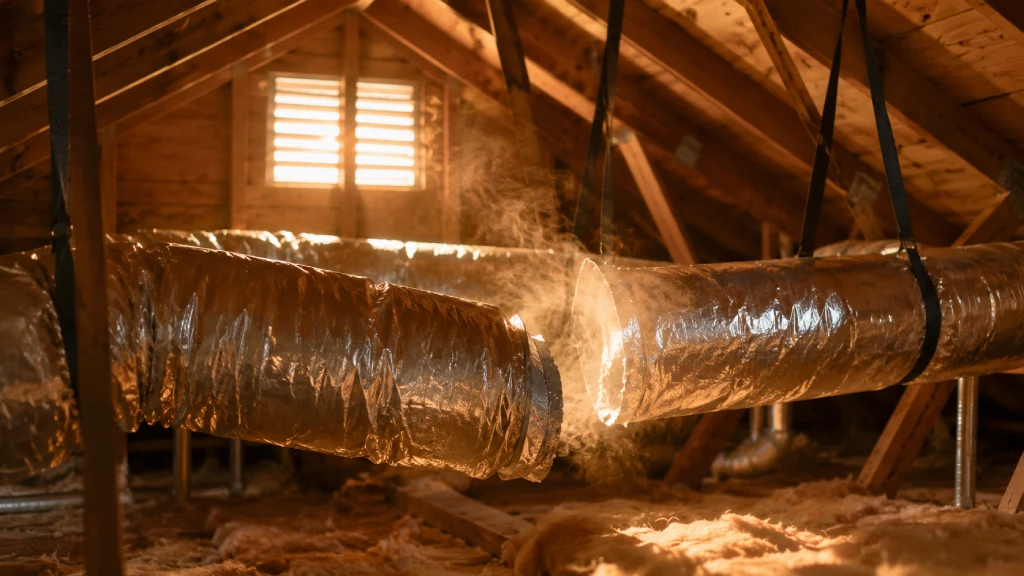
Hot attics: most Florida ductwork runs through an unconditioned attic that can hit 130°F to 150°F on a summer afternoon, so any leak in that ductwork loses cooled air into some of the hottest space in the house.
Older housing stock: many Florida homes built before the 2000s have thinner insulation, older single-pane windows, and ductwork that was never pressure-tested.
None of that means a high bill is just the cost of living in Florida. It means the fixes that actually move the needle are the ones aimed at cooling load specifically, which is exactly what the rest of this guide covers.
It also explains why a bill can jump noticeably from May to July even if your household’s day-to-day habits haven’t changed at all. As outdoor temperature and humidity climb, the same thermostat setting demands more compressor runtime to hold steady, so the bill reflects the weather as much as it reflects anything you’re doing differently.
FPL vs. Duke Energy Florida: How Do 2026 Bills Compare?
Which utility bills you doesn’t just depend on your city, it depends on your specific address. FPL serves most of the state’s east coast and southern counties, from Miami-Dade and Broward up through the Space Coast, plus much of the Panhandle following its Gulf Power merger. Duke Energy Florida serves the Pinellas County side of Tampa Bay (St. Petersburg, Clearwater) and stretches into Central Florida, including Ocala and parts of the Orlando metro. Tampa itself is served by Tampa Electric (TECO), and much of Orlando’s core is served by the Orlando Utilities Commission (OUC), so it’s worth confirming your provider on your own bill before comparing rates.
2026 has moved the two big investor-owned utilities in opposite directions. FPL’s rates ticked up slightly under a four-year plan approved by the Florida Public Service Commission in late 2025, while Duke Energy Florida cut typical bills significantly after storm-recovery charges from the 2024 hurricane season rolled off.
2026 Snapshot
FPL
Duke Energy Florida
Typical bill at 1,000 kWh
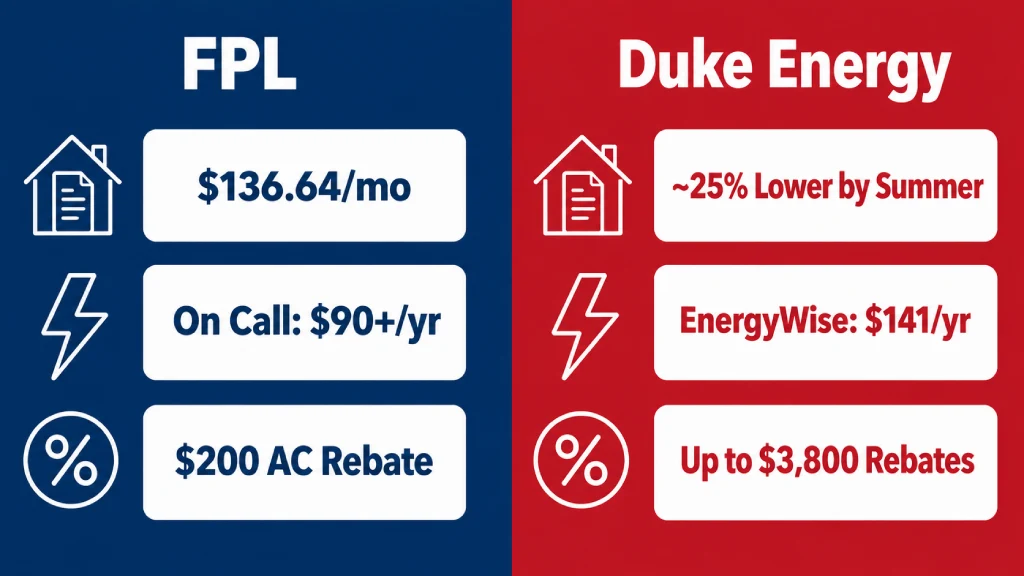
$136.64/month across most of the state (about $141.36 in Northwest Florida)
Fell roughly 25% ($50) between January and the June–September 2026 period
What moved it
PSC-approved base rate increase, phased through 2029
Early removal of hurricane storm-cost recovery charges
AC demand-response credit
On Call: guaranteed bill credits worth over $90/year, April–October
EnergyWise Home: up to $141/year for enrolling a qualifying smart thermostat
New AC equipment rebate
$200 instant rebate on SEER2 15.2+ systems installed by a Participating Independent Contractor
Home Energy Improvement rebates, up to $3,800 combined across HVAC, insulation, and duct sealing
Free home energy check
FPL Home Energy Survey
Duke Energy Home Energy Check
Figures reflect each utility’s own published program pages and Florida Public Service Commission filings as of mid-2026. Bill credit and rebate amounts are subject to change and enrollment requirements; confirm current terms directly with FPL or Duke Energy Florida before enrolling.
FPL customers have one more lever Duke Energy Florida customers currently don’t: an optional Time-of-Use rate (RTR-1). On-peak hours run roughly noon to 9 p.m. on summer weekdays, and electricity costs noticeably more during that window than overnight. It only pays off if you can genuinely shift laundry, dishwashing, pool pump, and EV charging to off-peak hours; if your household runs the AC hardest during that same afternoon window with no flexibility elsewhere, a standard rate usually works out better. It’s worth running the comparison on your own bill before switching.
The takeaway either way: your utility’s per-kWh rate is only half the story. The programs in that table, especially the AC demand-response credits, are free money most homeowners never bother to sign up for.
How Much Should Your Florida Electric Bill Actually Be?
There’s no single “correct” number, since a 900 square foot condo and a 3,000 square foot two-story home with a pool don’t belong on the same scale. That said, it helps to know where the state average sits before deciding whether your bill is normal or worth investigating.
Florida households use about 1,166 kWh a month on average, roughly a third more electricity than the 875 kWh national average, driven almost entirely by cooling demand. Statewide, the average Florida summer electric bill has climbed to around $207 a month in 2026, up from about $150 in 2020, a 39% increase in just a few years.
Where you land relative to that average comes down to a handful of factors:
Pushes your bill above average: a system older than 12 to 15 years, a two-story or larger home, a pool pump, west-facing windows with no film or screens, and an under-insulated attic.
Pushes your bill below average: a SEER2-rated system installed in the last few years, sealed and insulated ductwork, a smart thermostat enrolled in your utility’s demand-response program, and consistent 78°F habits.
If your bill sits well above the state average and none of the behavior changes in this guide move the needle, that’s usually a sign the problem is the equipment itself, not your habits. The Operating Cost Calculator above is the fastest way to check where your specific system stands.
💡 Run Your Own Numbers
See Your Estimated Savings
Plug in your system size, thermostat habits, and utility to see roughly what a few of these changes could save you this summer, before you spend a dollar on anything.
Free tools · No obligation · Built for Florida homeowners
What’s the Ideal Thermostat Setting for Florida Homes?
The U.S. Department of Energy recommends 78°F when you’re home and awake in the summer, with the thermostat raised another 7°F to 10°F when the house is empty. UF’s IFAS Extension puts a number on the cost of ignoring that guidance: for every degree you set below 78°F, expect up to 8% more in cooling costs.
That 8% figure compounds fast. A household running its thermostat at 72°F instead of 78°F isn’t looking at a small difference, it’s looking at a meaningfully larger AC bill every single month of the summer, for a temperature swing most people stop noticing within a week or two.
Illustrative estimate based on UF IFAS Extension’s guidance of up to 8% added cooling cost per degree below 78°F. Actual savings depend on your home’s insulation, system efficiency, and outdoor conditions.
Home and awake: 78°F is the DOE benchmark. If that feels like a big jump, move one to two degrees at a time over a couple of weeks.
Away for the day: raise it 7°F to 10°F rather than shutting the system off completely; a fully off AC lets humidity build up in the walls and furniture, which takes longer, and more energy, to pull back out.
Sleeping: most guidance lands around 78°F to 82°F for energy savings, though the National Sleep Foundation’s comfort range runs cooler, so this one comes down to personal preference more than efficiency.
Fan setting: keep it on “Auto,” not “On.” A fan that runs continuously blows across a wet coil between cooling cycles and can push humidity back into the house.
💡 Florida-Specific Note: If your home always feels clammy no matter how low you set the thermostat, the problem usually isn’t the temperature, it’s dehumidification. An oversized AC system cools the air quickly but shuts off before it has time to remove enough moisture, leaving a home that reads “cool” on the thermostat but still feels sticky. That’s a sizing and airflow issue, not a setting you can fix by turning the temperature down further. Our AC equipment sizing guide walks through how a proper Manual J load calculation accounts for Florida’s humidity, not just square footage.
Do Ceiling Fans Actually Reduce AC Costs?
Yes, but only when they’re used correctly, and only in the room you’re actually in. A ceiling fan doesn’t lower the air temperature at all. It creates a wind-chill effect on your skin that makes a given temperature feel a few degrees cooler, which lets you raise the thermostat without losing comfort.
The Department of Energy’s rule of thumb is that a ceiling fan lets most people raise the thermostat about 4°F with no drop in comfort. In Florida’s humidity, that number can run a little lower than in drier climates, since fans cool primarily by helping sweat evaporate off your skin, and thick, humid air slows that evaporation down. It’s still a real, useful effect, just don’t expect the exact same 4°F everywhere in the state on a 90%-humidity afternoon.
Direction matters: run the fan counterclockwise in summer (check the small switch on the motor housing) so it pushes air straight down and creates a breeze, not just circulates warm air near the ceiling.
Turn it off when you leave the room. A fan running in an empty room cools no one and just adds to your bill for no benefit.
Fans are cheap to run. A typical ceiling fan uses a fraction of the electricity your AC compressor does, so using one to justify a higher thermostat setting is almost always a net win.
Don’t confuse a ceiling fan with a whole-house or attic fan. Those move much larger volumes of air and can genuinely reduce attic temperatures, which helps your ductwork and roof, but they’re a different tool solving a different problem than the comfort boost a bedroom or living room ceiling fan provides.
How Much Can a SEER2 Upgrade Save You Long-Term?
Behavior changes like thermostat settings and ceiling fans help immediately, but they can’t overcome an aging, inefficient system. If your AC is pushing 12 to 15 years old, the equipment itself is likely the biggest lever left to pull.
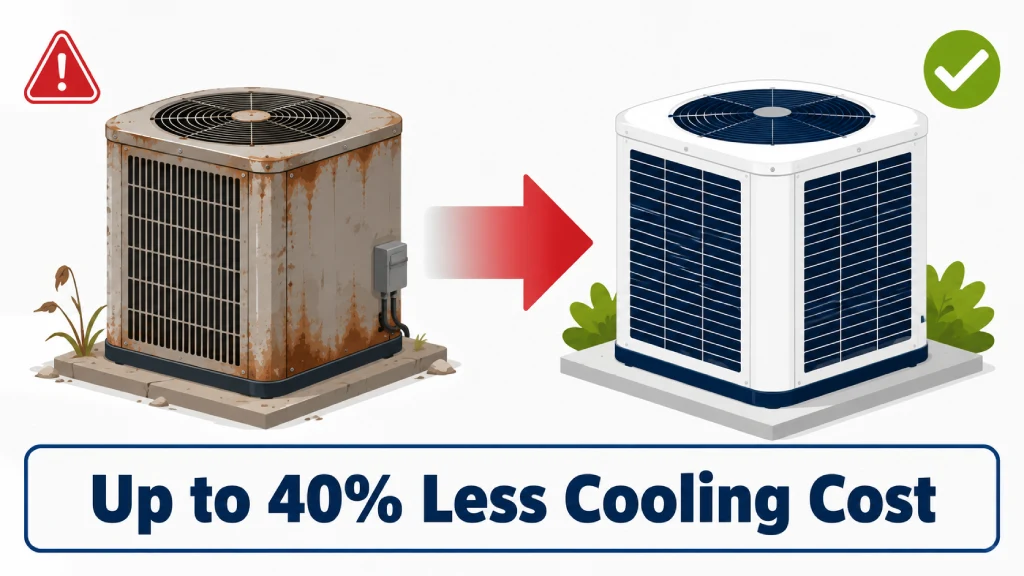
SEER2 measures how much cooling a system produces per unit of electricity it consumes, so the math on an upgrade is straightforward: divide your old system’s rating by the new one’s, and the difference is roughly your expected drop in cooling energy use. Moving from Florida’s 14.3 SEER2 code minimum up to an 18 SEER2 system works out to about a 20% reduction in cooling energy for the same square footage. Replacing an older 10-SEER unit with a 16 SEER2 system, a common upgrade for homes built in the 2000s or earlier, can cut cooling costs by closer to 35% to 40%, which lines up with the “up to 40%” figure UF’s IFAS Extension cites for similar upgrades.
FPL’s own AC rebate FAQ has cited savings around $470 a year for a typical three-ton system upgraded to a higher-efficiency model, based on a South Florida usage estimate. Current 2026 rates run higher than the estimate FPL used for that figure, so the real dollar savings on today’s rates are likely higher, not lower.
Two things are worth knowing before you commit to a new system:
The federal 25C tax credit expired December 31, 2025 and does not apply to 2026 installations, so utility rebates and the operating savings themselves are now the main financial incentive, not a tax credit.
Rebates are separate from operating savings. FPL’s $200 instant rebate and Duke Energy Florida’s Home Energy Improvement rebates knock money off the upfront cost, while the SEER2 jump is what lowers your bill every month after that.
For a full breakdown of what a new system actually costs installed in 2026, including how tonnage, SEER2 tier, and your county affect the price, our AC installation cost Florida guide covers it in detail. When you’re ready to compare quotes, our network of licensed Florida HVAC contractors can walk your attic and ductwork before quoting, not just estimate from square footage.
If your AC and heating system are both nearing the end of their service life, replacing both with a single heat pump is worth comparing before you commit to a straight AC swap, since one high-efficiency outdoor unit then covers both jobs on your electric bill. The Heat Pump Savings Calculator estimates the combined annual savings for your specific home.
📊 Free Operating Cost Calculator
What Is Your AC Actually Costing You Right Now?
Enter your system’s age, tonnage, and roughly how often it runs to see an estimated monthly operating cost, then compare it against what a higher SEER2 system would cost to run instead.
Step 1 of 70%
⚡
Air Conditioner Operating Cost Calculator
Calculate the estimated monthly and annual operating cost of your air conditioner based on your usage, climate, and electricity rate.
What type of air conditioner do you have?
What is the size of the area you are cooling?
How well insulated is your space?
What is your climate region?
What temperature do you set your thermostat to?
Thermostat setting affects how hard your AC works.
22°C
17°C27°C
What is your average electricity rate? ($/kWh)
Check your electricity bill for your rate. Average is $0.12–$0.15/kWh.
$0.13/kWh
0.07/kWh0.3/kWh
Would you like to receive a free no-obligation estimate from our local contractor partners as well?
Great! Almost done, your result is on the next page.
Please enter your contact details so our Certified contractors can provide estimates as well.
This field is required.
Please enter a valid email address.
Please enter your phone number.
Please enter your city or ZIP code.
By submitting this form, you are giving your consent to receive phone calls and text messages from our contractor partners.
You're almost done!
Please provide your details to see your results.
Name is required.
Email is required.
City is required.
⚡ Costs Calculated
Your AC Operating Costs
Monthly Cost
—
Annual Cost
—
Reduce Your Energy Costs
A properly sized, high-efficiency AC keeps operating costs low. Get free quotes from certified contractors.
Are Smart Thermostats Worth It for Florida Humidity Control?
For most Florida homes, yes, and not only for the scheduling convenience. ENERGY STAR-certified smart thermostats track how long your system actually runs per cycle, which matters in a humid climate because short, frequent cycles cool the air without giving the coil enough time to pull moisture out of it.
A smart thermostat with a dedicated humidity sensor can hold a slightly higher temperature while still keeping the air from feeling sticky, which is often the real reason Florida homeowners keep reaching for the "cooler" setting instead of the more efficient one. Remote scheduling also closes the gap between "away" and "forgot to raise the thermostat before leaving for work," which is where a lot of wasted cooling actually happens.
There's also a financial reason specific to FPL and Duke Energy Florida customers: both utilities pay you to enroll a qualifying smart thermostat in their demand-response programs.
FPL On Call guarantees bill credits worth more than $90 a year, April through October, whether or not FPL ever actually cycles your AC. Activations are rare and brief, typically only during extreme demand.
Duke Energy Florida's EnergyWise Home pays up to $141 a year in bill credits for enrolling a qualifying smart thermostat, on top of a free Home Energy Check.
Both programs let you opt out of individual events from the thermostat's app if the timing is inconvenient, and neither requires you to buy a specific brand as long as the device is on the utility's approved list.
One more detail worth knowing: a smart thermostat can't fix a system that's already struggling to dehumidify. If your AC short-cycles, meaning it hits the target temperature and shuts off within a few minutes, no thermostat, smart or otherwise, will pull much moisture out of the air in that window. In that scenario, the thermostat is a genuine upgrade for scheduling and utility bill credits, but the underlying comfort complaint usually points back to system sizing rather than the control device sitting on your wall.
⚠️ Check compatibility first: Enrollment in FPL On Call or Duke Energy Florida's EnergyWise Home requires a qualifying central electric AC system and, in most cases, an approved smart thermostat model. Confirm your specific equipment and thermostat are eligible directly on FPL.com or Duke-Energy.com before assuming you qualify.
More Ways to Cut Your Summer AC Bill
The five levers above cover most of the savings available, but a handful of smaller habits and overlooked details add up, and a few common assumptions actually work against you in Florida's climate.
Change the air filter monthly during peak season. A clogged filter restricts airflow, forcing the system to run longer to move the same amount of air, and it's the cheapest maintenance item on this list.
Don't close vents in unused rooms on a standard central system. Most Florida homes run one system sized for the whole house; closing vents raises duct pressure and can strain the blower rather than saving energy. Zoned systems, built specifically to condition rooms separately, are the exception.
Have ductwork checked, especially in attic-run systems. Given how hot Florida attics get, even a modest duct leak is losing cooled air into some of the harshest heat in the house, not just a mild loss like it would be in a cooler attic elsewhere in the country.
Window film or solar screens on west-facing windows cut a meaningful amount of afternoon solar heat gain, which is often when Florida AC systems are working hardest.
Schedule annual maintenance before peak season, not during it. A technician catches a low refrigerant charge or a dirty coil in the spring; in July, that same issue means a diminished system fighting the year's hottest weather.
Don't overlook the pool pump. It's not AC, but in homes with a pool it's frequently the second-largest electricity user in the house, and an older single-speed pump running 8 to 12 hours a day adds up fast next to a variable-speed one.
Signs Your AC Is Wasting Electricity (Repair or Replace?)
Sometimes the bill isn't a habit problem at all, it's the equipment quietly working harder than it should. These are the signs worth paying attention to:
Short cycling: the system turns on and off in bursts of 10 minutes or less instead of running a full cooling cycle.
Rising bills with no change in habits or weather: a steady creep upward with the same thermostat settings usually points to declining efficiency.
Uneven cooling room to room, especially in a single-story home that should cool evenly.
Weak airflow from the vents, or ice forming on the indoor coil or refrigerant lines.
Grinding, squealing, or banging noises the system didn't make when it was newer.
The system is 12 to 15 years old or older and has needed more than one repair in the past two years.
If one or two of these sound familiar, a repair usually makes sense. If several apply at once, especially on an older system, it's worth running the numbers before paying for another repair. A commonly used HVAC industry rule of thumb: multiply the age of the unit by the estimated repair cost. If that number comes out above roughly $5,000, replacement is typically the better financial call over another repair.
🔧 Free Repair Cost Calculator
Repair or Replace? Run the Numbers First
Enter your system's age and the repair estimate you were quoted to see how it stacks up against the cost of a new SEER2-rated system before you decide.
Step 1 of 160%
🔧
A/C Repair Cost Calculator
How much will repairing your existing A/C cost? Answer a few questions about what you're experiencing and get a repair cost estimate.
How well has your A/C been cooling your home lately?
Have you noticed large indoor temperature fluctuations?
Is the thermostat on and appears to be functioning properly?
Have you noticed reduced airflow from vents even though the A/C is on?
Have you noticed air coming from vents feels warm?
Is the fan spinning very slowly or not at all on outdoor unit?
Does the air conditioner fan appear to never shut off (outdoor unit)?
Have you noticed strange odours coming from vents or near your furnace?
Have you noticed any unusual noises?
What best describes the unusual noise(s)?
Does your A/C turn on but shuts off soon after?
Does the breaker regularly trip or fuses repeatedly blow?
Have you noticed water damage or water leaking or pooling near your furnace?
Have you noticed ice build up on the refrigerant lines, copper tubing, or coil?
Have your electrical bills been significantly higher than usual lately?
Would you like to receive a free no-obligation estimate from our local contractor partners as well?
Great! Almost done, your result is on the next page.
Please enter your contact details so our Certified contractors can provide estimates as well.
This field is required.
Please enter a valid email address.
Please enter your phone number.
Please enter your city or ZIP code.
By submitting this form, you are giving your consent to receive phone calls and text messages from our contractor partners.
You're almost done!
Please provide your details to see your results.
Name is required.
Email is required.
City is required.
🔧 Diagnosis Complete
Your A/C Repair Estimate
Estimated Repair Range
—
Likely Issue
—
Get an Accurate Repair Quote
A certified HVAC technician can diagnose the exact issue and provide a firm quote. Many offer free diagnostics.
Get a Free Quote From a Florida-Licensed Contractor
A quick home energy visit can tell you whether your bill is a thermostat habit, a duct leak, or a system that's simply aging out. Compare real numbers from licensed, background-checked contractors before you spend anything.
🔒 Free · No obligation · Florida-licensed contractors only
Lower AC Electric Bill Florida: The Bottom Line
If you take one thing from this guide, let it be this: to lower AC electric bill Florida costs without sacrificing comfort, start with the settings that cost nothing. Set 78°F when you're home, a higher setting when you're away, keep the filter clean, and run ceiling fans in the right direction in the rooms you actually use. Enroll in your utility's demand-response program, FPL On Call or Duke Energy Florida's EnergyWise Home, since both pay you whether or not they ever activate.
If your system is aging and your bill still feels high after the easy fixes, that's the signal to get an actual assessment rather than guessing. A SEER2 upgrade, paired with your utility's current rebate, is often the difference between fighting your electric bill every summer and not thinking about it at all.
Frequently Asked Questions
What temperature should I set my AC in Florida summer?
The U.S. Department of Energy recommends 78°F when you're home and awake, raised 7°F to 10°F when you're away. Each degree below 78°F can add up to 8% to your cooling cost.
Does closing vents in unused rooms save money?
Usually not. Most Florida homes use one central system sized for the whole house, so closing vents raises duct pressure and strains the blower instead of saving energy. Zoned systems are the exception.
Is it cheaper to leave AC running all day?
No. Letting the thermostat rise 7°F to 10°F while you're out, then cooling back down when you return, typically saves more than leaving it at one constant temperature all day.
Why is my FPL or Duke Energy bill so much higher in summer?
Air conditioning can account for more than 50% of a Florida electric bill during peak cooling months, driven by near year-round runtime and Florida's humidity, not just outdoor temperature.
Does a SEER2 upgrade actually lower my bill?
Yes. Moving from an older 10-SEER system to a 16 SEER2 or higher system typically cuts cooling energy use by roughly 35% to 40%, on top of any current utility rebate.
Are FPL and Duke Energy Florida rebates the same?
No. Each utility runs its own separate rebate and bill-credit programs with different amounts and eligibility rules, so confirm current terms directly on FPL.com or Duke-Energy.com.
Why did my FPL or Duke Energy bill suddenly spike?
Usually a combination of hotter weather driving longer AC runtime and a seasonal or storm-recovery rate adjustment. Check your utility’s current rate notices before assuming something is broken.
How do I know if my AC is wasting electricity?
Watch for short cycling, rising bills with no change in habits, uneven cooling, weak airflow, or unusual noises. Any of these on a system over 12 years old is worth a professional look.