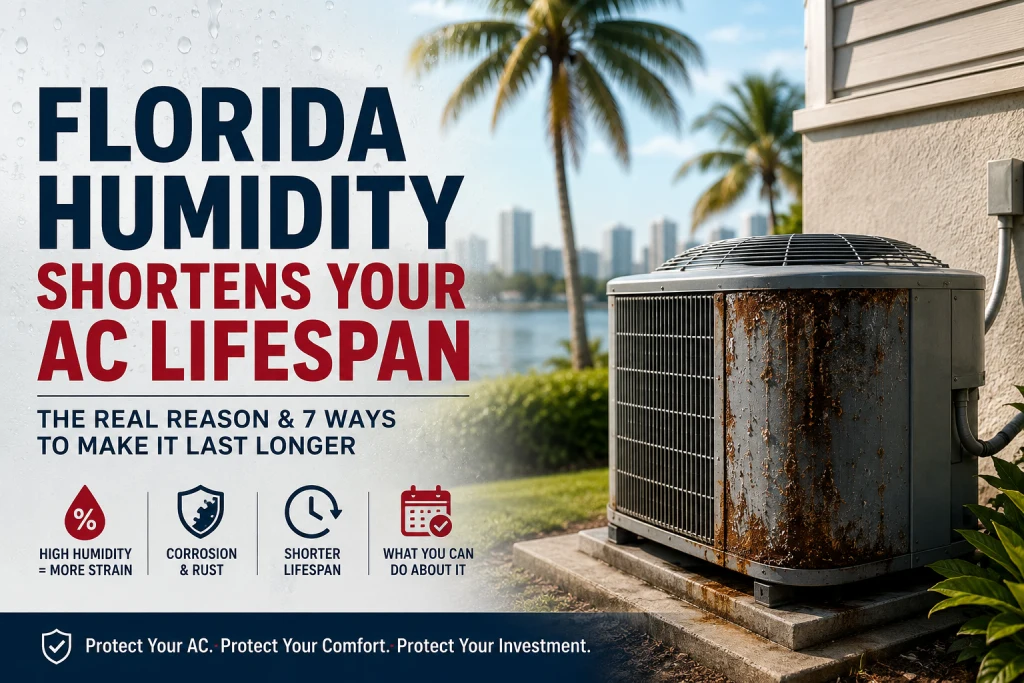
Florida humidity AC lifespan data is blunt: air conditioners here typically check out two to four years earlier than the same equipment running in a drier climate, and coastal units can fail even sooner. If you have been wondering whether the thick, sticky air outside your window is quietly wearing out the system inside, the answer is yes. In our experience working with Florida homeowners, a central air conditioner that would comfortably run 15 to 20 years elsewhere typically does not make it that far here.
By the ACPrices.com Editorial Team•✔ Checked against EPA indoor humidity guidance and DOE HVAC lifespan data•Updated: August 2026
This guide is for Florida homeowners who want to understand why their AC seems to work harder than a friend’s system up north, and what actually moves the needle on how long it lasts. You will get a plain explanation of the mechanical reason humidity ages equipment, real lifespan numbers for Florida versus the national average, the added toll of coastal salt air, and the maintenance habits worth doing versus the ones that are mostly marketing.
None of this requires guesswork. By the end of this 2026 guide, you will know whether your system’s age and symptoms point toward more maintenance or a replacement conversation.
Why Does Humidity Put Extra Strain on an AC System?
Short answer: your air conditioner is doing two jobs at once, and humidity makes the second job much bigger. Every central AC removes sensible heat, the temperature you feel, and latent heat, the energy stored in water vapor. In Florida’s climate, latent heat is not a minor side task. Industry estimates put dehumidification at up to 30 percent of a system’s total cooling capacity during a typical Florida summer, a far larger share than a dry climate like Arizona ever asks of the same equipment.
Here is what that looks like mechanically. Warm, humid return air passes over the cold evaporator coil, and only after enough moisture condenses and drains away does the coil start dropping the air temperature in a way you can feel. A system that would cycle off in 15 minutes on a dry 90°F day can run 45 minutes or longer on a humid one, chasing the same thermostat setpoint.
Engineers who design cooling systems treat latent load as a core part of the job, not an afterthought. When the film of condensed moisture on an evaporator coil gets too thick, because a filter is clogged or airflow is restricted, that water layer actually insulates the coil and blocks the heat transfer the system depends on. The compressor keeps running, but less of that effort turns into cooling, which is part of why a neglected filter does more damage in Florida than it would in a milder state.
That extra run time is where the wear accumulates. The compressor, the most expensive part of your AC to replace, spends more hours under load every summer. Blower motors and outdoor fan motors push denser, moisture-laden air and heat up more during longer cycles. Run capacitors, the small components that help motors start, are especially sensitive to heat and humidity together, and it is common for capacitors in Florida homes to need replacement well before the equivalent part in a drier northern state.
Florida-Specific Insight: In our experience with Florida service patterns, homes running the thermostat fan on “On” instead of “Auto” see faster capacitor and blower motor wear, because the blower never gets the downtime between cycles that lets components cool. Switching to Auto is a five-second fix with a real effect on component life.
Think of it the way you would think about a car on a highway versus a car stuck idling in stop-and-go traffic all day. Both engines are technically running, but the one under constant load with little rest wears out its parts faster even if the total mileage looks similar on paper. A Florida AC in July is closer to that stop-and-go traffic scenario almost every single day of the cooling season, while the same equipment in a northern state gets long stretches of highway cruising, or simply sits off, for most of the year.
None of this means Florida homeowners are stuck with short-lived equipment. It means the humidity load has to be accounted for, both in how the system is sized and how it is maintained, which is exactly what the rest of this guide covers.
What’s the Average AC Lifespan in Florida vs the National Average?
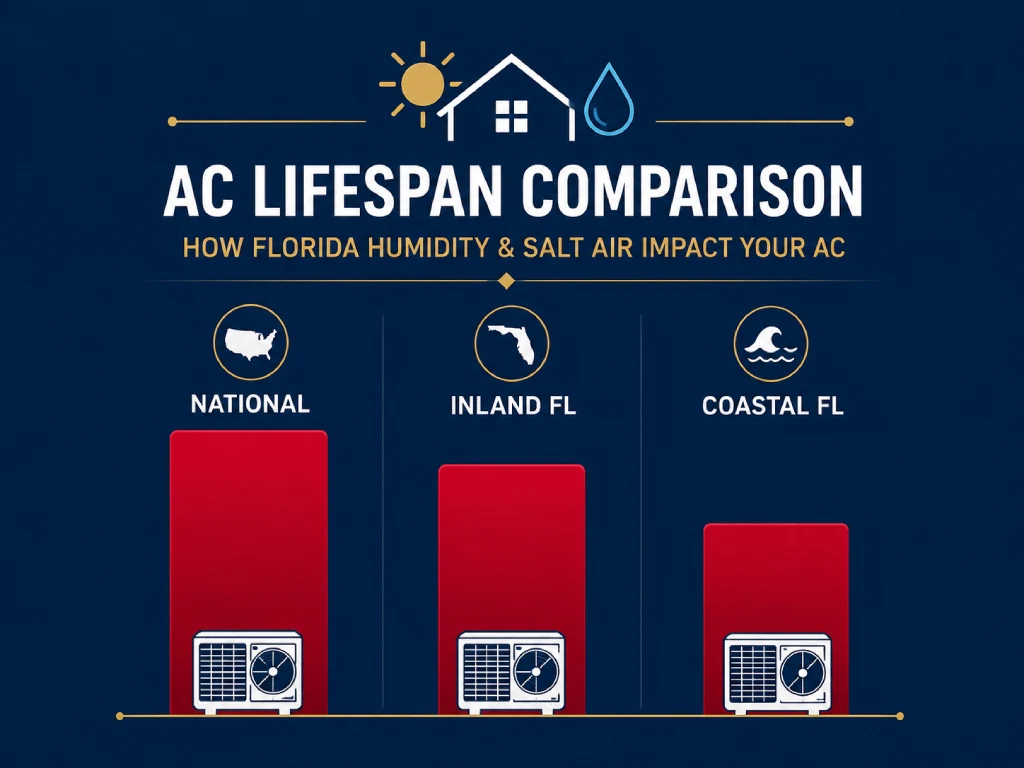
Short answer: nationally, a central air conditioner is assumed to last 15 to 20 years. In Florida, 12 to 15 years is a more realistic planning number for an inland home with regular maintenance, and coastal homes without corrosion protection often see 7 to 10 years.
The U.S. Department of Energy uses 15 years as the assumed useful life of a central air conditioner in its national efficiency modeling, and ENERGY STAR’s own consumer guidance cites a broader 15 to 20 year range for a well maintained system under typical conditions. Those numbers are built from a national mix of climates, including plenty of homes that only run their AC three or four months a year.
Florida is not that home. Most of the state runs central air 8 to 10 months a year, and in South Florida it is close to year-round. That single difference, hours of compressor runtime per year, is the biggest reason Florida systems age faster than the DOE and ENERGY STAR baseline numbers suggest, even before humidity and salt air enter the picture.
Region / Condition
Typical Central AC Lifespan
National average, all climates
15 to 20 years
Florida, inland, maintained annually
12 to 15 years
Florida, coastal, no corrosion protection
7 to 10 years
Florida, any location, minimal maintenance
8 to 12 years
Ranges reflect typical patterns reported across Florida HVAC service data and national DOE and ENERGY STAR lifespan assumptions as of mid-2026. Individual results vary by installation quality, usage, and maintenance history.
In our experience working with Florida homeowners, the two to four year gap between the national average and a well cared for inland Florida system comes down almost entirely to runtime and humidity load rather than any difference in equipment quality. The same Carrier, Trane, Daikin, or Goodman condenser installed in Minnesota and in Tampa is doing fundamentally different amounts of work over a given year.
If your system was installed with an oversized or undersized load calculation rather than a proper Manual J assessment, that mismatch compounds the humidity problem from the section above. An oversized unit short cycles and never fully removes moisture, while an undersized one runs close to constantly trying to keep up. Our free AC Size & Tonnage Calculator is a quick way to sanity check whether your current system’s capacity is in the right range for your home before you assume age alone explains a short lifespan.
📐 Free Sizing Check
Is Your AC Actually the Right Size?
Oversized and undersized systems both struggle with Florida’s humidity. Plug in your home’s details below to see the recommended tonnage in under a minute.
Step 1 of 30%
📐
A/C Size Calculator
This short quiz is designed to help homeowners estimate the correct central air conditioning system size and BTU rating for your home.
Select your home type
Approximate home square footage of finished living space
Would you like to receive a free no-obligation estimate from our local contractor partners as well?
Great! Almost done, your result is on the next page.
Please enter your contact details so our Certified contractors can provide estimates as well.
This field is required.
Please enter a valid email address.
Please enter your phone number.
Please enter your city or ZIP code.
By submitting this form, you are giving your consent to receive phone calls and text messages from our contractor partners.
You're almost done!
Please provide your details to see your results.
Name is required.
Email is required.
City is required.
📐 Size Calculated
Your Recommended AC Size
Recommended Tonnage
—
BTU Output
—
Get a Confirmed Size from a Pro
A certified HVAC contractor performs a Manual J load calculation for exact sizing.
That gap widens fast once you add salt air to the equation, which is the next factor worth understanding if you live anywhere near the coast.
How Does Coastal Salt Air Compound the Problem?
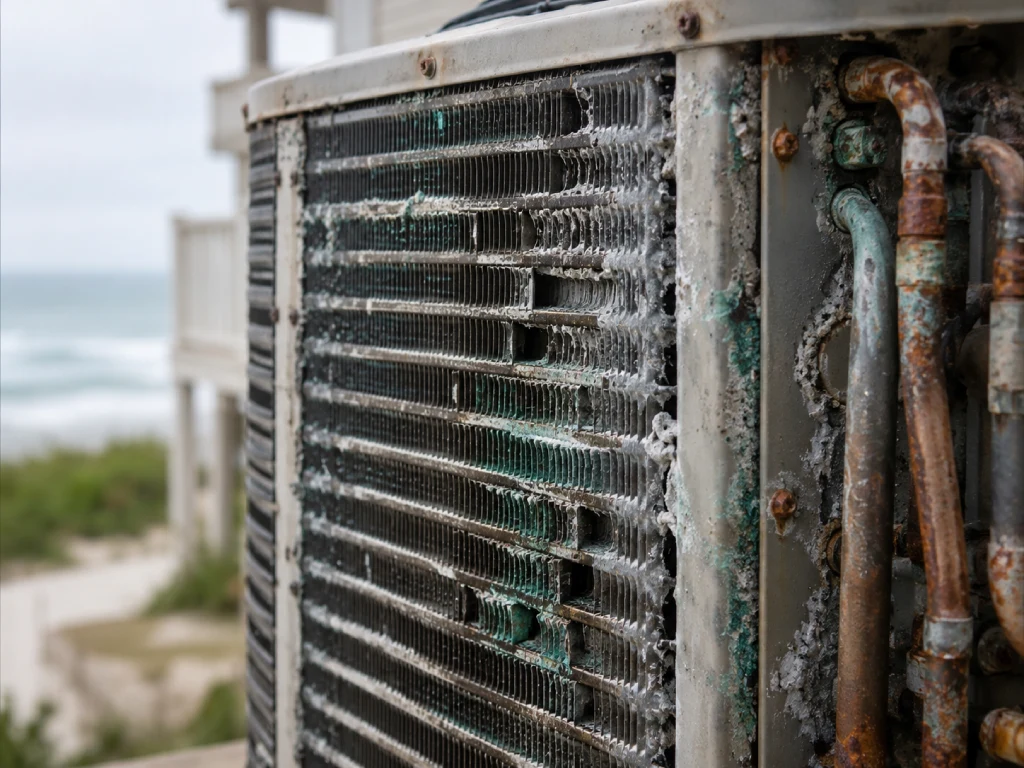
Short answer: salt is hygroscopic, meaning it pulls moisture out of the air and holds it against metal, and that combination of salt and Florida's humidity corrodes an outdoor condenser far faster than humidity alone. A system that would last 12 to 15 years a few miles inland can fail in half that time within a mile or two of saltwater if it has no protective coating.
Here is the mechanism. Salt particles carried on sea breeze settle on the aluminum fins and copper tubing of your outdoor unit. Florida's humidity, often above 70 percent for long stretches, keeps that salt film damp, and a damp salt film becomes an electrolyte that accelerates galvanic corrosion between the different metals in the coil. The fins are usually the first casualty, thinning and eventually flaking, which reduces the coil's ability to transfer heat and forces the compressor to work harder for the same result.
Coastal Alert: Once salt has pitted through a coil, patching it is rarely possible. A coil replacement or full system replacement is usually the only fix, which is why prevention matters far more than repair once corrosion has started.
Distance from the water matters more than most homeowners expect, and it is not a small difference. Homes within a mile or two of the coast, think stretches of Naples, Sarasota, or St. Petersburg near the water, face significantly heavier salt exposure than homes even a few miles inland, and that exposure shows up directly in how often the outdoor unit needs attention and how long it realistically lasts. Inland metros like Orlando skip most of this concern entirely, since salt exposure drops off sharply with distance from open water, leaving humidity as the dominant wear factor rather than corrosion.
Location Type
Recommended Coil Rinse Frequency
Typical Lifespan Without Coating
Waterfront / within 1 mile (parts of Naples, Sarasota, St. Petersburg)
Every 1 to 2 weeks
5 to 8 years
Near-coastal, 1 to 5 miles inland
Every 2 to 4 weeks
8 to 12 years
Inland, 5+ miles from saltwater (Orlando and similar metros)
Monthly
12 to 15 years
A few protective steps make a real difference for coastal homeowners:
Factory or aftermarket coil coatings. Epoxy or polymer coatings, sometimes sold as Seacoast or coastal packages, add a barrier between salt and bare metal and are worth requesting on any new coastal install.
Monthly fresh water rinses. A gentle garden hose rinse, never a pressure washer, washes accumulated salt off the coil before it has time to bond with the metal.
Smart condenser placement. Positioning the outdoor unit away from prevailing ocean winds, or adding a simple windbreak, reduces how much salt spray reaches the cabinet in the first place.
Twice yearly professional inspection. A technician can catch early pitting or fin damage before it becomes a refrigerant leak.
If you are comparing installation quotes for a coastal home, ask directly whether the proposed equipment includes coastal-grade coil protection. It typically adds a modest amount to the upfront cost and can meaningfully extend the years before you are back in the market for a full AC installation.
What Maintenance Habits Actually Extend Lifespan?
Short answer: the habits that matter most are airflow, drainage, and professional eyes on the equipment twice a year. Everything else is a smaller lever. Florida's humidity does not just wear on your compressor, it changes which maintenance tasks actually move the needle compared to a drier climate. Here is what to prioritize, in order of impact.
Change your air filter every 30 to 45 days during cooling season. A dirty filter restricts airflow across the evaporator coil, and in Florida's humidity that restricted airflow means less moisture removal and a thicker condensate film insulating the coil, both of which force the compressor to run longer for the same result.
Schedule a professional tune-up twice a year. Once before the heavy summer cooling season and once in the fall. A technician checks refrigerant charge, cleans the coils, and inspects capacitors and electrical contacts, the components most affected by heat and humidity together.
Keep the condensate drain line clear. Florida's humidity means your AC produces gallons of condensate on a typical day, and algae growth in that drain line is one of the most common Florida-specific AC problems. A clogged line can back up and trip a safety switch or cause water damage.
Rinse the outdoor condenser coil monthly. Every one to two weeks within a mile or two of the coast, using a gentle garden hose stream rather than a pressure washer.
Set the thermostat fan to Auto, not On. Running the blower continuously adds thousands of hours of runtime a year and does not meaningfully improve dehumidification on most single-stage systems.
Have capacitors and electrical contacts inspected annually. These components fail faster in humid climates than in dry ones, and a failed capacitor is one of the most common reasons a Florida AC stops cooling on the hottest day of the year.
🔧 Free System Health Check
Not Sure Where Your AC Stands?
A licensed Florida contractor can check your coils, capacitors, and condensate line for early signs of humidity or salt damage before they turn into a breakdown.
Free · No obligation · Licensed Florida contractors only
None of these habits require special tools or expertise beyond the filter changes and coil rinses, which most homeowners can do themselves. The professional tune-up is the one item worth budgeting for every year, since a technician can catch a struggling capacitor or a slow refrigerant leak long before it becomes the kind of failure that happens at 9 p.m. on a July weekend.
Is a Dehumidifier Worth Adding Alongside Your AC?
Short answer: for most Florida homes, a correctly sized AC handles humidity well enough on its own. A whole-home dehumidifier earns its cost mainly in specific situations: tightly sealed newer homes, homes with persistent indoor humidity above 55 percent despite a working AC, or homes where the AC is oversized and cannot run long enough to dehumidify properly.
A whole-home dehumidifier ties into your ductwork and handles moisture removal independently, which means your AC can focus its capacity on temperature rather than splitting effort between the two jobs described earlier in this guide. That division of labor can meaningfully reduce AC runtime, and less runtime generally means less accumulated wear over the life of the system.
Whole-home units are installed by an HVAC contractor and tie directly into your ductwork, so they treat the entire house at once and are the right call if multiple rooms run humid. Portable standalone units cost far less upfront but only treat one room or zone, which makes them a reasonable stopgap for a single problem area, like a garage conversion or a room with poor airflow, rather than a whole-house fix. The EPA recommends keeping indoor relative humidity below 60 percent, ideally between 30 and 50 percent, and that target is a useful benchmark for deciding which type of unit actually fits your situation.
Where a dehumidifier tends to make sense:
Your indoor humidity stays above 55 to 60 percent even with the AC running normally
You notice musty odors, visible condensation, or early mold spotting despite a functioning AC
Your home has an oversized AC that short cycles before removing enough moisture
You want to run the thermostat a few degrees warmer for energy savings without feeling sticky
Where it is probably not worth it:
Your indoor humidity already sits in the 45 to 50 percent range most of the time
Your AC is correctly sized and running normal cycle lengths
Budget is tight and your money would do more good on deferred maintenance or an aging capacitor
If you are not sure which category you fall into, an inexpensive hygrometer, available for $10 to $50 at most hardware stores, gives you a real number instead of a guess. It is also worth confirming your current system is sized correctly in the first place, since an oversized AC is a more common root cause of stubborn humidity than most Florida homeowners realize. Our free AC equipment sizing guide walks through the factors a proper load calculation accounts for beyond square footage alone, including ceiling height, window area, and insulation, all of which matter more in Florida's climate than they would up north.
A dehumidifier is a real tool, not a marketing add-on, but it solves a specific problem. Fix an undersized filter habit or an oversized system first, then decide whether you still need one.
When Does Humidity Damage Mean It's Time to Replace?
Short answer: age combined with symptoms, not age alone, is what should drive a replacement decision. A 10-year-old coastal system with visible coil corrosion and a recent refrigerant leak is in a very different position than a 10-year-old inland system that has been maintained on schedule.
Watch for these signs that humidity or salt-related wear has crossed from normal aging into replace territory:
Visible rust or corrosion on the outdoor coil or cabinet, especially flaking aluminum fins, which usually cannot be repaired and often signals the coil itself is compromised.
Recurring mold or musty odor even with the AC running and the filter changed on schedule, which can point to a coil or drain problem rather than just a humidity setting issue.
Rising repair frequency, particularly repeated capacitor or refrigerant leak repairs within a short window.
A repair quote approaching half the cost of a new system. Many Florida contractors use this rule of thumb, and it holds up well once a coastal unit's coil integrity is in question.
Noticeably higher electric bills without a change in habits, which often means the compressor is running longer to compensate for reduced coil efficiency.
If your system is showing two or more of these signs, a repair-versus-replace conversation with a licensed contractor is worth having sooner rather than later. Our free AC Repair Cost Calculator is a useful gut check before that call, since it gives you a realistic range for the repair in question so you can compare it against replacement math instead of guessing.
🧾 Free Repair Estimate
What Would This Repair Actually Cost?
Get a realistic Florida repair price range before you call a contractor, so you can compare it against replacement math with real numbers.
Step 1 of 160%
🔧
A/C Repair Cost Calculator
How much will repairing your existing A/C cost? Answer a few questions about what you're experiencing and get a repair cost estimate.
How well has your A/C been cooling your home lately?
Have you noticed large indoor temperature fluctuations?
Is the thermostat on and appears to be functioning properly?
Have you noticed reduced airflow from vents even though the A/C is on?
Have you noticed air coming from vents feels warm?
Is the fan spinning very slowly or not at all on outdoor unit?
Does the air conditioner fan appear to never shut off (outdoor unit)?
Have you noticed strange odours coming from vents or near your furnace?
Have you noticed any unusual noises?
What best describes the unusual noise(s)?
Does your A/C turn on but shuts off soon after?
Does the breaker regularly trip or fuses repeatedly blow?
Have you noticed water damage or water leaking or pooling near your furnace?
Have you noticed ice build up on the refrigerant lines, copper tubing, or coil?
Have your electrical bills been significantly higher than usual lately?
Would you like to receive a free no-obligation estimate from our local contractor partners as well?
Great! Almost done, your result is on the next page.
Please enter your contact details so our Certified contractors can provide estimates as well.
This field is required.
Please enter a valid email address.
Please enter your phone number.
Please enter your city or ZIP code.
By submitting this form, you are giving your consent to receive phone calls and text messages from our contractor partners.
You're almost done!
Please provide your details to see your results.
Name is required.
Email is required.
City is required.
🔧 Diagnosis Complete
Your A/C Repair Estimate
Estimated Repair Range
—
Likely Issue
—
Get an Accurate Repair Quote
A certified HVAC technician can diagnose the exact issue and provide a firm quote. Many offer free diagnostics.
A licensed Florida contractor can inspect your coil, capacitors, and refrigerant charge and tell you honestly which side of the line your system falls on.
🔒 Free · No pressure · Florida-licensed contractors only
Florida Humidity AC Lifespan: The Bottom Line
Florida humidity AC lifespan numbers do not have to stay a mystery once you know what drives them. A well maintained inland system realistically lasts 12 to 15 years, coastal homes need extra protection to get anywhere close to that, and the maintenance habits that matter most, filter changes, drain line clearing, and twice-yearly tune-ups, cost far less than a single premature compressor failure.
If your system is aging, showing corrosion, or you are simply not sure where it stands, getting an honest assessment now is cheaper than an emergency replacement in August. Run your numbers through the calculators above, keep an eye on the signs covered in this guide, and let a licensed Florida contractor confirm what your equipment actually needs before you decide anything.
Frequently Asked Questions
Does running AC constantly reduce humidity damage?
Not necessarily. Nonstop operation increases compressor and blower runtime, adding wear. A correctly sized system on a normal thermostat schedule with the fan set to Auto controls humidity more effectively than constant running.
What's the ideal indoor humidity level in Florida?
The EPA recommends keeping indoor relative humidity between 30 and 50 percent, and never above 60 percent. Most Florida homes feel comfortable and stay mold resistant in the 45 to 50 percent range.
Can mold form even with AC running?
Yes. An oversized AC cools the air quickly and shuts off before removing enough moisture, leaving humidity above 60 percent even when the thermostat reads a comfortable temperature, which is exactly when mold can start.
How often should Florida homeowners get AC tune-ups because of humidity?
Twice a year is standard, once before summer and once in fall. Homes within a mile or two of saltwater often benefit from an additional coil inspection given the added corrosion risk.
Does a bigger AC system handle Florida humidity better?
No. An oversized system short cycles, cooling air before it runs long enough to remove humidity, leaving rooms cold and clammy. A correct size from a Manual J load calculation matters more than raw capacity.