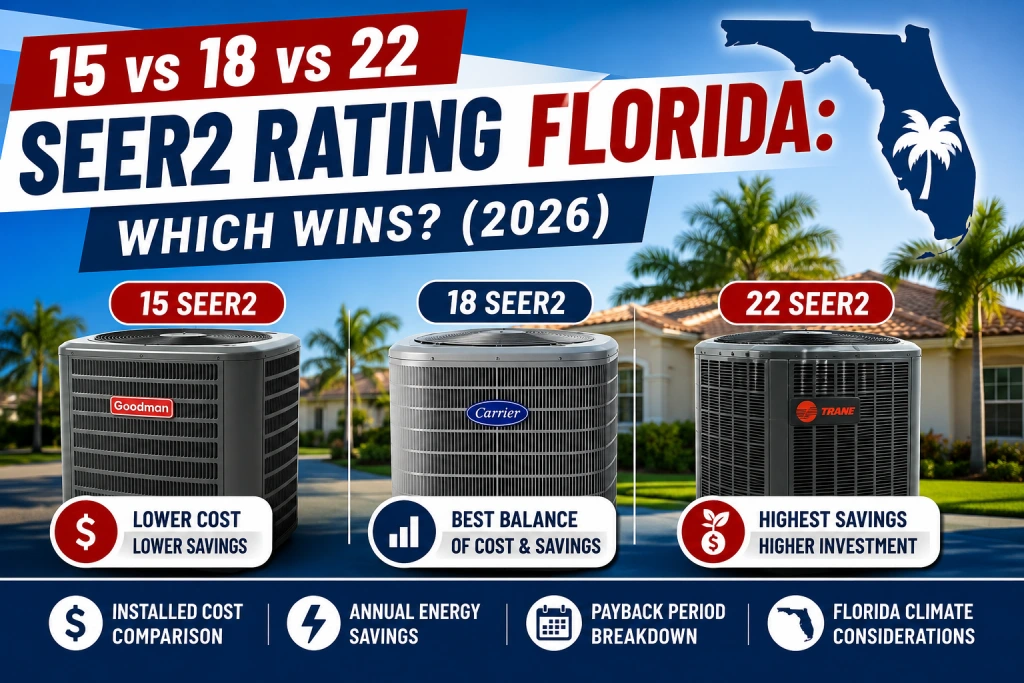
SEER2 rating Florida homeowners actually need is the question that gets skipped every time a contractor pitches an upgrade, and it costs people real money in both directions. Some homeowners overpay for a 22 SEER2 system that will never earn back its premium. Others buy the cheapest unit on the lot and lock in higher electric bills for the next 12 to 15 years.
By the ACPrices.com Editorial Team•✔ Checked against FPL, Duke Energy Florida, and DOE Southeast region efficiency standards•Updated: July 2026
This guide walks through the real installed cost, the actual annual cooling savings, and the honest payback period for three common tiers: 15 SEER2, 18 SEER2, and 22 SEER2. No inflated efficiency claims, just the math a licensed contractor would show you if you asked them to sit down and do it properly.
For a typical 3 to 4 ton system in a Florida home, 18 SEER2 is the tier most homeowners should actually target. It costs more upfront than the 14.3 SEER2 code minimum, but it delivers a meaningful drop in cooling costs without the long payback period that comes with 22 SEER2 equipment. Here’s how the three tiers stack up.
SEER2 Tier
Installed Cost (3–4 Ton)
Est. Annual Cooling Cost
Simple Payback vs. 15 SEER2
15 SEER2 (near code minimum)
$7,500 – $10,500
$780 – $830
Baseline
18 SEER2 (mid to high efficiency, two-stage)
$10,000 – $13,500
$650 – $700
Roughly 18 to 22 years
22 SEER2 (variable-speed, premium tier)
$15,000 – $19,500
$530 – $580
Roughly 24 to 28 years
Estimates assume a 3 to 4 ton system, roughly 2,400 equivalent full-load cooling hours per year (typical for Florida’s climate), and a blended electricity rate near $0.14/kWh across FPL, Duke Energy Florida, and TECO territory. Your actual numbers will vary with home size, insulation, thermostat habits, and local rates.
Notice the payback periods run longer than most sales pitches suggest. That’s the honest picture before rebates, and it’s covered in detail further down. If you want your exact numbers instead of the ranges above, run your system size and current utility rate through the AC Savings Calculator.
What SEER2 Actually Measures
SEER2 stands for Seasonal Energy Efficiency Ratio 2, the updated testing standard the U.S. Department of Energy introduced in 2023 to reflect real-world duct static pressure more accurately than the older SEER metric. In plain terms: it tells you how many BTUs of cooling you get for every watt-hour of electricity your system uses over a full cooling season.
A higher SEER2 number means the system squeezes more cooling out of the same electricity, but it also means more complex compressor and coil technology, which is exactly why the equipment costs more upfront. Florida sits in the DOE’s Southeast region, so the minimum allowed here is 14.3 SEER2 for split systems, stricter than the 13.4 SEER2 floor that applies in northern states.
15 SEER2: single-stage or entry two-stage compressor, closest to code minimum, lowest equipment cost.
18 SEER2: typically a two-stage or entry variable-speed compressor, better humidity control, noticeably quieter operation.
22 SEER2: full variable-speed (inverter-driven) compressor, the smoothest humidity control and lowest sound levels available, usually paired with a matched variable-speed air handler.
💡 Pro Insight: SEER2 is a seasonal average, not a peak-performance number. On the hottest, most humid Florida afternoons, every system runs closer to its minimum efficiency point regardless of tier. The real-world gap between 15 and 22 SEER2 narrows somewhat during August heat waves compared to what the rating alone suggests.
15 vs 18 vs 22 SEER2: Installed Cost Compared
The jump from 15 to 18 SEER2 is a moderate step: better components, but still within reach of most replacement budgets. The jump from 18 to 22 SEER2 is a much bigger leap, since it usually requires a fully matched variable-speed indoor and outdoor unit rather than a mix-and-match combination.
System Size
15 SEER2
18 SEER2
22 SEER2
2.5–3 ton
$6,200 – $8,800
$8,500 – $11,500
$12,500 – $16,500
3.5–4 ton
$7,500 – $10,500
$10,000 – $13,500
$15,000 – $19,500
4.5–5 ton
$9,000 – $12,000
$12,000 – $16,000
$17,500 – $22,000
Brand and warranty tier move these numbers around too. Budget, mid-tier, and premium lines from manufacturers like Carrier, Trane, Daikin, and Goodman all offer 18 SEER2 and 22 SEER2 options, but the price for the same rating can swing by $1,500 or more between brands based on warranty length and parts availability.
💰 Free Local Pricing
See What Each SEER2 Tier Would Cost at Your House
Plug in your tonnage, city, and preferred efficiency tier to get an installed price range, then compare it against real quotes from licensed Florida contractors.
Free tools · No obligation · Built for Florida homeowners
15 vs 18 vs 22 SEER2: Annual Cost and Payback Period
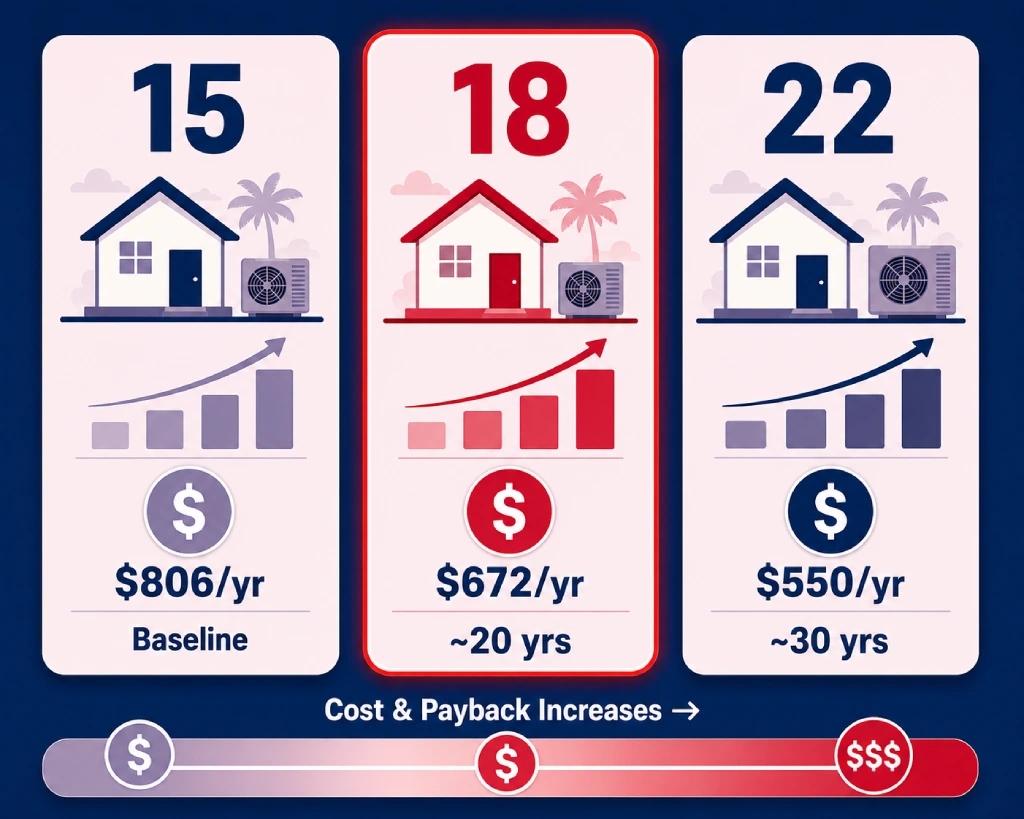
This is where most SEER2 comparisons online lose credibility, because they skip the math and jump straight to “upgrade and save.” Here’s the actual arithmetic for a 3.5 to 4 ton system running roughly 2,400 equivalent full-load cooling hours a year, which is a reasonable estimate for a typical Florida home based on FPL and Duke Energy Florida usage patterns.
15 SEER2
18 SEER2
22 SEER2
Est. annual cooling energy use
~5,760 kWh
~4,800 kWh
~3,930 kWh
Est. annual cooling cost (at $0.14/kWh)
~$806
~$672
~$550
Annual savings vs. 15 SEER2
Baseline
~$134
~$256
Installed cost premium vs. 15 SEER2 (3.5–4 ton)
Baseline
~$2,500 – $3,000
~$7,500 – $9,000
Simple payback
Baseline
~19 – 22 years
~29 – 35 years
Two honest takeaways here. First, 18 SEER2 pays for itself over a normal equipment lifespan of 15 to 20 years, though it’s closer to break-even than a slam-dunk return. Second, 22 SEER2 rarely pays for itself on electricity savings alone within the equipment’s useful life, at least not without rebates or unusually high electric rates.
That doesn’t mean 22 SEER2 is a bad choice. It just means the decision should be based on comfort, humidity control, and noise level rather than pure return on investment. See how the numbers shift with your specific home’s tonnage and current utility rate below.
💰 Free SEER2 Savings Calculator
Compare Your Real Savings Across SEER2 Tiers
Enter your system size, current SEER2 rating, and the tier you’re considering to see your actual annual savings and payback period, not a generic estimate.
Step 1 of 80%
💚
New Air Conditioner Savings Calculator
How much can you save by upgrading your air conditioner? Get an instant estimate of your potential annual electricity cost savings.
What is the size of your home?
How would you rate your home's insulation & windows?
How many months per year do you use your AC?
Hours per day you run your AC (on average)
How old is your current central air conditioner?
The SEER rating of older units is used to calculate your current running costs.
What type of new AC are you considering?
What is your average electricity rate? ($/kWh)
Check your electricity bill. Average is $0.12–$0.15/kWh.
$0.13/kWh
0.07/kWh0.3/kWh
Would you like to receive a free no-obligation estimate from our local contractor partners as well?
Great! Almost done, your result is on the next page.
Please enter your contact details so our Certified contractors can provide estimates as well.
This field is required.
Please enter a valid email address.
Please enter your phone number.
Please enter your city or ZIP code.
By submitting this form, you are giving your consent to receive phone calls and text messages from our contractor partners.
You're almost done!
Please provide your details to see your results.
Name is required.
Email is required.
Please enter your city or ZIP code.
💚 Savings Calculated
Your Potential AC Savings
Annual Savings
—
Payback Period
—
Current Annual Cost
—
New Annual Cost
—
Start Saving — Get Free Quotes
These are estimates. Certified HVAC contractors can give you accurate savings projections based on your home.
⚠️ Watch for this: Some contractors present SEER2 upgrade savings using the national average electricity rate of roughly $0.19/kWh rather than Florida's actual rate. That inflates the projected payback by 25 to 30 percent. Always ask which rate their savings estimate is based on, and check it against your own bill.
Rebates That Change the Math
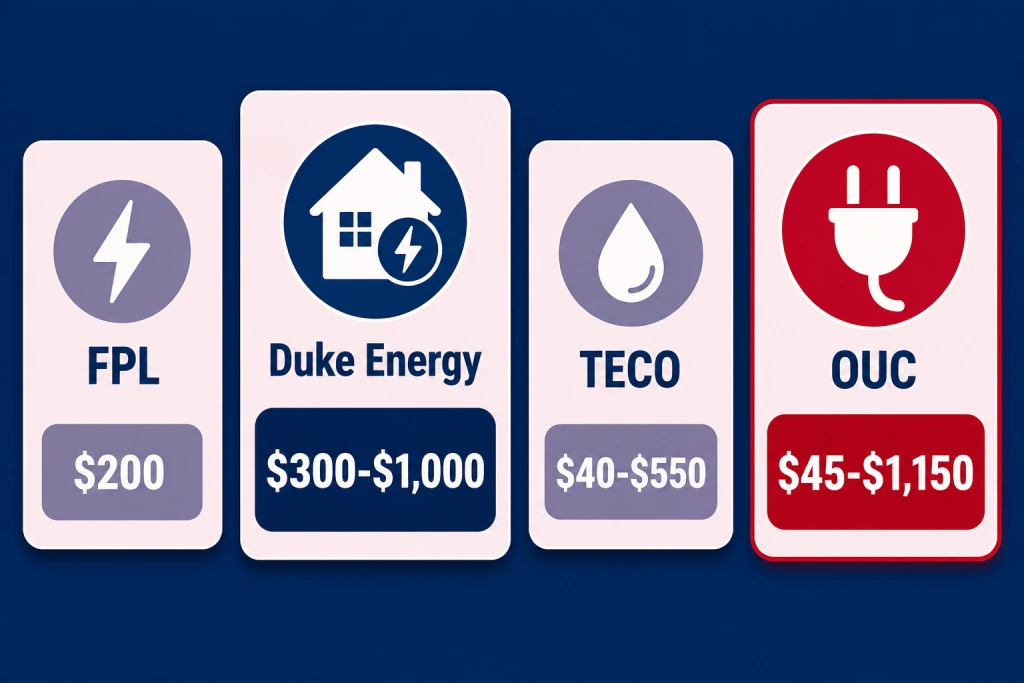
Utility rebates won't close the entire gap, but they shave real years off the payback period, especially on the 18 SEER2 tier. Florida's major utilities currently offer:
FPL: around $200 instant rebate on qualifying SEER2 15.2+ installs through a participating contractor
Duke Energy Florida: $300 to $1,000 depending on the SEER2 tier and system type installed
TECO (Tampa Electric): $40 to $550 depending on the efficiency tier
OUC (Orlando Utilities Commission): $45 to $1,150 on qualifying high-efficiency equipment
The federal Section 25C tax credit expired at the end of 2025 and doesn't apply to 2026 installations, so these utility programs are currently the main incentive money on the table. Applied to the 18 SEER2 premium, a $500 to $1,000 rebate trims roughly 6 to 8 years off the simple payback shown above, which is enough to move it from marginal to genuinely worthwhile for homeowners planning to stay put for the long haul.
Which SEER2 Tier Actually Makes Sense for Your Home
Choose 15 SEER2 if you're on a strict budget, plan to sell within a few years, or this is a rental or investment property where you won't see the utility savings yourself.
Choose 18 SEER2 if you plan to stay in the home for 10+ years, want a real (if modest) return on the extra spend, and would appreciate quieter, more consistent cooling than a single-stage unit provides.
Choose 22 SEER2 if humidity control, whisper-quiet operation, or allergy and air-quality concerns matter more to your household than the electric bill, or if a large rebate and a long-term ownership horizon make the math work in your specific case.
Home size matters here too. A larger home with a higher cooling load sees bigger absolute dollar savings from a higher SEER2 tier than a smaller home does, which shortens the payback period. If you haven't confirmed your correct tonnage yet, that number changes every calculation above, so it's worth checking before comparing quotes.
📏 Free AC Sizing Calculator
Confirm Your Tonnage Before You Compare SEER2 Quotes
Every payback number on this page depends on getting the tonnage right first. Estimate your home's recommended AC size in under a minute.
Step 1 of 30%
📐
A/C Size Calculator
This short quiz is designed to help homeowners estimate the correct central air conditioning system size and BTU rating for your home.
Select your home type
Approximate home square footage of finished living space
Would you like to receive a free no-obligation estimate from our local contractor partners as well?
Great! Almost done, your result is on the next page.
Please enter your contact details so our Certified contractors can provide estimates as well.
This field is required.
Please enter a valid email address.
Please enter your phone number.
Please enter your city or ZIP code.
By submitting this form, you are giving your consent to receive phone calls and text messages from our contractor partners.
You're almost done!
Please provide your details to see your results.
Name is required.
Email is required.
Please enter your city or ZIP code.
📐 Size Calculated
Your Recommended AC Size
Recommended Tonnage
—
BTU Output
—
Get a Confirmed Size from a Pro
A certified HVAC contractor performs a Manual J load calculation for exact sizing.
Then run your monthly bill and target SEER2 tier through the AC Operating Cost Calculator for a side-by-side annual cost comparison.
Homes that need to replace both the AC and the heating side of the system should also compare a heat pump before settling on a straight SEER2 upgrade, since one matched outdoor unit then handles both jobs on the same electric circuit. The Heat Pump Savings Calculator estimates the combined annual savings for your home.
🚀 Compare Before You Commit
Get 2–3 Local Quotes Across SEER2 Tiers
Every contractor in our network is Florida-licensed, insured, and background-checked. Ask each one to quote 15, 18, and 22 SEER2 side by side before you decide.
🔒 Free · No obligation · Licensed Florida contractors only
Common Mistakes When Comparing SEER2 Ratings
Comparing the outdoor unit's rating alone: SEER2 applies to the matched indoor and outdoor combination. Check the AHRI certified directory for the exact pairing, not just the condenser's spec sheet.
Using national average electricity rates: Florida's rate structure and long cooling season change the payback math significantly from a generic online calculator.
Ignoring ductwork condition: a leaky or undersized duct system caps the real-world efficiency of any unit, no matter how high the SEER2 rating on the box.
Assuming higher SEER2 always means better comfort: a poorly sized 22 SEER2 system will still short-cycle and struggle with humidity, just like an oversized 15 SEER2 unit would.
Skipping the ENERGY STAR check: not every high-SEER2 unit carries the ENERGY STAR label, and some rebate programs require it.
Bottom Line: Which SEER2 Rating Is Worth It
For most Florida homeowners planning to stay put for a decade or more, 18 SEER2 is the sensible middle ground: a real, if modest, financial payback and a noticeable comfort upgrade over a code-minimum unit. 22 SEER2 is worth it when comfort, humidity control, or noise matter more than pure ROI, particularly with rebates in play. 15 SEER2 remains a reasonable choice for budget-driven replacements or short-term ownership.
The SEER2 rating Florida homeowners choose ultimately comes down to how long they'll own the home and what they value beyond the electric bill. Run your own numbers through the calculators above, then get quotes across all three tiers so you're comparing real prices instead of marketing claims.
🇺🇸 Ready When You Are
Compare SEER2 Options With a Licensed Florida Contractor
Tell us a bit about your home and we'll connect you with licensed, background-checked contractors who can quote 15, 18, and 22 SEER2 side by side. Free, fast, and no obligation.
🔒 Free · No pressure · Florida-licensed contractors only
Frequently Asked Questions
What is a good SEER2 rating for Florida?
18 SEER2 is a good target for most Florida homes. It sits well above the 14.3 SEER2 code minimum and offers a reasonable payback period, while 22 SEER2 is better justified by comfort and humidity control than by electricity savings alone.
Is 22 SEER2 worth the extra cost in Florida?
On electricity savings alone, 22 SEER2 usually takes 25 to 35 years to pay back its premium over a 15 SEER2 system. It's worth it primarily for homeowners who value the quieter operation and superior humidity control, or who qualify for a substantial utility rebate.
What is the minimum SEER2 rating allowed in Florida?
Florida falls in the DOE's Southeast region, which requires a 14.3 SEER2 minimum for split-system central air conditioners, higher than the 13.4 SEER2 floor in northern states.
Does SEER2 rating affect humidity control?
Yes. Higher SEER2 systems typically use two-stage or variable-speed compressors that run longer at lower capacity, which removes more moisture from the air than a single-stage system cycling on and off.
Are there rebates for high SEER2 systems in Florida?
Yes. FPL, Duke Energy Florida, TECO, and OUC all offer rebates ranging from about $40 to $1,150 on qualifying high-efficiency systems. The federal Section 25C tax credit expired at the end of 2025 and does not apply to 2026 installations.