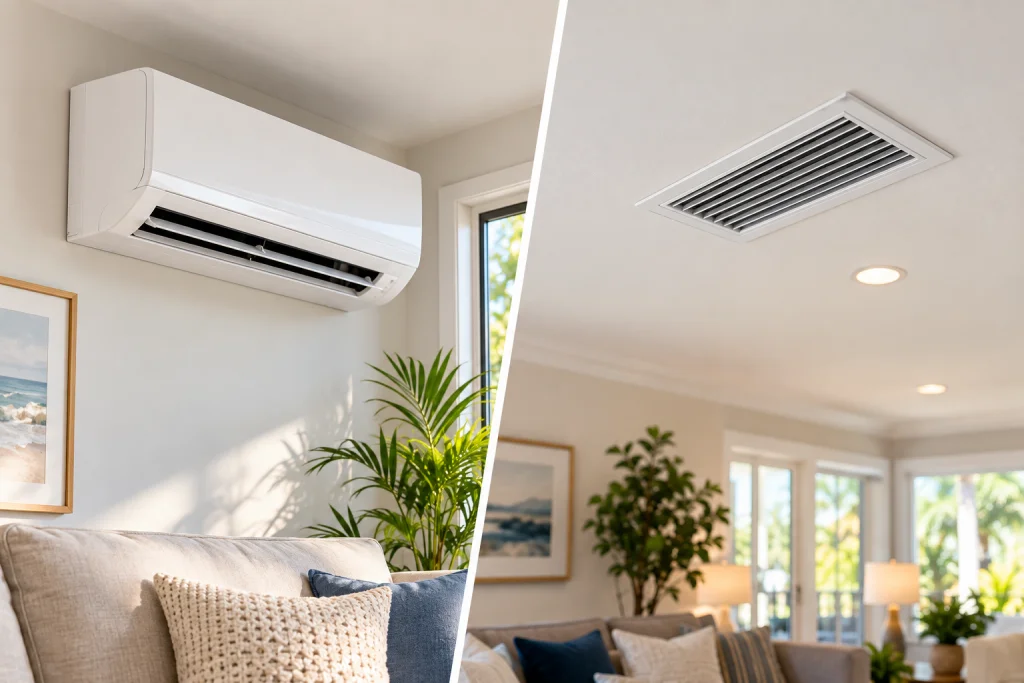
Ductless mini split vs central air Florida homeowners actually need to decide between usually comes down to one specific room, one failing duct system, or one addition that never had cooling to begin with, not a blank-slate choice between two equal options. Both technologies cool a Florida home reliably in 2026, but they solve different problems and carry very different costs over a system’s 12 to 15 year life.
The short answer: central air conditioning still wins for whole-home cooling in most Florida homes, especially where working ductwork is already in place and resale value matters. Ductless mini splits win for additions, guest suites, garage conversions, and older homes that never had ductwork installed. Many Florida homeowners end up running both, not choosing one over the other permanently.
By the ACPrices.com Editorial Team•✔ Checked against current Florida HVAC code and DOE/ENERGY STAR efficiency data•Last Updated: September 2026
This comparison is built for homeowners weighing real bids right now, whether you’re replacing a failing central system in Tampa, finishing a lanai conversion in St. Petersburg, or trying to cool a detached guest suite anywhere in the state. In our experience working with Florida homeowners, the two systems get compared far more often than they actually compete for the same job, which is exactly what makes the decision confusing.
Based on our analysis of 2026 installer pricing and product data across Florida’s HVAC market, this guide breaks down real installed costs, efficiency numbers, and long-term fit for both systems so you can match the equipment to your actual situation instead of guessing from a generic national comparison.
How We Compared These Systems: We compared ductless and central systems on installed cost, SEER2/HSPF2 ratings verified against the AHRI certified directory, ductwork condition, zoning flexibility, humidity control, maintenance requirements, and Florida-specific factors like coastal exposure and HVHZ code in Miami-Dade and Broward. Pricing ranges reflect 2026 Florida installer quotes rather than a national average applied to Florida after the fact.
What’s the Core Difference Between Ductless and Central Systems?
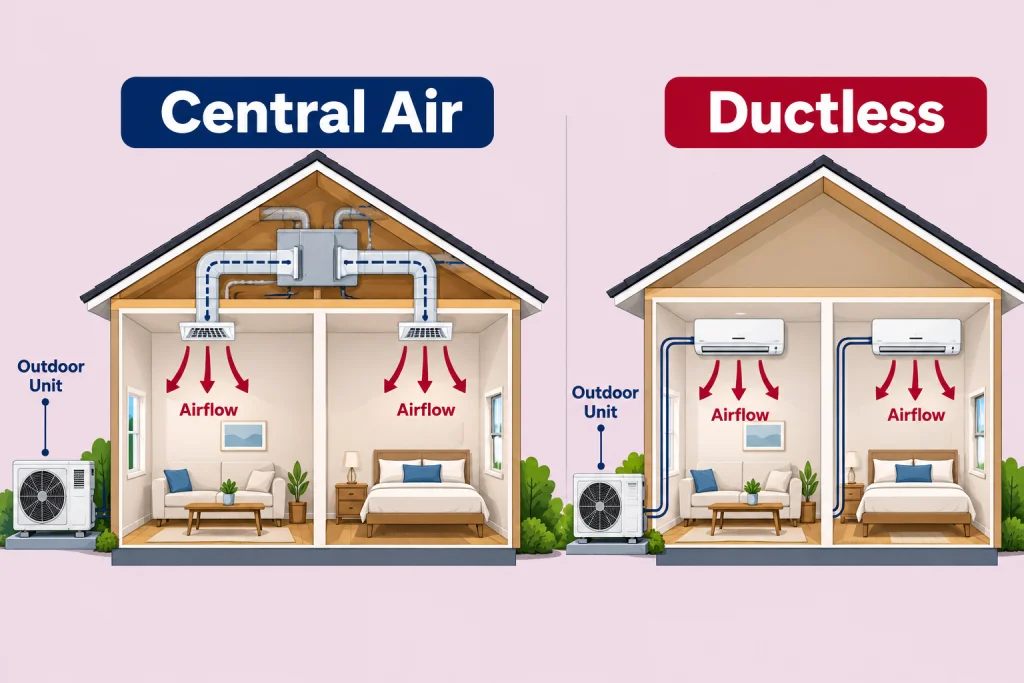
The core difference is how each system moves cooled air through your home. Central air conditioning uses one outdoor condenser connected to a single indoor air handler, which pushes conditioned air through a network of ducts to every room in the house. A ductless mini split uses one outdoor condenser connected directly to one or more individual indoor units, called heads, mounted on a wall or ceiling in each room it serves, with no ductwork anywhere in the system.
How Central Air Works in a Florida Home
A central system draws warm, humid air in through a return grille, cools and dehumidifies it across an indoor coil, then pushes it back out through supply ducts that typically run through the attic. One thermostat controls the whole house, though zoning dampers can split a single duct system into two or three independently controlled zones for an added cost.
How Ductless Mini Splits Work
A ductless system runs refrigerant lines directly from the outdoor unit to each indoor head through a small wall penetration, skipping ducts entirely. Each head has its own remote or app control, so a guest suite can run at 74°F while a rarely used office sits at 80°F, with no shared thermostat forcing a compromise between rooms with very different cooling needs.
Most ductless equipment sold today is technically a heat pump, not an AC-only unit, which means it also provides efficient supplemental heating during Florida’s occasional cold snaps. Many central systems are still paired with electric heat strips instead of a heat pump, which are far less efficient for the handful of cold nights Florida actually sees each winter.
Feature
Central Air
Ductless Mini Split
Air distribution
Ductwork to every room
Individual wall or ceiling head per zone
Zones per outdoor unit
Whole home, one thermostat (dampers optional)
Varies by outdoor unit model, commonly 1 to 5 zones, some support more
Best fit
Whole-home cooling with existing or planned ductwork
Additions, single rooms, homes with no ductwork
Typical install time
1 to 3 days
Single zone: often 1 day. Multi-zone: longer, depending on line-set routing and electrical work
Heating option
Heat strips (common) or heat pump
Heat pump standard on nearly all models
Sizing works differently too. A central system is sized once for the entire home using a Manual J load calculation. A ductless system is sized per zone, and an oversized single head can short cycle and struggle with humidity just as easily as an oversized central unit does. Our AC equipment sizing guide walks through the load calculation factors that apply to either system before you commit to a size.
🧭 Free System Recommendation Tool
Not Sure Which System Fits Your Home?
Answer a few questions about your home’s layout, existing ductwork, and budget, and our free AC Recommendation Wizard will point you toward the system type that fits your situation best.
Step 1 of 110%
🏆
AC Recommendation Wizard
Which air conditioner should you buy? Find out which air conditioning system is ideal for your home, needs, and budget.
What region do you live in?
How large is your home?
How well insulated is your home?
How often do you run your AC in the summer?
How important is energy efficiency to you?
What is your budget preference?
How long are you planning on staying in your home?
Do you want smart/advanced features?
Do you have central ductwork?
How many people live in your home?
Would you like to receive a free no-obligation estimate from our local contractor partners as well?
Great! Almost done, your result is on the next page.
Please enter your contact details so our Certified contractors can provide estimates as well.
This field is required.
Please enter a valid email address.
Please enter your phone number.
Please enter your city or ZIP code.
By submitting this form, you are giving your consent to receive phone calls and text messages from our contractor partners.
You're almost done!
Please provide your details to see your results.
Name is required.
Email is required.
Please enter your city or ZIP code.
🏆 Recommendation Ready
Your Recommended AC System
Best Match For You
—
Get Expert Advice & Free Quotes
A certified HVAC contractor can confirm the best unit for your specific home and climate.
For a single room or zone, ductless almost always costs less than extending central ductwork to reach it. For cooling an entire home from scratch, central air is usually the cheaper option per square foot once you're serving more than three or four rooms from one system.
A straightforward central AC replacement with existing ductwork in good shape runs $4,500 to $14,500 installed in Florida in 2026, depending on tonnage and SEER2 tier. Most 3 to 4 ton, mid-efficiency systems land between $7,500 and $12,500. Our full AC installation cost Florida breakdown covers every tonnage and efficiency tier in detail.
A single-zone ductless mini split, one outdoor condenser paired with one indoor head, typically installs for $3,000 to $6,000 in Florida, depending on capacity and brand. Multi-zone systems serving two to four rooms from a single outdoor unit generally run $8,000 to $16,000 installed, since each additional indoor head and line set adds labor and material cost.
System Type
Typical Installed Cost, Florida 2026
Central AC, 1.5–2 ton (condo or small home)
$4,500 – $7,800
Central AC, 3–4 ton (average home)
$7,500 – $12,500
Ductless, single zone (1 room or addition)
$3,000 – $6,000
Ductless, 2-zone system
$8,000 – $11,500
Ductless, 4-zone system
$12,000 – $16,000+
Ranges reflect typical Florida installer pricing as of September 2026. Coastal counties, HVHZ compliance in Miami-Dade and Broward, and homes needing new electrical circuits run higher on either system type. Always confirm with a local written quote.
The variable that flips this comparison fastest is ductwork. When a central system needs new or extended ducts to reach an addition or a room that never had any, that alone can add several thousand dollars, often enough to make a two or three zone ductless system the cheaper total project even though its per-zone sticker price looks higher on paper.
Both system types require a Florida mechanical permit, generally $100 to $500 depending on the county, and neither is exempt from Florida's 14.3 SEER2 minimum for common residential split-system air conditioners. Utility rebates from FPL, TECO, Duke Energy Florida, and OUC can apply to either system type once the installed equipment clears the SEER2 or HSPF2 threshold the program requires. The federal Section 25C tax credit expired for equipment placed in service after December 31, 2025, and does not apply to 2026 installations of either system, per the IRS's own guidance on the credit's cutoff.
One 2026-specific cost factor applies to both systems: new residential AC and heat pump equipment now ships with lower-GWP A2L refrigerants like R-454B or R-32 under the EPA's AIM Act technology transition rules, replacing R-410A in new manufacturing. In May 2026, the EPA reconsidered part of this rule and removed the installation deadline for residential and light commercial AC and heat pump equipment manufactured or imported before January 1, 2025, so some pre-2025 R-410A inventory can still legally be installed while supplies last. Either way, expect new-manufacture equipment, ductless or central, to carry a modest cost premium tied to this transition. It isn't something one technology avoids and the other doesn't.
Comparing only the sticker price — a low ductless quote with a single low-capacity head sometimes can't actually cool the room it's meant for, which shows up as a comfort complaint later, not a refund.
Forgetting the ductwork math — get a real quote for extending central ductwork to a new space before assuming central is automatically cheaper.
Skipping the rebate check — ask your contractor directly which utility rebates the specific equipment combination qualifies for before you sign anything.
💰 Run Your Own Numbers
See What Your System Would Cost Installed
Plug in your tonnage or zone count, SEER2 tier, and city to get a real installed price range, then compare it against quotes from licensed Florida contractors.
Free tools · No obligation · Built for Florida homeowners
Which Is More Energy-Efficient Long-Term?
On paper, ductless usually wins. In practice, the real-world gap depends heavily on how disciplined you are about closing off unused zones, because a ductless system only saves the energy you actually stop conditioning.
Ductless systems skip one of the biggest efficiency leaks in a Florida home: the ductwork itself. ENERGY STAR notes that energy lost through ducts routed through hot attics can account for more than 30 percent of a home's total space conditioning energy use. A ductless head delivers cooled air directly into the room, so that particular loss simply doesn't exist.
Rated efficiency reflects this gap too. Central AC systems in Florida top out around 20 to 26 SEER2 for premium variable-speed models. Single-zone ductless mini splits routinely reach into the mid-20s to low-30s SEER2 on ENERGY STAR's certified product list, partly because they're tested without any duct losses factored into the number. Our SEER2 rating comparison guide breaks down what these ratings actually mean for a Florida cooling season.
Inverter-driven compressors, standard on nearly every ductless system and increasingly common on central units, run longer at lower capacity instead of cycling on and off. In our experience working with Florida homeowners, that steadier runtime is what actually controls humidity day to day, not just temperature on the thermostat.
The Department of Energy's own writeup on going ductless describes a homeowner running ductless heat pumps successfully in dehumidification mode after retiring a standalone dehumidifier entirely. That lines up with what Florida contractors see in the field: a right-sized, inverter-driven zone often controls moisture better than an oversized, single-speed central unit that short cycles on and off all afternoon.
Before comparing SEER2 numbers between quotes, confirm the exact indoor and outdoor unit combination is listed together on the AHRI certified directory, since the rating applies to the matched pair, not the outdoor condenser alone. This matters for ductless systems too, since mixing an indoor head from one efficiency tier with an outdoor unit from another can quietly lower the real rating you're paying for.
For the actual dollar impact of a higher SEER2 tier on your monthly bill, whichever system you land on, our lowering your Florida AC electric bill guide walks through the payback math step by step.
💡 Proprietary Insight: The 30 percent-plus duct-loss figure from ENERGY STAR is a national number, but it's modeled on ducts running through unconditioned attic space, and Florida attics see some of the most extreme summer temperatures in the country, well above the mild-climate conditions many duct-loss studies assume. In our experience, a leaky, undersized duct run through a Florida attic loses more real cooling capacity than that same duct would in a cooler climate, which is exactly why ductless comes out ahead so decisively in additions where the alternative is stretching new ducts through that same attic space.
What If Your Ductwork Is Old, Leaky, or Nonexistent?
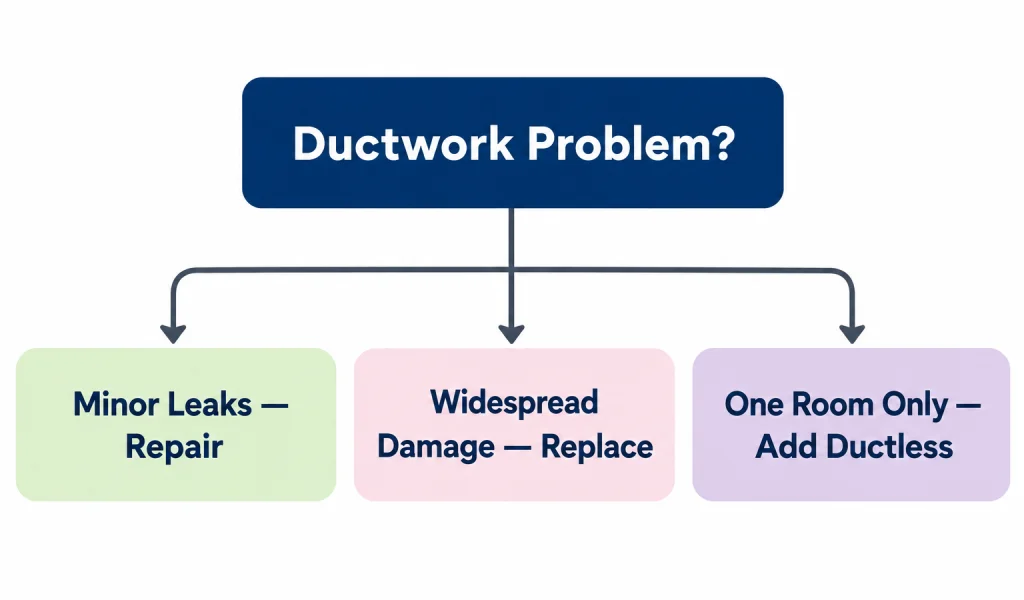
Most homeowners aren't actually choosing ductless versus central from a blank slate. They're staring at a failing central system and an aging duct run, trying to figure out whether to repair the ducts, replace the whole system including ducts, or sidestep the problem with a ductless zone instead. That's a different, more specific decision than the general comparison above, and it deserves its own answer.
Repair, Replace, or Go Ductless?
Repair the ducts, keep central — makes sense when the ductwork is otherwise sound and correctly sized, with isolated leaks or disconnected sections a technician can seal or reconnect. This is usually the cheapest fix by far.
Replace the ducts and the central system together — worth it when ductwork is undersized for the home, crushed or damaged throughout the attic run, or original to a home from an era before current insulation and sealing standards. Doing both at once avoids paying labor twice.
Add a ductless zone instead of touching the ducts — makes sense when only one room or area is the actual problem, or when the budget doesn't support a full duct replacement right now. This is also the more common path in the older, no-duct homes discussed in the next section.
A contractor should walk your attic and inspect the actual duct run before recommending any of these three paths. If a quote jumps straight to a full system replacement without that inspection, or without explaining why repair isn't an option, that's worth a second opinion. Our guide to avoiding AC installation scams in Florida covers the red flags to watch for in a quote like this.
Can Central Air Be Installed in a Florida Home With No Ducts at All?
Yes, technically. A contractor can run new trunk and branch ductwork through the attic and cut supply registers into the ceilings or walls of a home that never had central air. In practice, this is close to a full renovation project, not a simple equipment swap, and the labor to run that ductwork often costs as much as the AC equipment itself, sometimes more in a multi-story or masonry home where running lines is harder.
That cost reality is exactly why so many older Florida homes without ducts end up going ductless instead of retrofitting central air from scratch. It isn't that central air can't be done. It's that ductless usually gets you comparable comfort for meaningfully less money once new ductwork is the alternative.
Is Ductless a Good Fit for Florida Additions or Older Homes?
Yes, and this is where ductless earns most of its keep in Florida. Any time existing ductwork doesn't already reach a space, running new ducts to get there is usually the most expensive part of a central AC solution, not the equipment itself.
The scenarios we see most often in older-home markets like Tampa and St. Petersburg, both cities with a lot of mid-century housing stock, include:
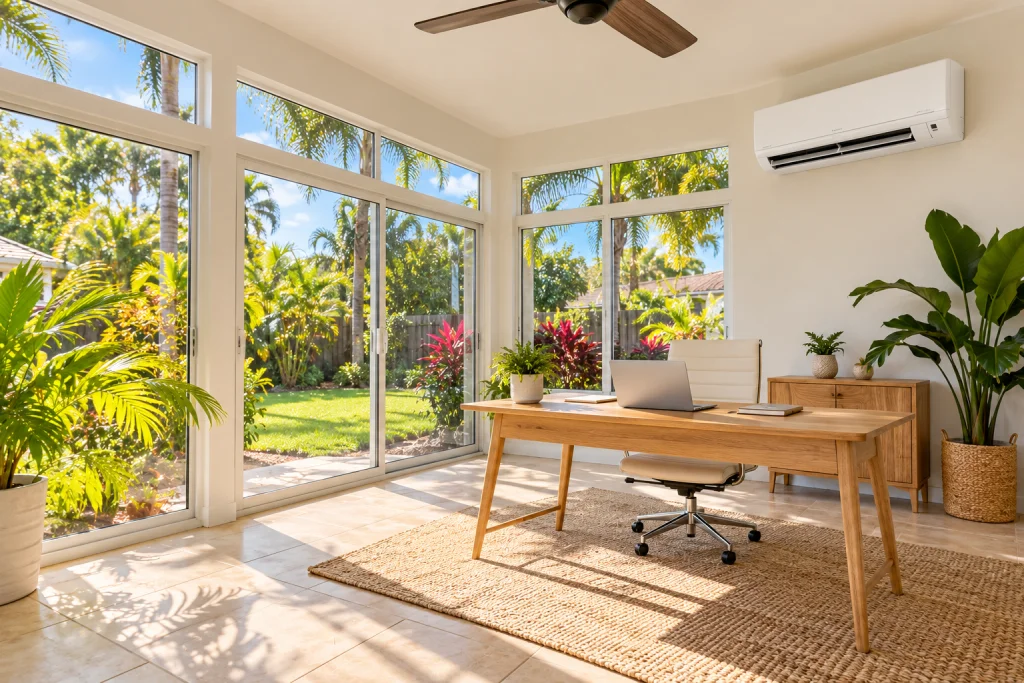
Florida room and lanai conversions turned into full-time living space that the original ductwork was never designed to cool.
Garage conversions used as a bonus room, home office, or in-law suite.
Detached guest suites and casitas where running new ductwork to a separate structure is rarely practical.
Mid-century bungalows in neighborhoods like Tampa's Seminole Heights or St. Petersburg's Historic Kenwood that were originally cooled with window units and never had central ductwork installed at all.
One quirk homeowners in HOA-governed and historic-district neighborhoods often miss: a wall-mounted ductless head, plus its exposed outdoor unit and line set, is usually more visible from the street than a central condenser tucked beside the house. Some associations and historic review boards require architectural approval before installation. Check your HOA documents or local historic district guidelines before you buy equipment, not after.
Permitting itself doesn't change based on system type. Florida still requires a mechanical permit for a ductless install just as it does for central air, and the same 14.3 SEER2 minimum applies to both. Homeowners insurance is worth a second look too: ask your agent whether newer HVAC equipment or documented hurricane strapping on the outdoor unit affects your coverage or premium, since available credits vary by carrier and change from year to year, and apply the same way whether that unit feeds ductwork or a single ductless head.
Extending Central Ductwork
Adding a Ductless Zone
Typical added cost
Several thousand dollars, varies widely with attic access
$3,000 – $6,000 for one zone
Disruption to existing rooms
Attic and sometimes ceiling work in the main house
One wall penetration, contained to the new space
Timeline
Often 2 to 4 days
Usually 1 day
Best when
Ductwork is close by and easily extended
The space is detached, far from existing ducts, or has none
Not sure what size unit a new zone actually needs? Square footage alone doesn't cut it once you factor in Florida's heat and humidity load, ceiling height, and window exposure.
📐 Sizing an Addition or Guest Suite?
Get a Quick BTU Estimate
Use our free AC Size & Tonnage Calculator to estimate the capacity a single zone needs based on the room's square footage and key sizing factors, before you call a contractor.
Free · Takes about a minute · Built for Florida homes
Air Quality, Noise, and Appearance: The Overlooked Differences
Cost and efficiency get most of the attention, but three quieter factors decide whether homeowners are actually happy living with either system day to day: air quality, noise, and how much of the equipment you have to look at.
Air Quality and Filtration
Central systems pull all the air in the house through one return, which makes it straightforward to install a single larger filter with a higher MERV rating, or add a whole-home accessory like a UV light or media air cleaner that treats every room at once. Ductless heads each use a smaller washable filter built into the unit, which catches dust and larger particles well but generally isn't rated to the same MERV standard as a central return filter, and there's no single point in the system to bolt on whole-home filtration.
For a household managing allergies or asthma across the whole home, central air's filtration options are usually easier to upgrade. For a single ductless zone, that tradeoff matters less since you're only conditioning the air in that one room to begin with.
Noise and Appearance
Outdoor equipment noise is roughly comparable between modern systems of either type, and varies more by model than by technology. Indoors is where they differ: a ducted central system is close to silent in the room itself, since only the supply register is audible, while a ductless head has its own fan running in that room. Modern inverter units run quiet, but "quiet" isn't "silent," and it's worth listening to a demo unit if a head is going in a bedroom.
Appearance follows the same pattern. Central air keeps equipment out of sight, with only supply and return grilles visible in the room. A ductless head is a visible wall or ceiling unit in every room it serves, which some homeowners like being able to see and control per room, and others simply don't want to look at.
Factor
Central Air
Ductless Mini Split
Indoor appearance
Mostly hidden, grilles only
Indoor heads visible on the wall or ceiling
Filtration upgrade path
Single return, easy to upgrade MERV rating or add whole-home filtration
Per-head washable filter, no single whole-home upgrade point
Room noise
Airflow from supply register only
Indoor head fan runs in the room
Design flexibility
High, equipment stays out of view
More limited, head placement affects the room's look
What Are the Maintenance Differences?
Central air has one filter to remember and a duct system you can't see. Ductless has a filter in every head you can see and clean yourself, and nothing hidden in the attic to leak or grow mold in the first place.
Maintenance Task
Central Air
Ductless Mini Split
Filter changes
One return filter, monthly in peak season
Washable filter per head, monthly in peak season
Condensate line
One primary drain line, checked regularly
One line per head or shared manifold
Ductwork inspection
Every few years for leaks or moisture
Not applicable, no ductwork
Outdoor coil cleaning
Annual, more often near the coast
Annual, more often near the coast
Whichever system you choose, the outdoor condenser sits exposed to the same salt air near the coast. Homes within a few miles of saltwater in Tampa Bay or South Florida should ask for a corrosion-resistant coil coating regardless of which system they pick, since a ductless outdoor unit corrodes at essentially the same rate as a central one in identical conditions.
Humidity, not heat, is what actually shortens AC equipment life fastest in Florida, for ductless and central alike. Our Florida humidity and AC lifespan guide breaks down exactly how that plays out and what extends a system's service life either way.
Skipping filter changes — a dirty filter can ice over the coil on either system, cutting off airflow and eventually stressing the compressor.
Ignoring condensate clogs — algae growth in a drain line is a routine Florida service call on both system types and is worth a rinse a few times a season.
Adding heads without a matching maintenance plan — every additional ductless zone is one more filter and one more drain line to actually stay on top of.
Which Should Snowbirds Consider for Part-Time-Occupied Homes?
For a home occupied only part of the year, ductless zoning usually has the edge, because you can condition just the rooms in use instead of running a full central system for months at a time while nobody's there.
The catch is that a Florida home can't simply go without any cooling while you're away, regardless of which system you install. Humidity, not heat, is the real risk during an empty summer, and a closed-up, uncooled Florida home can develop mold and moisture damage in a matter of weeks.
Many Florida homeowner and condo insurance policies include language around maintaining reasonable humidity control while a property sits vacant, and mold-related claims are scrutinized closely if a home was left without any cooling or dehumidification running. Check your policy's vacancy clause before you decide to shut a system down completely for the season.
⚠️ Vacancy Alert: Setting a system back to a higher temperature while you're away is normal and smart. Turning it off entirely for months is a common and costly mistake among part-time Florida residents, on ductless and central systems alike.
A common approach among snowbirds is running a single ductless zone in the main living area on a modest setback while away, which keeps humidity in check cheaply, then pairing it with a central system left on a wider setback for the rest of the home. It's the same setup that works well for a detached guest suite or casita that only gets used when family visits during the season.
Both system types now commonly offer a WiFi module that lets you check temperature and humidity remotely from wherever you're spending the off season, which is worth asking for whether you land on ductless, central, or a hybrid of the two.
How Do Installation Costs Vary Across Florida's Regions?
The statewide ranges earlier in this guide are a solid starting budget, but Florida isn't one HVAC market, and the same system can price differently depending on where you live. The shift isn't random. A handful of specific, identifiable factors drive it in every region:
South Florida (Miami-Dade & Broward) — outdoor equipment and mounting hardware need High Velocity Hurricane Zone product approval on top of the standard mechanical permit, and contractor demand runs high, both of which push installed prices above the state average for either system type.
Tampa Bay — a generally competitive contractor market, with a coastal corrosion-coating upcharge common near the bay itself.
Orlando and Central Florida — typically the most competitive labor market in the state, since a denser contractor pool means more homeowners collecting multiple quotes.
Southwest Florida — similar coastal and hurricane-exposure considerations to South Florida, without the HVHZ product approval requirement outside Miami-Dade and Broward specifically.
Jacksonville, the Panhandle, and inland North Florida — generally lower labor costs, though distance from major equipment distribution hubs can add modest freight cost on certain brands or high-efficiency models.
We're not publishing exact city-by-city dollar figures here, because pricing shifts too often, block by block, based on individual contractor overhead and current material costs, and a specific number would go stale faster than this guide gets updated. The factors above are what to ask a local quote to account for, and what to compare when a bid from one city looks meaningfully different from another.
Bottom Line: Ductless Mini-Split or Central AC for Your Florida Home?
For most Florida homes, central air conditioning is generally the better fit for whole-home comfort and resale expectations, especially when working ductwork is already in place. Ductless mini splits earn their keep in the gaps central air can't reach affordably: additions, garage conversions, detached guest suites, and older homes that never had ducts to begin with.
Your Situation
Better Fit
Whole-home replacement, ductwork in good shape
Central Air
Addition, garage conversion, or bonus room
Ductless Mini Split
Older home with no existing ductwork
Ductless Mini Split
Detached guest suite or casita
Ductless Mini Split
Part-time or snowbird-occupied home
Ductless zoning, or a hybrid setup
Selling within the next few years
Central Air (buyer expectation)
The homeowners who end up happiest with either choice do the same two things: they size the system to the actual space using a real load calculation, not a square footage guess, and they get at least two or three quotes from Florida-licensed contractors before signing anything.
If you'd rather skip the legwork, our network of licensed Florida HVAC contractors already quotes both system types, so you're comparing apples to apples on whichever path you choose.
🇺🇸 Ready When You Are
Get a Custom System Recommendation
Tell us about your space, whether it's a whole home, an addition, or a guest suite, and we'll connect you with licensed, background-checked Florida contractors who quote both ductless and central options.
🔒 Free · No pressure · Florida-licensed contractors only
Frequently Asked Questions
Can a mini-split handle Florida humidity as well as central air?
Yes, often better. Inverter-driven mini splits modulate compressor speed to run longer at partial capacity, which pulls more moisture from the air than an oversized central unit that short cycles on hot, humid days.
Is ductless cheaper to run than central air in Florida?
Often yes, per zone. Ductless avoids duct energy losses and lets you turn off unused rooms, but running many heads at once all day can erase that advantage quickly.
Do mini-splits work well in guest houses or casitas?
Yes. A single-zone ductless mini split is one of the most cost-effective ways to cool a detached guest suite or casita, since running new ductwork to a separate structure is rarely practical.
Can I mix ductless and central AC in the same Florida home?
Yes, this is common. Many Florida homeowners keep central air for the main living areas and add a ductless zone for a converted garage, addition, or guest suite the ductwork never reached.
How long do ductless mini splits last compared to central air in Florida?
Both typically last 12 to 15 years in Florida with proper maintenance. Coastal salt exposure and neglected filters shorten either system's lifespan more than the underlying technology ever does.
Does a ductless mini split hurt home resale value in Florida?
Not if it supplements central air. Florida buyers generally expect whole-home central AC, so a ductless zone added for an addition or guest suite reads as a bonus, not a replacement.