Does insurance cover AC storm damage in Florida? For homeowners, the answer in most cases, yes: wind and wind-driven debris damage to your outdoor condenser or attic-mounted air handler is typically paid under the wind portion of a standard policy. But there is a hard line most homeowners do not discover until a claim gets denied. Flood damage to that same unit is excluded from a standard homeowners policy unless you carry separate flood insurance.
This guide breaks down what a typical Florida homeowners policy actually pays for after a hurricane or severe storm, what gets excluded even when the timing looks obvious, and the documentation steps that keep an AC claim from getting bounced back by an adjuster. It is written for Florida homeowners filing, or about to file, a storm damage claim on their AC system in 2026.
By the ACPrices.com Editorial Team•✔ Checked against current Florida Statutes and Florida DFS consumer guidance•Updated: September 2026
Quick answer: Wind and wind-driven rain damage to your AC is typically covered by your homeowners policy, subject to your hurricane deductible during a declared storm. Flood damage to the same unit needs a separate NFIP or private flood policy. Neglect, corrosion, and ordinary mechanical wear are excluded either way.
One note before you read further: insurance coverage varies by policy, carrier, and the specific facts of a loss. This article provides general educational information based on typical Florida policy language and public Florida Statutes and Department of Financial Services guidance. It is not a substitute for advice from your insurer, a licensed insurance professional, a public adjuster, or an attorney, so confirm the specifics of your own policy before you file or settle a claim.
What Storm-Related AC Damage Is Typically Covered?
Most Florida homeowners policies pay for AC damage caused by wind, wind-driven debris, and lightning during a storm, since these are treated as sudden, accidental physical loss under the wind portion of the policy. Your outdoor condenser is normally covered the same way as the rest of your fixed dwelling systems, not as a separate item.
Situations that typically get paid without much of a fight include:
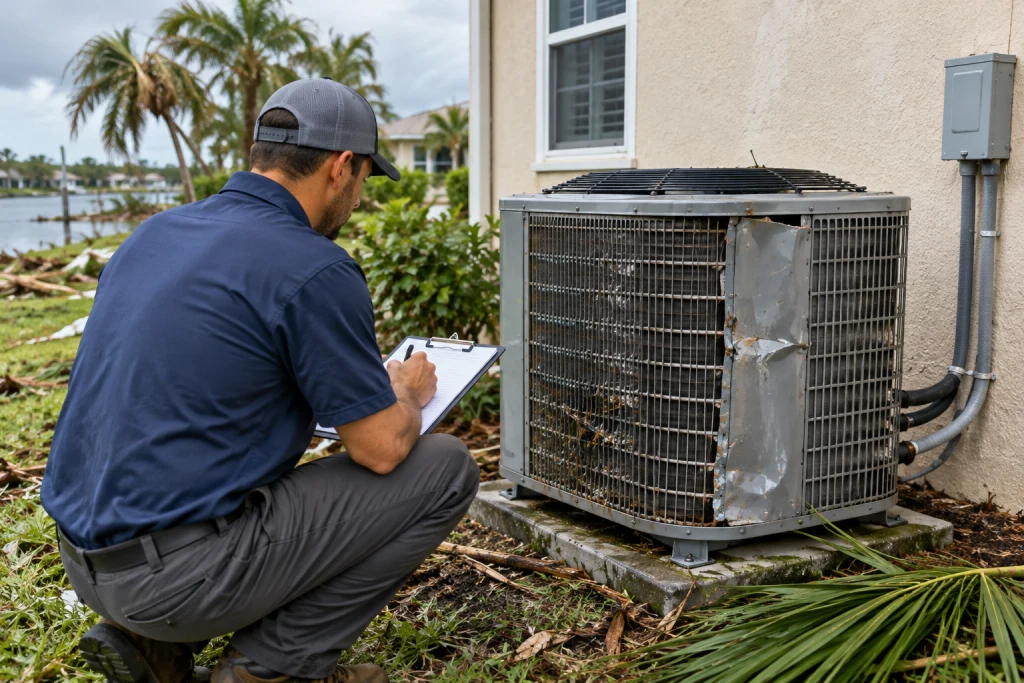
Wind or flying debris dents the cabinet, snaps a fan blade, or knocks the condenser off its pad
A falling tree limb or fence panel lands on the unit during high winds
Wind-driven rain enters through a storm-created opening in the roof or wall and damages an attic-mounted air handler
A lightning strike fries the control board, compressor, or thermostat
Fire or smoke from a storm-related electrical event reaches ductwork or equipment
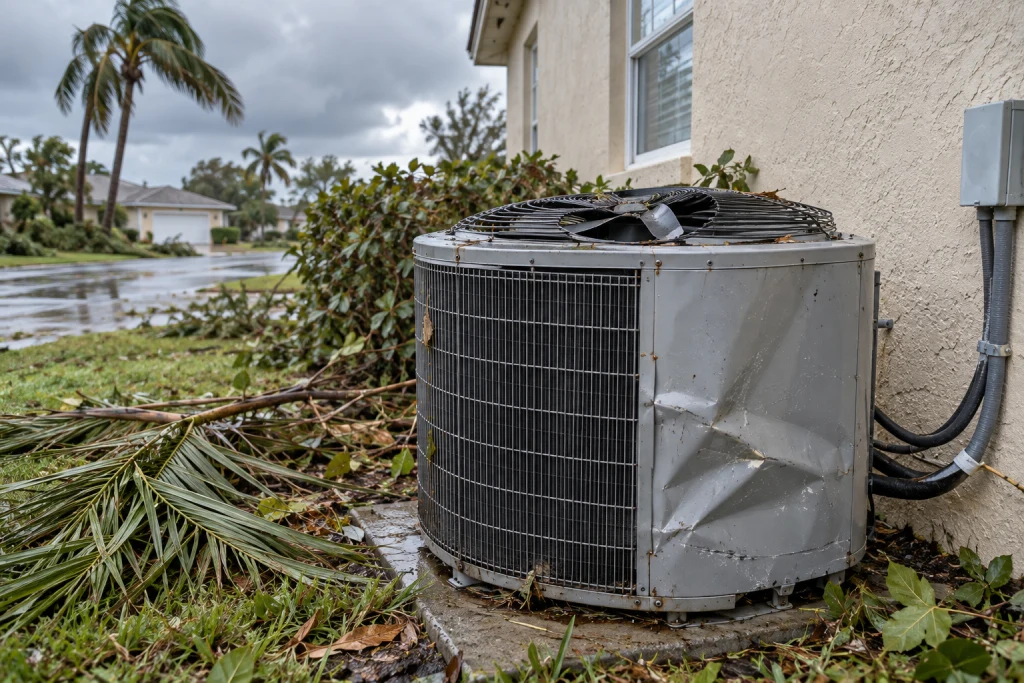
In practice, visible physical evidence tends to make the cause of loss easier to document. A dented cabinet, a cracked fan blade, or debris embedded in the coil gives an adjuster something concrete to evaluate alongside the policy language and any contractor findings, rather than a component that simply stopped running with no visible mark.
It also helps to know where your AC sits on your policy. An outdoor condenser wired into your home’s central system is generally treated as part of the dwelling, not as separate personal property, which is why it is adjusted alongside roof and siding damage rather than under a lower personal-property sublimit.
What Parts of an AC System Can Storm Damage Affect?
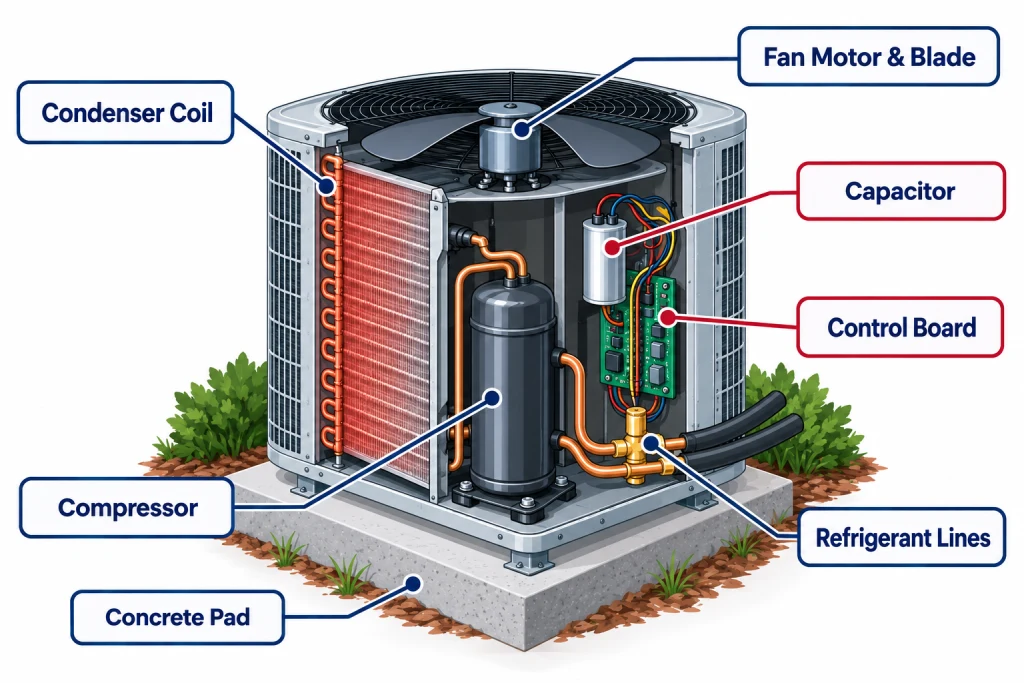
A central air system has several components that can each be damaged in different ways during a storm, and the component that failed often tells you whether you are looking at physical storm damage or an unrelated mechanical failure. Components a storm can plausibly damage include:
Condenser cabinet and coil: dented, punctured, or bent by wind-driven debris or a falling limb
Fan blade and fan motor: bent, cracked, or seized by impact or debris caught in the housing
Compressor: can be damaged by a direct impact, or by electrical surge from a nearby lightning strike
Capacitor and contactor: frequently the components a power surge or lightning strike takes out first
Control board and thermostat: vulnerable to lightning-related electrical surges even without a direct strike on the unit
Disconnect box and exterior wiring: can be torn loose or exposed by wind, sometimes creating a safety hazard on top of the coverage question
Refrigerant lines and line-set connections: can be crimped or pulled loose if the outdoor unit shifts or is struck
Concrete pad or mounting stand: cracked or displaced by wind, a falling object, or shifting ground
Attic-mounted air handler and ductwork: exposed to wind-driven rain when a storm opens the roof or a wall
The distinction that matters for coverage is physical storm damage versus ordinary mechanical failure. A capacitor that failed because lightning surged through the electrical system is a different claim than a capacitor that failed because it was eight years old and due for replacement anyway, even though the visible symptom, an AC that will not start, looks identical from the thermostat. This is exactly why a technician’s diagnosis of which component failed and why matters more than simply noting that the AC stopped working.
Does Insurance Cover Window or Portable AC Units?
Everything above describes a permanently installed central air system, the condenser, air handler, and ductwork wired into your home. Window units and portable AC units are usually classified differently on a homeowners policy: rather than being treated as part of the dwelling, they are typically treated as personal property, similar to other appliances you own.
That distinction can affect which part of your policy responds and which limit and deductible apply, though it does not change the underlying coverage logic. Wind or storm-related physical damage to a window unit can still be a covered loss, and flood damage, neglect, and ordinary wear are still excluded the same way they are for a central system. If you rent, a landlord’s policy typically covers the building and any central AC system, while a portable or window unit you own is more likely to fall under your own renters or personal property coverage instead. Confirm with your specific policy or insurer how it classifies AC equipment, since this varies by carrier.
What’s Usually Excluded (Flood, Neglect, Pre-Existing Wear)?
Three common reasons an AC storm claim gets denied or disputed in Florida are flood damage, ordinary wear and tear, and damage the insurer attributes to neglect or a pre-existing condition rather than the storm itself. All three generally sit outside what a standard homeowners policy is built to pay for, though the outcome always depends on the specific policy language and the facts of the loss.
Flood water: any damage from rising water, storm surge, or water entering at ground level is excluded from a standard homeowners policy, even when a named hurricane caused it. That risk sits under a separate flood policy.
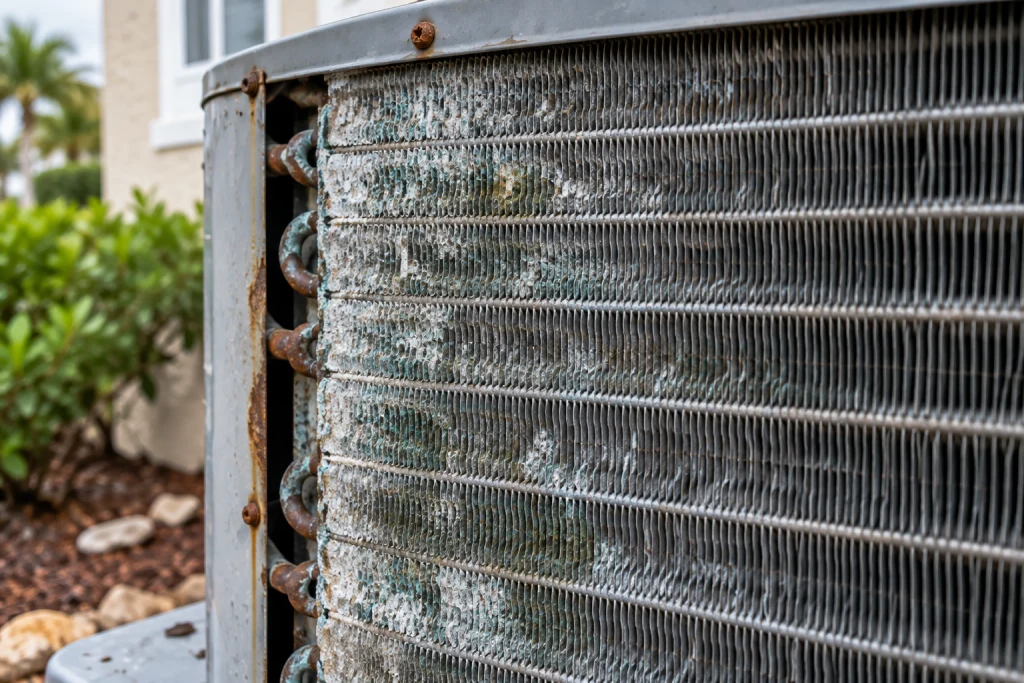
Wear and tear and corrosion: refrigerant leaks from age, worn contactors, and coils corroded by years of coastal salt air are treated as maintenance issues, not storm losses, even if the unit happens to fail during a storm.
Pre-existing condition: if a prior repair invoice already documented corrosion or a slow refrigerant leak, expect the insurer to apportion or deny the claim on that basis.
Ordinary mechanical breakdown: a burned-out compressor, a failed capacitor, or a worn motor with no connection to wind, lightning, or fire is excluded from storm coverage. A separate equipment breakdown endorsement, not your storm coverage, is the product built for that risk.
⚠️ Coastal Corrosion Alert: In coastal counties from Naples to Fort Lauderdale to Tampa Bay, long-term salt-air corrosion can complicate the cause-of-loss analysis on an outdoor coil. If a unit has visible corrosion, a contractor’s report should distinguish any pre-existing corrosion from a specific, datable storm event, such as a downed limb, a piece of fencing embedded in the cabinet, or a unit physically knocked off its pad. A unit that simply “stopped working after the hurricane” gives an adjuster less to work with than one with documented impact damage.
This is why the mechanism of damage matters as much as the timing. Two identical AC failures, one with a dent and a snapped fan blade and one with no visible mark, can be adjusted very differently even though both happened the same week.
What If My AC Stops Working Days After the Storm?
A very common real-world scenario is an AC that ran fine during the hurricane and then failed two or three days later. Timing alone does not establish or rule out coverage here, and it does not automatically point to either a covered loss or an excluded one. What matters is whether a technician can identify the specific component that failed and connect it to a storm-related cause, such as a lightning-induced power surge that damaged a capacitor or control board without an immediate, visible symptom.
Some electrical components can fail after a delay following a lightning event or power disturbance. A technician should determine whether the failed component and its failure mode are consistent with storm-related electrical damage, rather than assuming a connection from timing alone. If your AC stops days after a storm, our AC not working troubleshooting guide covers the fast checks worth running before you call anyone, and a technician’s diagnostic report describing which part failed and the likely cause is the document that actually supports a delayed-failure claim, not the date on your calendar.
How Do You Document Damage for a Claim?
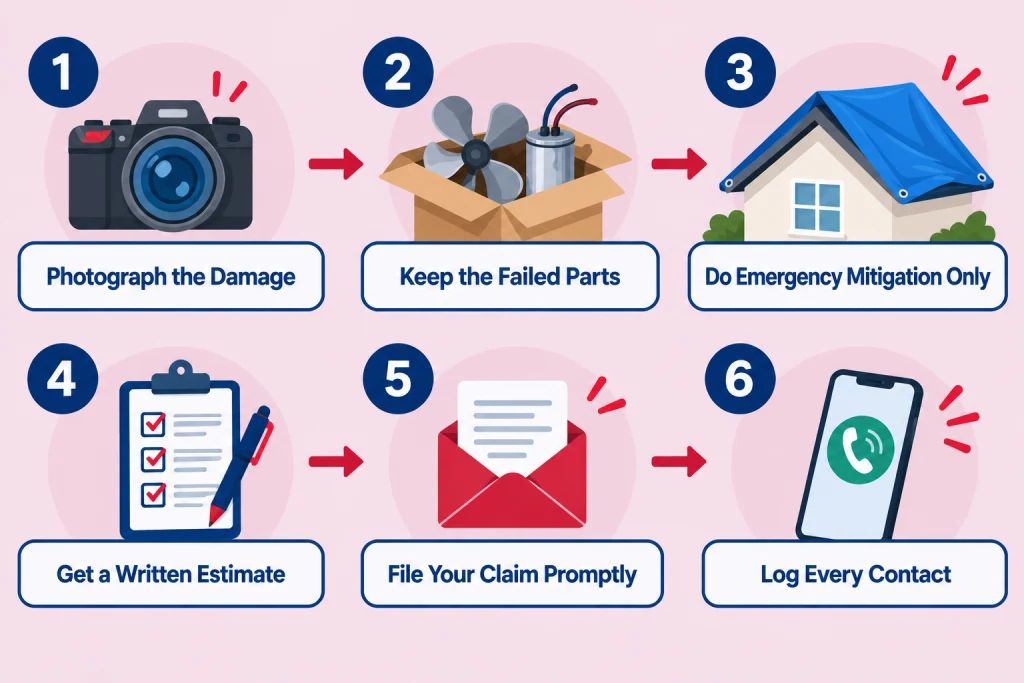
Document your AC storm damage the same day if you can. Photograph the unit from multiple angles before touching anything, note the date and time, and keep any parts the storm knocked loose rather than throwing them away. The steps below cover the full documentation sequence.
Photograph and video the damage immediately. Wide shots and close-ups, plus anything nearby that caused it, like a fallen limb or a piece of fencing.
Keep the failed parts. Do not discard a blown capacitor, a cracked fan blade, or a dented panel. An adjuster may want to inspect it.
Do emergency mitigation only. Your policy requires you to prevent further damage, so tarping an exposed roof opening or shutting off power to a compromised unit is expected. Hold off on full repairs until the adjuster inspects, unless a licensed contractor says the unit is a safety hazard.
Get a written estimate from a Florida-licensed HVAC contractor that describes the mechanism of damage, not just a repair price.
File your notice of claim promptly. Florida law gives you one year from the date of loss for a new or reopened claim, but insurers and adjusters respond faster to claims filed within days, not months.
Log every contact. Keep a written record of every call, email, and adjuster visit with dates attached.
If you took pre-storm precautions such as disconnecting power and securing the unit using our hurricane AC prep checklist, mention that to the adjuster. It supports the argument that the damage came from the storm itself rather than from a unit left exposed and neglected.
Under Florida Statute 627.70132, that one-year window applies to a new or reopened claim, and a supplemental claim for additional damage discovered later gets 18 months from the same date of loss. Miss either deadline and the claim can be barred permanently, regardless of how legitimate the damage is.
📸 Before You Call It In
Get a Second Set of Eyes on the Damage
A detailed contractor estimate gives you useful documentation to compare against the number your adjuster comes back with before you sign anything.
Free · No obligation · Licensed Florida HVAC contractors only
What’s the Difference Between Wind Damage and Flood Damage Claims?
Wind damage and flood damage are adjusted, and paid, under two completely different policies in Florida, even when the same storm causes both types of loss to the same AC unit. Knowing which bucket your damage falls into decides which claim you file and which deductible applies.
Factor
Wind Claim
Flood Claim
Policy type
Standard homeowners policy
Separate NFIP or private flood policy
What triggers it
Wind, flying debris, lightning, wind-driven rain through a storm-created opening
Storm surge, rising water, or water entering at or below ground level
Deductible
Hurricane deductible (2%, 5%, or 10% of dwelling coverage, or $500) during a declared hurricane; standard deductible otherwise
Set by the flood policy, separate from your homeowners deductible
Can you buy it after a storm is forecast
Coverage is already in force under your existing policy
No. NFIP flood policies carry a 30-day waiting period before coverage starts
A detail that surprises a lot of homeowners: the hurricane deductible applies only once per calendar year, not once per storm. Once you have satisfied it on the season’s first named-storm claim, AC damage from a second hurricane later that year is typically adjusted under your regular, much lower, all-other-perils deductible instead. Under Florida law, the hurricane deductible period begins when the National Hurricane Center issues a hurricane warning for any part of Florida, not specifically your county, and it ends 72 hours after the last hurricane watch or warning for any part of the state is terminated. Damage from an ordinary thunderstorm or a tropical storm that never reaches hurricane status, or damage that occurs well outside that statewide window, uses your standard, lower deductible instead.
A large share of Florida homeowners near the coast carry their policy through Citizens Property Insurance Corporation, the state-created insurer of last resort for properties private carriers will not write or price affordably. Citizens follows the exact wind-versus-flood split described here: its policies pay for wind and wind-driven rain damage to your AC on the same terms as a private homeowners policy, and exclude flood damage the same way. If Citizens is your carrier, the hurricane deductible rules, the one-year filing deadline, and the DFS mediation rights covered later in this guide all apply exactly as they would with a private insurer.
A single hurricane often does both kinds of damage to the same property, and that is where a policy provision called an anti-concurrent causation clause becomes relevant. Some Florida property policies contain this language, which can let an insurer deny an entire claim, including the wind portion, when an excluded peril such as flooding contributed to the same loss, even where the wind damage on its own would otherwise have been covered. Whether it applies, and how far it reaches, depends on the exact wording of your policy and the facts of the loss, and Florida courts have generally enforced clear anti-concurrent causation language when an insurer can show an excluded peril contributed. Because of this, a homeowner whose condenser was both battered by wind and later submerged by storm surge benefits from documentation that separates the two: timestamped photos and, ideally, a contractor’s written assessment of which damage happened first and from which cause, rather than one claim that blends both losses together.
Flood coverage works differently, and it is worth understanding before you assume your homeowners policy has you covered. If storm surge or rising water reached your outdoor unit, that is a flood claim, filed with your National Flood Insurance Program policy or a private flood carrier, not your homeowners insurer.
One Florida Building Code detail rarely comes up until after a storm. In a mapped flood zone, outdoor HVAC equipment is allowed to sit below the required base flood elevation only if it is mounted on a stand or platform designed to keep water from entering it. If your outdoor unit was installed at grade in a flood zone rather than elevated to code, that becomes relevant to both your flood claim and your next elevation certificate, not just the immediate repair.
This split matters most in coastal, flood-prone cities. Fort Lauderdale and Tampa Bay homeowners near the water often need both a wind claim and a flood claim from the same storm, while an inland homeowner further from a mapped flood zone is usually dealing with wind exposure alone.
Is My AC Damage Likely to Be a Storm Claim? (Scenario Examples)
Putting the coverage rules above into a few concrete scenarios makes them easier to apply to your own situation. None of these are guarantees, since every policy and every claim is different, but they show which bucket a given loss usually falls into.
Scenario
Likely Coverage Question
A tree limb falls on the condenser during high wind
Wind and impact damage, usually a straightforward wind claim
Lightning strikes nearby and the control board fails
Lightning and electrical surge damage, usually a wind-policy claim
Storm surge submerges the outdoor condenser
Flood damage, needs a separate NFIP or private flood policy
The compressor fails and it was already 12 years old
Likely wear and tear or mechanical breakdown, not a storm claim
The AC runs fine during the storm, then stops 2 days later
Needs a technician’s diagnosis connecting a specific component to a storm-related cause, such as surge damage
Wind opens a roof section and rain reaches the attic air handler
Wind-driven rain through a storm-created opening, usually a wind-policy claim
The unit was already leaking refrigerant before the storm
Pre-existing condition, likely to be apportioned or denied
Should You Get a Contractor Estimate Before or After Filing?
In many cases, you can notify your insurer as soon as you discover the loss and then arrange a contractor inspection close to when the adjuster inspects, so both reports describe the same damage. Filing does not require final numbers, only notice that a loss occurred, but check your own policy and insurer’s instructions before authorizing major repairs.
Under Florida’s Homeowner Claims Bill of Rights, your insurer must acknowledge the claim within 14 days and complete an inspection within 30 days, then decide to pay or deny within 60 days of receiving your complete proof of loss. Getting your own contractor’s estimate lined up inside that same window gives you a number to compare against the adjuster’s scope before you agree to anything.
An independent estimate matters because adjusters often price a claim off standardized estimating software that can undervalue Florida-specific line items, things like HVHZ-rated hardware in Miami-Dade and Broward, or corrosion-resistant coil coatings near the coast. A licensed contractor’s itemized estimate can be useful supporting documentation if the scope or pricing differs from the insurer’s assessment.
🧮 Free Repair Cost Estimate
See What Your AC Repair Might Cost Before the Adjuster Does
Get a ballpark repair cost for your specific issue before you compare it against your insurer’s number, or decide whether repairing makes more sense than replacing. It only takes a minute.
Step 1 of 160%
🔧
A/C Repair Cost Calculator
How much will repairing your existing A/C cost? Answer a few questions about what you're experiencing and get a repair cost estimate.
How well has your A/C been cooling your home lately?
Have you noticed large indoor temperature fluctuations?
Is the thermostat on and appears to be functioning properly?
Have you noticed reduced airflow from vents even though the A/C is on?
Have you noticed air coming from vents feels warm?
Is the fan spinning very slowly or not at all on outdoor unit?
Does the air conditioner fan appear to never shut off (outdoor unit)?
Have you noticed strange odours coming from vents or near your furnace?
Have you noticed any unusual noises?
What best describes the unusual noise(s)?
Does your A/C turn on but shuts off soon after?
Does the breaker regularly trip or fuses repeatedly blow?
Have you noticed water damage or water leaking or pooling near your furnace?
Have you noticed ice build up on the refrigerant lines, copper tubing, or coil?
Have your electrical bills been significantly higher than usual lately?
Would you like to receive a free no-obligation estimate from our local contractor partners as well?
Great! Almost done, your result is on the next page.
Please enter your contact details so our Certified contractors can provide estimates as well.
This field is required.
Please enter a valid email address.
Please enter your phone number.
Please enter your city or ZIP code.
By submitting this form, you are giving your consent to receive phone calls and text messages from our contractor partners.
You're almost done!
Please provide your details to see your results.
Name is required.
Email is required.
Please enter your city or ZIP code.
🔧 Diagnosis Complete
Your A/C Repair Estimate
Estimated Repair Range
—
Likely Issue
—
Get an Accurate Repair Quote
A certified HVAC technician can diagnose the exact issue and provide a firm quote. Many offer free diagnostics.
Also confirm whether your policy pays actual cash value or replacement cost. Actual cash value pays the depreciated value of your old unit upfront. Replacement cost value pays the full cost, but usually only after repairs are complete and you submit paid invoices to release the depreciation holdback the insurer withheld at first payment.
What If Your Claim Gets Denied?
A denial is not the final word. Florida gives policyholders several no-cost or low-cost ways to challenge a denied or underpaid AC storm claim before anyone needs to hire an attorney.
Request the written denial letter and the specific policy provision the insurer cited.
Submit additional documentation. New photos, your independent contractor estimate, or a request for re-inspection can reopen a conversation an adjuster closed too quickly.
Request free mediation through the Florida DFS mediation program. It is available for disputes of $500 or more after your deductible, the insurer pays the mediator's cost, and the process is non-binding.
Invoke your policy's appraisal clause if the dispute is only about the dollar amount, not whether the loss is covered. Each side picks an appraiser and a neutral umpire settles any disagreement.
File a complaint with DFS or call the Insurance Consumer Helpline if you believe the insurer missed a statutory deadline or mishandled the claim.
File a Civil Remedy Notice under Florida Statute 624.155 if you believe the insurer is acting in bad faith. It starts a 60-day cure period before a bad-faith lawsuit can proceed. This step is typically handled by a public adjuster or attorney rather than filed by a homeowner directly, and is usually reserved for a claim that has stalled well past the statutory deadlines above.
Mediation and appraisal solve different problems. Mediation is for a claim that was denied or underpaid and you want a neutral third party to help both sides find a number. Appraisal only works once the insurer has already accepted the loss is covered and the fight is purely over how much it is worth. You can find both programs explained on the Florida DFS mediation page.
Wind, wind-driven rain, and lightning damage to your AC are usually covered, subject to your hurricane deductible during a declared storm. Flood damage to the same unit needs a separate flood policy, and damage the insurer attributes to neglect, corrosion, or a pre-existing condition is likely to be disputed or denied regardless of when it surfaced.
Three habits can help support a stronger AC storm claim: documenting the mechanism of damage with photos the same day, filing notice well inside Florida's one-year deadline, and getting an independent contractor estimate to compare against the adjuster's number. Every policy reads a little differently, so treat the ranges and rules above as a starting point and confirm the specifics with your own carrier before you sign off on a settlement.
Frequently Asked Questions
Does flood insurance cover AC units?
Yes, if the unit is damaged by rising water, storm surge, or flooding, but only if you carry separate NFIP or private flood coverage. Standard homeowners insurance always excludes flood damage.
How long do I have to file a storm damage claim in Florida?
One year from the date of loss for a new or reopened claim, and 18 months for a supplemental claim, under Florida Statute 627.70132. Missing either deadline can permanently bar your claim.
Do I need a licensed contractor's estimate for insurance?
It is not always legally required, but a written estimate from a Florida licensed HVAC contractor is strong supporting documentation, especially if you plan to dispute the adjuster's scope or pricing.
What is the difference between actual cash value and replacement cost for a storm-damaged AC?
ACV pays the depreciated value of your old unit upfront. RCV pays full replacement cost, but usually only after repairs are complete and you submit paid invoices to release the depreciation holdback.
Does a hurricane deductible apply if my AC was damaged by a non-hurricane storm?
No. The higher, percentage-based hurricane deductible only applies within the statutory hurricane period, which runs from a hurricane warning for any part of Florida to 72 hours after the last such warning ends statewide. Ordinary storms outside that window use your regular, lower deductible.
What is an anti-concurrent causation clause?
It is a policy clause letting an insurer deny an entire claim, including covered wind damage, if an excluded peril like flooding contributed to the same loss. Florida courts generally enforce it, so documenting wind and flood damage separately matters.
Does insurance cover AC storm damage in Florida?
In most cases, yes. Wind and wind-driven damage to your AC is typically covered under a standard Florida homeowners policy, subject to your hurricane deductible during a declared storm. Flood damage to the same unit needs separate flood insurance, and neglect, corrosion, or ordinary wear is excluded either way.