Your AC not cooling properly by late July or August almost never means the system is broken outright. In most Florida homes, a unit that has run hard since May starts showing fatigue before it fails completely, and the difference matters because a fatigued system is usually a cheap fix while a failed one rarely is.
By the ACPrices.com Editorial Team•✔ Checked against DOE efficiency guidance and EPA Section 608 refrigerant rules•Updated: August 2026
This guide is for Florida homeowners in Miami, Tampa, Orlando, and everywhere in between whose AC runs constantly but still can’t quite keep up with the heat. You’ll learn the six warning signs that show up most in August and September, how to tell simple maintenance from a real repair, and what a Florida contractor actually checks during a late-summer visit.
None of this means every struggling AC is on its last leg. Plenty of the systems showing these signs right now just need a proper cleaning and a recharge to finish the season strong. The goal here is helping you tell “needs attention” from “needs replacing” before the decision gets made for you on the hottest day of September.
If your AC runs all day but the house still isn’t cooling, the three most common causes are short cycling, weak airflow, and a refrigerant charge that has quietly dropped after months of continuous summer runtime. All three are usually fixable without a full replacement, but each one gets more expensive to correct the longer it runs unaddressed.
What You’re Noticing
Most Likely Cause
Urgency
AC runs constantly, never quite reaches setpoint
Low refrigerant or reduced capacity
Schedule this week
Short cycling on and off every few minutes
Dirty filter, weak capacitor, or airflow restriction
Schedule this week
Ice on the coil or refrigerant lines
Airflow restriction or low refrigerant
Stop and call today
Burning smell, sparking, or repeated breaker trips
Electrical fault
Stop and call today
⚠️ When to Call Today, Not This Week: stop troubleshooting and call a licensed technician immediately if you smell burning near the vents or air handler, see sparking, notice ice on the refrigerant lines, or a breaker trips again right after you reset it. These point to an electrical fault or a frozen coil, and running the system in that condition risks turning a moderate repair into a compressor replacement.
Everything short of those red flags is worth a closer look before you call anyone. The rest of this guide walks through why Florida’s climate causes this pattern, the full list of warning signs, and how to tell a simple fix from a real repair.
Why AC Systems Wear Down Faster in Florida’s July and August Heat
A central air conditioner in most of the country runs a few hours a day during a handful of hot weeks. In Florida, the same equipment can run eight to fourteen hours a day for four or five months straight. That difference in duty cycle is the real reason systems that looked healthy in May start struggling by late summer.
Every hour of runtime adds wear to the compressor, the motor bearings, and the electrical components that start and stop the system. Florida’s climate also keeps an AC in high-humidity removal mode far more than in drier states, so the coil and blower are fighting moisture load on top of temperature load the entire season.
Refrigerant charge drifts slightly over time through normal wear at fittings and connections too. A system properly charged in spring can lose just enough refrigerant by August to noticeably reduce cooling capacity, even without an obvious leak. That’s often what’s really behind an AC that can’t keep up with Florida heat despite running nonstop.
Add a summer’s worth of dust, pollen, and grass clippings pulled into the outdoor condenser, and you get a system fighting reduced airflow, reduced refrigerant efficiency, and a heavier moisture load all at once. If you want a quick gut check on what’s normal right now, our AC not working triage guide covers the fast checks worth running before you call anyone.
💡 Real Number, Not a Guess: the U.S. Department of Energy states that replacing a dirty, clogged filter with a clean one can lower an air conditioner’s energy consumption by 5 to 15 percent. Over a five-month Florida cooling season, that single five-minute task is often the highest-value maintenance move a homeowner can make.
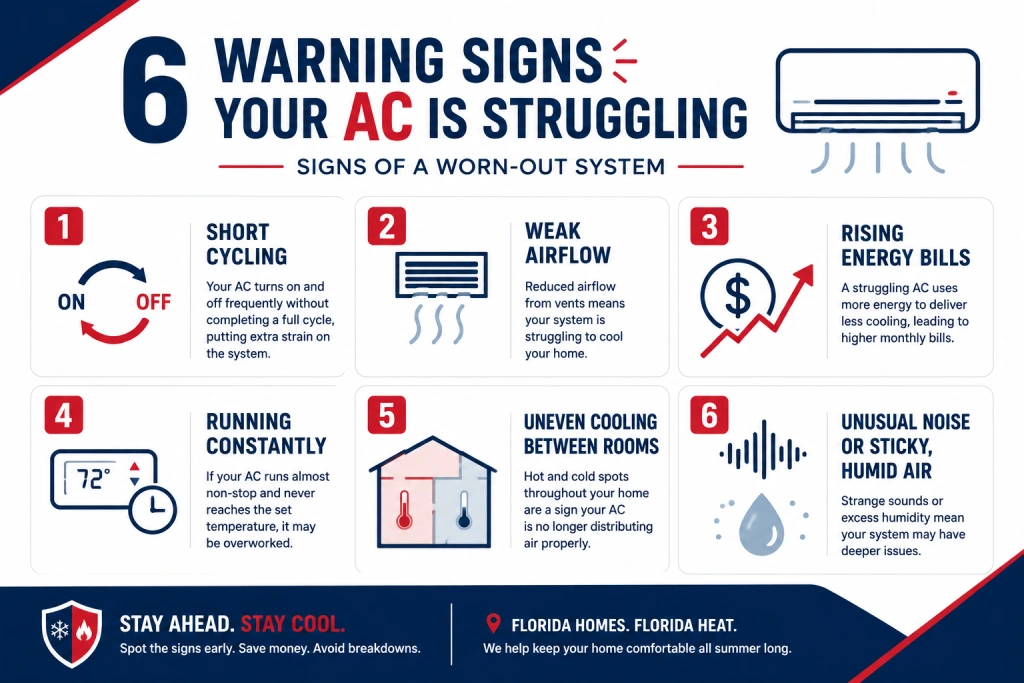
6 Warning Signs Your AC Is Struggling This Late Summer
Most homeowners notice one or two of these before they notice the rest. Watching for all six gives you a clearer picture of whether your system needs a simple tune-up or something more involved.
Where you live in Florida shapes which sign shows up first too. Coastal, high-humidity metros like Miami and Tampa tend to see humidity-related symptoms first, since the system is fighting a heavier latent load on top of temperature. Inland Orlando, with slightly drier air but longer stretches of direct sun, more often sees short cycling and weak airflow first, since the strain there tends to hit the compressor and blower before it hits humidity control.
1. Short Cycling
If your AC turns on, runs a few minutes, and shuts off before the house actually cools, that’s short cycling. It’s often caused by a dirty filter restricting airflow, a dropped refrigerant charge, or a compressor starting to fail. It also spikes your bill, since the compressor draws the most power on startup and a system restarting constantly burns more energy than one running longer, steady cycles.
2. Weak Airflow From the Vents
Hold your hand up to a supply vent. If the airflow feels noticeably weaker than it did in June, the cause is usually a clogged filter, a dirty blower wheel, or leaking attic ductwork. Weak airflow forces the system to run longer to reach the same temperature, which is exactly the strain that turns a minor issue into a compressor problem by season’s end.
3. Rising Bills Without Added Usage
If your thermostat setting and routine haven’t changed but your bill has climbed month over month since June, your system is losing efficiency. Every extra minute of runtime shows up on the bill. Our AC operating cost calculator can show whether your current bill lines up with what a healthy system your size should cost to run.
4. AC Runs Constantly But Never Reaches Setpoint
A healthy Florida AC often runs continuously on the hottest afternoons, but it should still bring the house down to the thermostat setting eventually. If the system runs nonstop and the indoor temperature stalls two or three degrees above setpoint, that’s a strong sign of reduced capacity, whether from low refrigerant, a failing compressor, or a system that was undersized to begin with.
5. Uneven Cooling Between Rooms
One room feeling noticeably warmer than the rest, especially rooms farthest from the air handler, often points to duct leakage, a struggling blower, or a system that has lost enough capacity to only cool the closest rooms well. This tends to get worse through August as overall output keeps declining.
6. Unusual Noises or a House That Feels Sticky
Grinding, squealing, or a hard clunk at compressor startup are mechanical warnings that shouldn’t wait. Rising indoor humidity, even when the thermostat reads fine, often means the system is short cycling too fast to actually pull moisture out of the air. That’s a classic Florida AC humidity problem, and it’s also the first condition that invites mold and mildew indoors.
🔧 Not Sure Which Sign Applies to You
Get a Free Diagnostic Before It Gets Worse
A quick visit from a licensed local technician can tell you in one trip whether you’re looking at a simple tune-up or a bigger repair, before the last stretch of summer puts more strain on the system.
🔒 Free · No obligation · Licensed Florida contractors only
Common Mistakes That Make a Struggling AC Worse
A few homeowner habits show up again and again in late-summer service calls, and most of them turn a manageable fix into a bigger bill.
Lowering the thermostat when the house won’t cool down — setting it to 65°F won’t make a struggling system cool faster, it just adds runtime to a unit that’s already overworked.
Letting a frozen coil keep running — running an iced-up system pushes liquid refrigerant into the compressor, which can turn a $200 repair into a $2,000 one.
Skipping the filter because “it still looks okay” — a filter can look clean on the surface while already restricting enough airflow to freeze the coil.
Skipping annual maintenance to save money — many manufacturer warranties require documented annual service to stay valid, and a skipped record can void coverage on a major failure.
Closing vents in unused rooms — this raises static pressure in the ductwork and can contribute to the short cycling and uneven cooling described above.
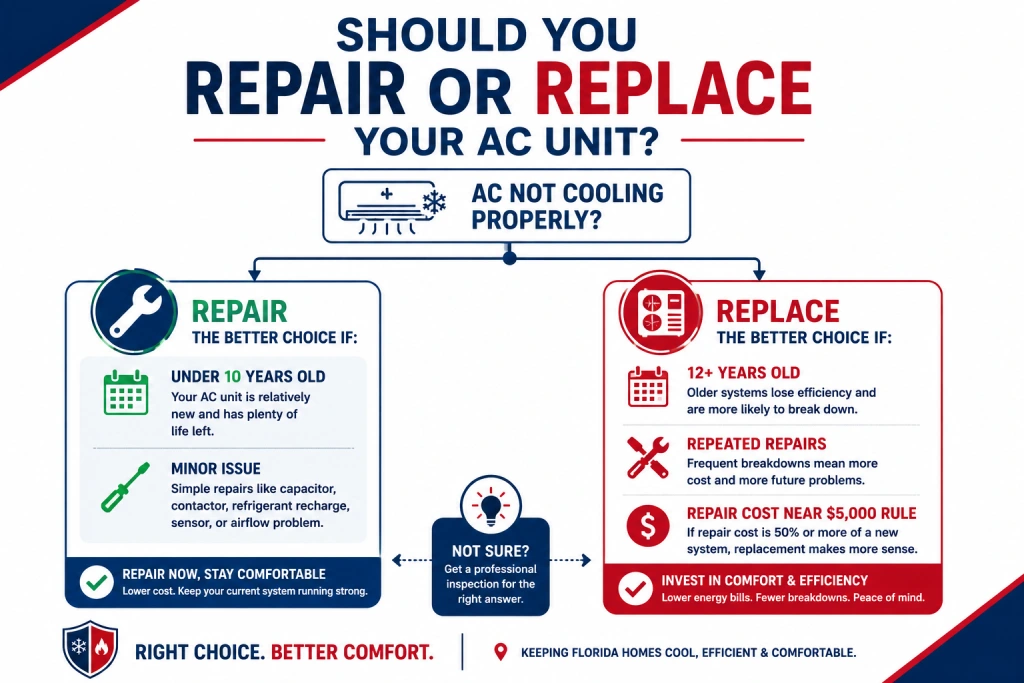
Is It Dirt, a Repair, or Time to Replace?
Not every late-summer symptom means you need a new system. Many of the signs above trace back to something as simple as a dirty filter or a coil that needs a rinse. The table below breaks down what typically causes each sign, how it’s usually fixed, and roughly what to budget for.
Sign You’re Seeing
Likely Cause
Typical Fix
Rough Cost Range
Weak airflow
Dirty filter, dirty coil, or duct leak
Filter change, coil cleaning, or duct sealing
$0 – $450
Short cycling
Low refrigerant, failing capacitor, or oversized unit
Refrigerant check, capacitor replacement
$150 – $600
Rising bills
Reduced efficiency from age or dirt buildup
Tune-up and cleaning, or component repair
$100 – $500
Grinding or squealing noise
Worn motor bearings or a failing compressor
Motor replacement or compressor repair
$300 – $2,500+
12+ years old with repeated repairs
End of typical service life
Full system replacement
$4,500 – $9,500+
Most Florida contractors use some version of the “5,000 rule”: multiply the repair estimate by the age of the unit in years, and if that number tops $5,000, replacement usually makes more financial sense than another repair. Our AC repair cost calculator gives you a ballpark before a technician even arrives.
🧮 Free AC Repair Cost Estimator
Get a Ballpark Repair Cost Before You Call
Not sure if a repair estimate is fair? Use our free AC Repair Cost Calculator to get a realistic price range based on your symptom and system age. It only takes a minute.
Step 1 of 160%
🔧
A/C Repair Cost Calculator
How much will repairing your existing A/C cost? Answer a few questions about what you're experiencing and get a repair cost estimate.
How well has your A/C been cooling your home lately?
Have you noticed large indoor temperature fluctuations?
Is the thermostat on and appears to be functioning properly?
Have you noticed reduced airflow from vents even though the A/C is on?
Have you noticed air coming from vents feels warm?
Is the fan spinning very slowly or not at all on outdoor unit?
Does the air conditioner fan appear to never shut off (outdoor unit)?
Have you noticed strange odours coming from vents or near your furnace?
Have you noticed any unusual noises?
What best describes the unusual noise(s)?
Does your A/C turn on but shuts off soon after?
Does the breaker regularly trip or fuses repeatedly blow?
Have you noticed water damage or water leaking or pooling near your furnace?
Have you noticed ice build up on the refrigerant lines, copper tubing, or coil?
Have your electrical bills been significantly higher than usual lately?
Would you like to receive a free no-obligation estimate from our local contractor partners as well?
Great! Almost done, your result is on the next page.
Please enter your contact details so our Certified contractors can provide estimates as well.
This field is required.
Please enter a valid email address.
Please enter your phone number.
Please enter your city or ZIP code.
By submitting this form, you are giving your consent to receive phone calls and text messages from our contractor partners.
You're almost done!
Please provide your details to see your results.
Name is required.
Email is required.
Please enter your city or ZIP code.
🔧 Diagnosis Complete
Your A/C Repair Estimate
Estimated Repair Range
—
Likely Issue
—
Get an Accurate Repair Quote
A certified HVAC technician can diagnose the exact issue and provide a firm quote. Many offer free diagnostics.
If the numbers point toward replacement, our guide on AC installation cost in Florida breaks down what a new system runs by tonnage and SEER2 rating. It's worth factoring in the efficiency gap too: newer equipment must meet a higher SEER2 minimum than systems installed even five or six years ago. Our SEER2 rating comparison guide shows what that difference actually saves on a typical Florida bill, and systems carrying the ENERGY STAR label clear the efficiency floor by a comfortable margin.
🚀 Compare Before You Commit
Get 2–3 Local Quotes in Minutes
Whether it turns out to be a repair or a replacement, every contractor in our network is Florida-licensed, insured, and background-checked. Compare real numbers before you agree to anything.
🔒 Free · No obligation · Licensed Florida contractors only
DIY vs. Professional: What's Safe to Try Right Now
Once you've spotted a sign, the next question is usually "can I try this myself, or should I wait for a pro?" Here's the honest split, based on what a licensed technician would actually be comfortable walking a homeowner through over the phone.
Situation
Safe to Try Yourself
Call a Pro Instead
Weak or reduced airflow
Replace the filter, clear debris from the condenser
If airflow doesn't improve after a filter change
System short cycling
Check the thermostat batteries and settings
If it persists after a reset, likely refrigerant or a part
Ice on the coil or lines
Switch to Fan Only and let it thaw fully
Never recharge or open the sealed system yourself
Standing water near the air handler
Clear the condensate line with a wet-dry vac
If water keeps returning after clearing it
Grinding, sparking, or burning smell
Turn the system off at the breaker
Always — this is never a homeowner fix
Refrigerant handling in particular is federally regulated. Only an EPA Section 608 certified technician can legally recover, recharge, or repair a sealed refrigerant system, so this is never a homeowner fix regardless of how simple it looks on a YouTube video.
As for waiting until after summer: don't. Florida's cooling season runs well into October for most of the state, so a system already struggling in July has two or three more months of heavy demand ahead of it, not a break to recover.
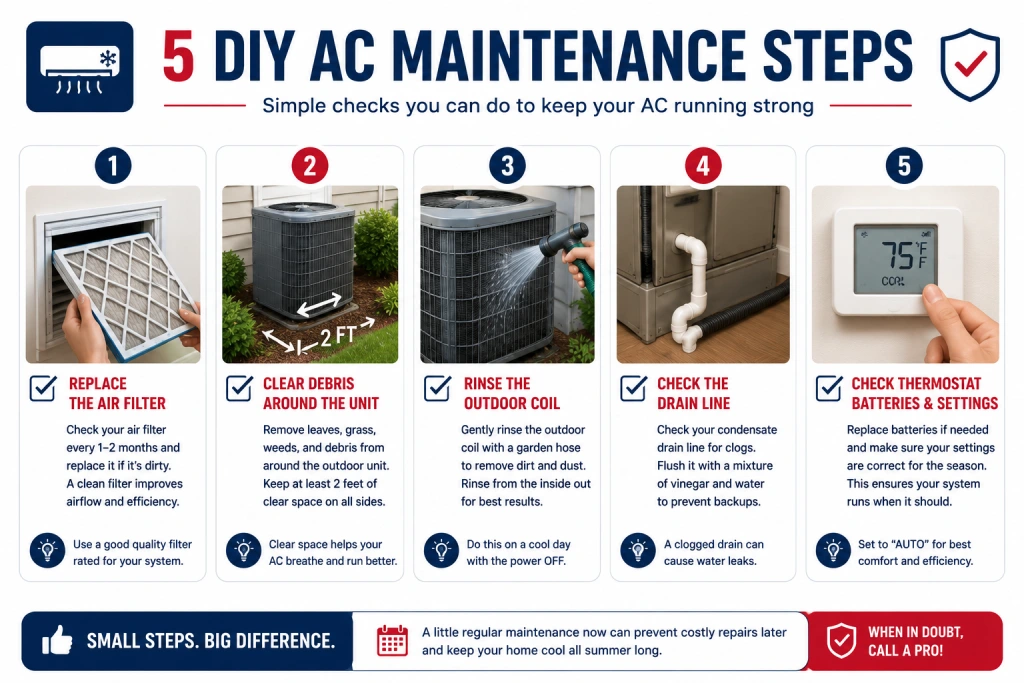
Simple Maintenance You Can Do This Weekend
Before you assume the worst, a handful of maintenance steps take under an hour combined and resolve a meaningful share of late-summer complaints on their own.
Replace the air filter. Check the size on the frame and swap it out even if it doesn't look heavily soiled. This is the single highest-value five minutes you can spend on your system.
Clear the area around the outdoor condenser. Grass clippings, mulch, and overgrown shrubs within two feet restrict the airflow it needs to release heat.
Rinse the outdoor coil with a garden hose. A gentle rinse from the top down, power off, clears surface dust and pollen. Skip the pressure washer, since it can bend the aluminum fins.
Check the condensate drain line. Standing water or a musty smell near the indoor air handler means the line needs to be cleared before it trips the safety switch.
Confirm the thermostat batteries and settings. A thermostat low on battery power or set to "on" instead of "auto" for the fan can mimic several signs above with no mechanical problem at all.
If you work through this list and the symptoms persist, that's a reliable signal you're dealing with something beyond routine maintenance, whether that's a refrigerant issue, an electrical component nearing failure, or a system reaching the end of its service life.
What Happens If You Ignore These Signs Into September?
A minor issue left unaddressed tends to compound. Low refrigerant causing a small capacity drop in July can lead to a frozen evaporator coil by September, which restricts airflow further and can damage the compressor if the system keeps running that way. A capacitor that's weak but still functioning today is a common cause of a no-cool emergency call a few weeks later, usually on the hottest day of the month.
There's an indoor air quality cost too. A system that's short cycling or losing capacity struggles to pull humidity out of the air even when the temperature feels acceptable. Florida homes sitting at 60 percent humidity or higher for extended periods create exactly the conditions mold and dust mites need to thrive, according to the EPA's guidance on indoor moisture control.
There's also a scheduling cost that's easy to overlook. A homeowner who calls for a routine tune-up in August can usually get an appointment within a day or two. A homeowner whose system fails completely in September is competing with every other emergency no-cool call in the area, which often means a longer wait, a higher after-hours rate, or both.
What a Florida Contractor Checks During a Late-Summer Inspection
A proper late-summer service call goes well beyond a filter swap. A thorough technician is doing detective work, ruling out the cheap and common causes before touching anything involving refrigerant. Here's what a licensed Florida HVAC technician typically checks:
Refrigerant charge and subcooling — confirms the system has the correct refrigerant level for its rated capacity.
Electrical components — tests the capacitor, contactor, and wiring for wear from months of daily cycling.
Condensate drain line — clears algae and buildup that commonly clog drains in Florida's humidity.
Evaporator and condenser coils — checks for dirt buildup that reduces heat transfer and cooling capacity.
Airflow and duct static pressure — verifies the blower and ductwork are moving the air the system was designed for.
Thermostat calibration — confirms the thermostat is reading and controlling temperature accurately.
If you want to walk through your own symptoms before scheduling anyone, our AC troubleshooting wizard below asks a few quick questions and points you toward the most likely cause.
🔍 Free AC Troubleshooting Wizard
Find Your Most Likely Cause in Under a Minute
Answer a few quick questions about what your system is doing and the wizard will point you toward the most likely cause, before you decide whether to call anyone.
Step 1 of 50%
🔍
AC Troubleshooting Wizard
Which AC issue are you having? Answer a few quick questions to help identify the most likely cause of your air conditioner problem and what to do next.
When you check your thermostat, what do you notice?
What sound do you hear from your AC unit?
How is the airflow from your vents?
When did you last have professional maintenance?
Would you like to receive a free no-obligation estimate from our local contractor partners as well?
Great! Almost done, your result is on the next page.
Please enter your contact details so our Certified contractors can provide estimates as well.
This field is required.
Please enter a valid email address.
Please enter your phone number.
Please enter your city or ZIP code.
By submitting this form, you are giving your consent to receive phone calls and text messages from our contractor partners.
You're almost done!
Please provide your details to see your results.
Name is required.
Email is required.
Please enter your city or ZIP code.
🔍 Diagnosis Ready
AC Troubleshooting Results
Most Likely Cause
—
Get a Certified Tech to Confirm
Our diagnosis is a starting point. A certified HVAC technician can confirm the issue and fix it right the first time.
If your system does need repair or replacement, working with a licensed, EPA-certified contractor matters, both for the quality of the work and for keeping any manufacturer warranty valid. Our directory of qualified HVAC contractors can connect you with a local pro who services your area.
🇺🇸 Ready When You Are
Get Connected With a Licensed Florida Tech Today
Tell us what your system is doing and we'll match you with a background-checked contractor who can confirm the diagnosis and get it fixed right, before September's heat puts any more strain on it.
🔒 Free · No pressure · Florida-licensed contractors only
An AC that's not cooling properly by late summer is usually telling you it has worked hard for months, not that it has failed completely. Catch the signs now, while there's still cooling season left, and you get to choose a straightforward repair instead of an emergency replacement in September. For more Florida-specific guides like this one, browse our full resources library.
Frequently Asked Questions
Why does my AC blow warm air sometimes?
Warm air in short bursts usually means the compressor is cycling off while the blower keeps running, which can happen with a failing capacitor, a tripped high-pressure safety switch, or low refrigerant. If the air stays warm consistently rather than in short bursts, check your thermostat mode and outdoor breaker first, since those are the most common simple causes.
Is ice on my AC line normal?
No. Ice on the refrigerant line or the indoor coil means airflow is restricted or refrigerant is low, and it's a sign to shut the system off and let it thaw rather than keep running it. Running an iced-up system can flood the compressor with liquid refrigerant and cause expensive damage.
How long should an AC run per cycle in Florida?
On a typical Florida summer afternoon, a properly sized system often runs 20 to 40 minutes per cycle, and it's common for it to run nearly continuously during the hottest part of the day. A cycle shorter than 10 minutes, repeated over and over, points to short cycling rather than normal operation.
Why does my AC run constantly but never cool the house?
This usually means the system has lost capacity relative to the cooling load, most often from low refrigerant, a dirty condenser coil, or ductwork that's leaking conditioned air before it reaches the rooms. It can also mean the system was undersized for the home to begin with, which a Manual J load calculation can confirm.
Should I repair or replace an AC that's over 10 years old?
As a general guideline, if your system is past 12 to 15 years old and the repair estimate is climbing into the thousands, replacement usually pays off faster through lower energy bills alone. A system under 10 years old with a single, moderate repair is almost always worth fixing rather than replacing.
Can a dirty air filter really cause all these symptoms?
Yes. A clogged filter restricts airflow across the evaporator coil, which can lower capacity, cause short cycling, allow the coil to freeze, and force the system to run longer for less cooling. It's the most common, and cheapest, cause of late-summer performance complaints, which is why checking it is always the first troubleshooting step.