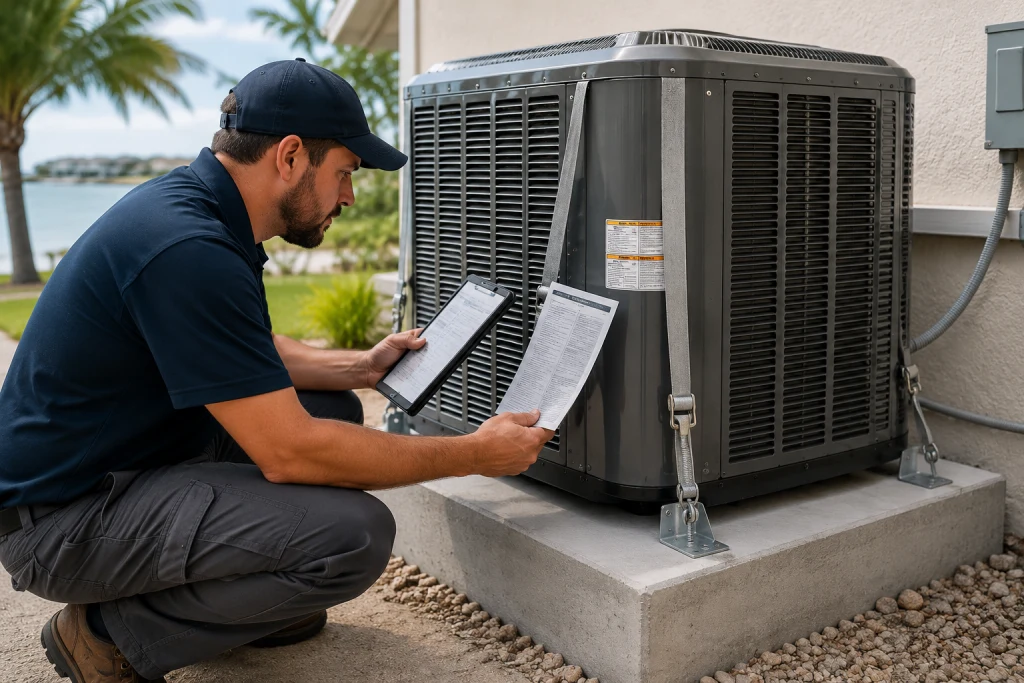
AC installation scams in Florida can cost homeowners thousands of dollars on a single bad decision, and most of them do not look like scams at the moment they happen. They look like a friendly salesman, a “today only” discount, and a contract you sign because the house is 88 degrees and you just want cold air again. This guide breaks down exactly how those quotes go wrong, what a fair Florida installation actually costs, and the questions that separate a licensed professional from someone who will disappear after taking your deposit.
Three red flags worth watching immediately are: a salesperson who will not give you a Florida license number in writing, pressure to sign the same day to “lock in” a price, and a quote that lands far below the Florida benchmark range of $4,500 to $14,500 installed. If you see any one of these, stop and read on before you sign anything.
Written by the ACPrices.com Editorial Team•Technical review: Florida HVAC licensing and installation requirements reviewed against current DBPR and Florida Building Commission guidance•Consumer-rights references checked against current Florida Statutes•Updated: August 2026
This applies whether you’re getting quotes in Miami-Dade, Orlando, Tampa Bay, Jacksonville, Fort Lauderdale, or St. Petersburg. Florida’s contractor licensing law is set at the state level, so the license verification steps below work the same way no matter which city you’re in, though permit administration and some product-approval rules do vary by county, which we cover in the sections below.
What Are the 10 Most Common AC Installation Scams in Florida?
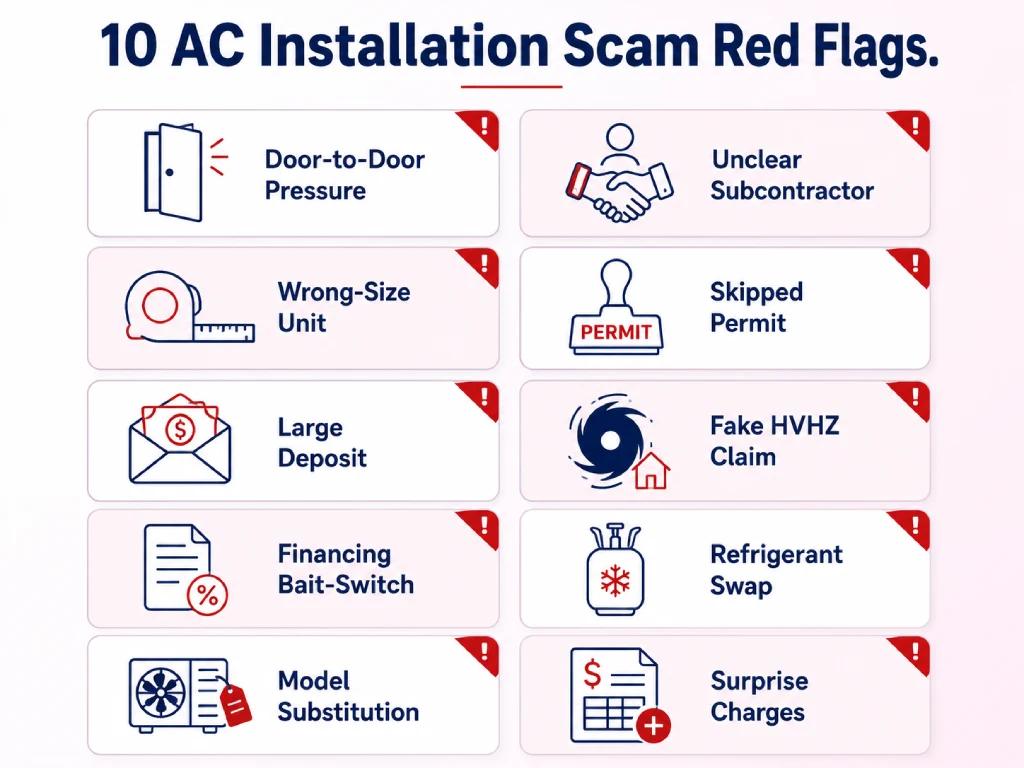
Florida’s near year-round cooling season makes it a magnet for AC installers, and most of them are honest, licensed businesses. But the same demand that supports thousands of legitimate contractors also draws in a smaller group who rely on heat, panic, and unfamiliarity with local code to push through bad deals. Here are the ten patterns our team sees reported most often by Florida homeowners.
The door-knocker “storm damage” pitch. After a hurricane watch or a heavy summer storm, some crews go door to door claiming your outdoor unit looks damaged and needs immediate replacement. Door-to-door selling is not automatically proof of a scam, plenty of legitimate businesses market this way. The real red flag is an unsolicited damage claim paired with pressure to sign immediately, or a refusal to provide verifiable license credentials on the spot.
The unclear subcontractor handoff. Subcontracting itself is not automatically suspicious, but problems arise when the licensed company hands off the installation without clearly identifying who is actually performing the work or who is responsible for it. Ask who will pull the permit, who will physically perform the installation, and whose license covers the work, before you sign.
The undersized or oversized “deal” unit. A rock-bottom price often means a system sized off a rough guess rather than a Manual J load calculation. An undersized 2-ton unit crammed into a home that needs 3.5 tons will run constantly and never quite cool the house, while an oversized unit short-cycles and leaves rooms humid.
The permit skip. AC replacement generally requires a mechanical permit through the local building department, though the specific process, fees, and any exemptions can vary by county and municipality. Some installers quietly skip this step to shave a day off the timeline and keep their price competitive. Ask your contractor directly which permit applies to your address and who is responsible for pulling it, since skipping it becomes the homeowner’s problem at resale, when an unpermitted AC swap shows up during a buyer’s inspection.
The deposit-and-disappear. A large upfront deposit, sometimes the full contract amount, is collected before any equipment arrives. Weeks pass with no install date, then the company stops answering calls.
The fake HVHZ compliance claim. In Miami-Dade and Broward County, outdoor equipment and mounting hardware must carry High Velocity Hurricane Zone product approval. Some installers verbally claim compliance without providing the actual product approval documentation, which can fail inspection later.
The financing bait and switch. A homeowner is quoted one cash price, then steered toward a financing plan with a much higher effective cost once interest, origination fees, and a “same as cash” deadline are factored in. The monthly payment sounds manageable, but the total paid over the loan term can run well above a competing cash quote.
Undisclosed refrigerant substitution. With the industry-wide shift toward R-454B refrigerant, ask which refrigerant the quoted system uses and confirm the equipment is approved for it. Installing a refrigerant that differs from the manufacturer’s specified requirements, or handling it improperly, can void the warranty and create a safety issue, so this is worth confirming in writing rather than accepting a verbal assurance.
The equipment model substitution. The signed contract names one brand and model, but a different or lower-tier unit shows up on install day, sometimes with a verbal explanation that it’s “basically the same.” Compare the model number on the installed equipment’s data plate against what’s written on your contract before you sign off on the job.
The surprise change-order charges. The initial quote looks complete, but extra charges for disconnecting the old unit, line-set work, electrical changes, disposal, or startup and commissioning appear only after work has started. These items should be disclosed in the original scope, not introduced once you’re already committed.
⚠️ Red Flag: If a salesperson will not put their Florida license number on your written quote before you sign, that alone is reason enough to walk away and call the next contractor on your list.
The ten warning signs covered in this guide, from door-to-door pressure tactics to surprise change-order charges.
What ties most of these patterns together is urgency. A legitimate Florida contractor with a full schedule during peak summer months does not usually need to close you on the spot, because they already have next week’s calendar filled with homeowners who took the time to compare. The instinct to rush is almost always coming from the sales side of the table, not from any real mechanical necessity.
None of this means you should assume every quote below the average is a scam. It means low price alone is not information. You need context, and that context starts with knowing what a real Florida installation costs.
How Do You Know If a Quote Is Too Good to Be True?
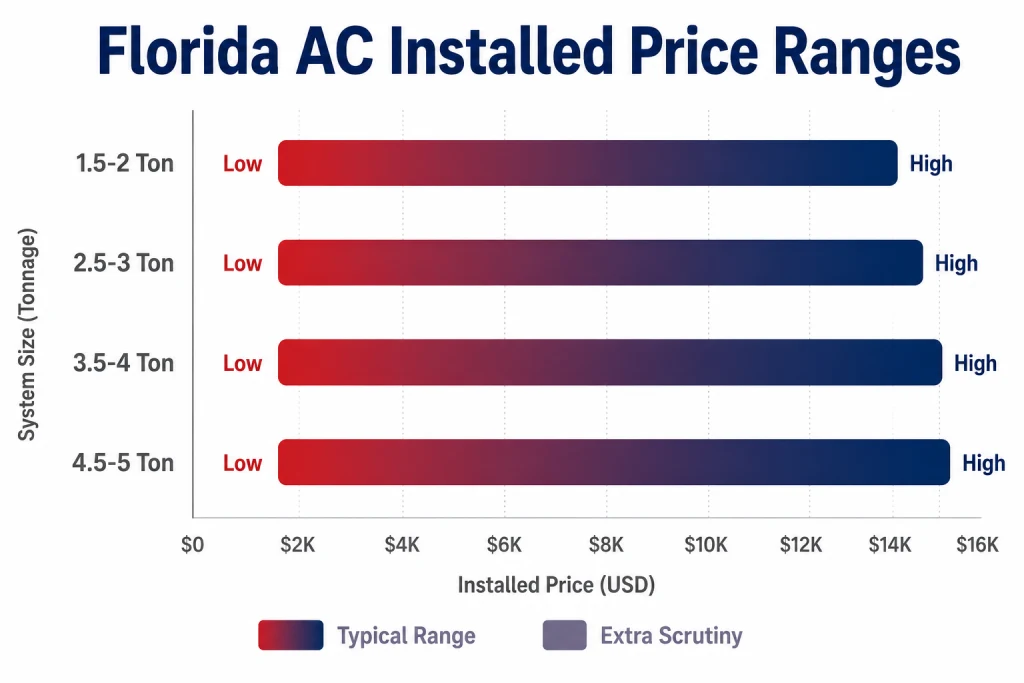
A quote is worth questioning when it sits meaningfully below what licensed Florida contractors are actually charging for the same tonnage and efficiency tier in 2026. Here is the realistic range by system size, along with a screening threshold that should prompt extra questions rather than an automatic rejection.
📋 How We Built These Price Ranges: These are editorial benchmark ranges based on contractor pricing reviewed by ACPrices.com across Miami-Dade, Broward, Orlando, and Tampa Bay, for like-for-like replacements with existing ductwork in good condition. They include equipment, standard labor, and a mechanical permit for systems in the code-minimum through mid-range 16 to 17 SEER2 tiers. They exclude ductwork repair or replacement, electrical panel upgrades, HVHZ product-approval premiums, and financing costs, all of which can move the number higher. They cover the four major markets listed above rather than every Florida county, so treat them as a benchmark to compare against, not a statewide average. The “extra scrutiny” thresholds are an editorial screening guide, not an official Florida pricing limit.
System Size (Tonnage)
Realistic Installed Range
Price That Deserves Extra Scrutiny
1.5–2 ton
$4,500 – $9,000
Under $3,500
2.5–3 ton
$6,000 – $11,000
Under $4,500
3.5–4 ton
$7,500 – $13,000
Under $5,500
4.5–5 ton
$9,000 – $14,500+
Under $6,500
A quote landing in the “extra scrutiny” column is not automatically fraudulent. A lower number can be legitimate if the equipment tier, installation scope, seasonal promotion, or available rebates genuinely differ from the assumptions above. Treat it as a prompt to ask more questions, not as proof of a scam.
Not sure which tonnage column applies to your home in the first place? Sizing scams and honest sizing mistakes both hide behind the same excuse, a contractor who never actually calculated your load. Run your square footage and home details through our free AC Size & Tonnage Calculator before anyone quotes you a tonnage number.
📏 Free AC Sizing Check
Confirm the Tonnage Before You Trust a Quote
Use our free AC Size & Tonnage Calculator to estimate the recommended system capacity for your home based on square footage and key sizing factors. If a contractor’s quoted tonnage is wildly different from this estimate, that’s your cue to ask why.
Step 1 of 30%
📐
A/C Size Calculator
This short quiz is designed to help homeowners estimate the correct central air conditioning system size and BTU rating for your home.
Select your home type
Approximate home square footage of finished living space
Would you like to receive a free no-obligation estimate from our local contractor partners as well?
Great! Almost done, your result is on the next page.
Please enter your contact details so our Certified contractors can provide estimates as well.
This field is required.
Please enter a valid email address.
Please enter your phone number.
Please enter your city or ZIP code.
By submitting this form, you are giving your consent to receive phone calls and text messages from our contractor partners.
You're almost done!
Please provide your details to see your results.
Name is required.
Email is required.
Please enter your city or ZIP code.
📐 Size Calculated
Your Recommended AC Size
Recommended Tonnage
—
BTU Output
—
Get a Confirmed Size from a Pro
A certified HVAC contractor performs a Manual J load calculation for exact sizing.
Whatever the tonnage turns out to be, a low quote should still trigger three specific questions before you sign: what SEER2 rating is actually being installed, is the price contingent on financing terms buried in the fine print, and does the number include the mechanical permit or is that an add-on you'll discover later.
It excludes the permit fee. Permit fees vary by county and municipality, so confirm the current fee with the building department handling your address. A quote that looks cheap but adds a permit fee back later is not actually cheaper.
It quotes equipment below Florida's applicable SEER2 floor. For split-system air conditioners installed in the Southeast region, which includes Florida, the federal minimum depends on cooling capacity. Systems under 45,000 Btu/h generally must meet 14.3 SEER2, while larger systems at or above that capacity have a different minimum. A contractor cannot legally install below the applicable floor for the equipment's capacity, so verify the specific rating for your system size rather than assuming one number applies to everything.
It skips the load calculation. A price built from a phone conversation about square footage, with no attic walkthrough or Manual J calculation, is a guess dressed up as a number.
It has no line-item breakdown. One flat number with no equipment model listed makes it easy to substitute a cheaper unit than what was verbally promised.
Financing deserves its own scrutiny here. A cash price and a financed price are not the same number wearing different clothes. Ask each contractor for the total amount you will actually repay over the full loan term, not just the advertised monthly payment, and get the interest rate and any deferred interest terms in writing. A "0 percent for 18 months" promotion can flip to a much higher retroactive rate if the balance is not paid in full before the deadline, and that fine print rarely gets read out loud during a sales pitch.
💰 Free Cost Check
See What Your Exact System Should Cost
Enter your tonnage, SEER2 tier, and city into our free AC Cost Calculator to get a fair installed price estimate. Hold every quote you receive up against this number before you sign anything.
Step 1 of 70%
❄️
Air Conditioner Cost Calculator
How much is adding or upgrading your existing A/C going to cost? Get a new air conditioner price estimate instantly with this short quiz.
What size AC unit do you need (tons)?
1 ton = 12,000 BTU. Most homes need 2–3 tons.
2.5 tons
1 tons5 tons
Which efficiency rating do you prefer (SEER)?
Higher SEER = more efficient = lower energy bills, but higher upfront cost.
Do you need additional ductwork installation?
Do you need installation included?
Do you want a smart thermostat included?
Do you want noise reduction upgrade?
Would you like to receive a free no-obligation estimate from our local contractor partners as well?
Great! Almost done, your result is on the next page.
Please enter your contact details so our Certified contractors can provide estimates as well.
This field is required.
Please enter a valid email address.
Please enter your phone number.
Please enter your city or ZIP code.
By submitting this form, you are giving your consent to receive phone calls and text messages from our contractor partners.
You're almost done!
Please provide your details to see your results.
Name is required.
Email is required.
Please enter your city or ZIP code.
❄️ Estimate Ready
Your Air Conditioner Cost Estimate
Equipment Cost
—
Total Estimated Cost
—
Get Accurate Quotes from Local Pros
These are estimates. Get precise quotes from certified HVAC contractors in your area — for free.
Check whether your equipment tier, tonnage, and installation scope are actually comparable to other Florida quotes before you decide if the price is fair.
Free · No obligation · ACPrices.com may be compensated if you request quotes through our contractor network. See our disclosure at the end of this article.
What Should a Legitimate Florida HVAC Contract Include?
A legitimate Florida HVAC contract should read like a specification, not a sales flyer. If any of the items below are missing, ask for them in writing before you sign, not after.
The contractor's Florida license number, printed directly on the contract, matching either a CAC (Certified Air Conditioning Contractor) or RA (Registered Air Conditioning Contractor) classification.
The exact equipment being installed, including brand, model number, tonnage, and SEER2 rating for both the indoor and outdoor unit, not just "high-efficiency system."
Confirmation that a mechanical permit will be pulled in the homeowner's or the contractor's name, and who is responsible for scheduling the final inspection.
HVHZ product approval documentation, if you're in Miami-Dade or Broward County, for the outdoor unit, pad, and any roof-mounted line set penetrations.
A written warranty breakdown covering parts, labor, and the manufacturer's coverage separately, since these often run on different timelines.
A payment schedule tied to milestones, not a single large deposit collected before any work or equipment delivery happens.
A start date and estimated completion date, in writing, with language covering what happens if either slips.
💡 Pro Insight: For split systems, verify the certified rating for the specific indoor and outdoor combination rather than relying only on the outdoor unit's rating. Ask for the AHRI certificate or certified combination number for the exact equipment being quoted, since a mismatched combination can fail to meet the applicable efficiency floor even if the outdoor unit's sticker looks impressive on its own.
A common pattern in installation disputes is a contract signed the same day the estimate was given, under time pressure, without a second set of eyes reading the fine print.
Here's what that looks like in practice. A homeowner in a two-story home near Tampa gets a same-day quote listing only "4 ton high-efficiency system, $8,900 installed." No brand, no SEER2 number, no mention of a permit. She asks the salesperson to add the equipment model and permit language before signing, and the price suddenly jumps to $10,400. That jump is not a bait and switch by itself, since a real quote should reflect real equipment. It's a sign the original number was written to look attractive first and accurate second, which is exactly the order those two priorities should never come in.
How Many Quotes Should You Get Before Signing?
For a major AC replacement, comparing two or three detailed quotes is a practical way to identify differences in equipment, scope, and pricing before you commit. Homeowners who take the time to compare consistently spot discrepancies that a single quote never reveals, and two or three is usually enough to catch an outlier without dragging the process out for weeks.
Here's what to do with those quotes once you have them. Rather than comparing bottom-line numbers, line the quotes up side by side using the same categories for each:
Quote Item
Quote A
Quote B
What to Check
Brand / model
Exact model number, not just brand name
Tonnage
Backed by a load calculation, not a guess
SEER2 rating
Matched indoor/outdoor system, per AHRI
Permit
Included in the price and who pulls it
Labor scope
What exactly is covered
Warranty
Parts and labor listed separately
Thermostat
Included or an add-on
Electrical work
Included if a circuit or panel upgrade is needed
Old unit removal
Included or a separate haul-away fee
Startup / commissioning
Refrigerant charge and airflow verified on-site
Financing total
Full repayment amount, not just the monthly figure
Fill in each column as quotes come in. A gap in tonnage, SEER2, or scope explains a price difference. A gap with no explanation at all is the one worth asking about directly.
Line up the equipment, not just the price. A $9,500 quote for an 18 SEER2 system and a $9,000 quote for a 14.3 SEER2 system are not comparable numbers, even though they look close.
Flag an outlier before dismissing or accepting it. If one quote is dramatically different from the others, ask that contractor directly what accounts for the gap.
Ask each contractor the same questions so you're comparing answers apples to apples: load calculation method, permit inclusion, warranty terms, and estimated timeline.
Do not tell one contractor another contractor's exact price before they've submitted their own. It invites a number engineered to just barely undercut, rather than an honest quote.
If you'd rather skip the legwork of sourcing quotes on your own, our Florida contractor network can help you compare quotes from contractors whose licensing information has been reviewed by ACPrices.com. You can also check current benchmark pricing in our full AC installation cost Florida guide or review brand and warranty differences before you fill in the table above.
Give yourself a realistic timeline where possible. A fully failed AC system in July with no cooling at all is an emergency and a same-week decision is understandable. But a system that is aging and merely running less efficiently gives you room to collect quotes over a week or two without discomfort, and that extra time is often what separates homeowners who negotiate a fair deal from those who accept the first offer out of exhaustion.
How Do You Verify a Contractor's License in Florida?
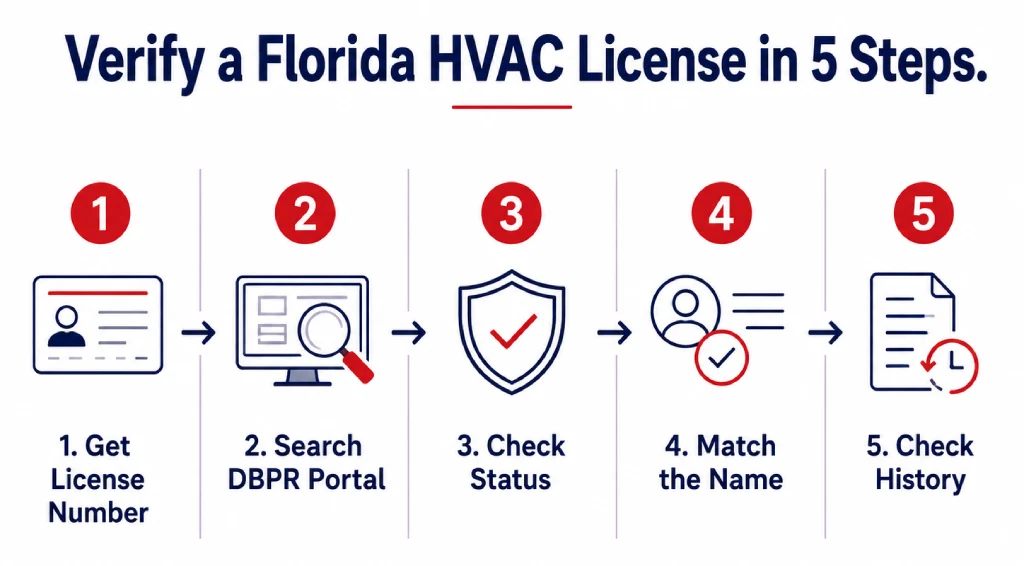
Florida HVAC licensing is handled at the state level by the Department of Business and Professional Regulation (DBPR), which means the same lookup process works whether you're hiring in Jacksonville or Fort Lauderdale. Verifying a license takes about five minutes and is the single highest-value step in this entire guide.
✅ Official Florida License Verification: Verify any contractor's license directly through the Florida DBPR license search. This is the state's own system, not a third-party directory, and it's the fastest way to confirm a license is real and current before anyone sets foot on your property.
Get the license number and the business name exactly as it appears on the contractor's quote or business card.
Search the DBPR license verification portal using either the license number or the business name to confirm the license is current and in the correct classification (CAC or RA).
Check the status field carefully. "Current, Active" is what you want. "Delinquent," "Suspended," or "Null and Void" all mean the license is not currently valid to legally perform work.
Confirm the name on the license matches the name on your contract. A common tactic is quoting under one licensed company's name while a different, unlicensed crew performs the actual work.
Review any disciplinary history or other public enforcement information associated with the license, which the DBPR portal also displays.
It's also worth a quick search on the Better Business Bureau for pattern complaints, since a single bad review is normal for any active business, but a cluster of similar complaints about deposits, missed timelines, or vanishing crews is a real signal.
It also helps to understand the difference between the two license types you'll see. A CAC (Certified Air Conditioning Contractor) license is issued by the state and allows a contractor to work anywhere in Florida. An RA (Registered Air Conditioning Contractor) license is issued locally and typically restricts that contractor to working within the specific county or municipality where they registered. Neither type is inherently more trustworthy than the other, but if an RA-licensed contractor is quoting a job outside their registered jurisdiction, that's worth a direct question before you sign, since it may mean the work is technically outside what their license covers.
A contractor license and a building permit are two different checks. Confirm that the person or company performing the HVAC work holds the appropriate Florida air-conditioning contractor license (CAC or RA), and separately confirm whether the installation requires a permit for your address and who is responsible for pulling it. Confirming the license through DBPR does not replace confirming the permit. For more on how the equipment itself factors into a legitimate quote, see our AC equipment sizing guide.
🔎 Find Licensed Contractors
Compare Contractors After You've Verified Their License
Once you've checked a license status yourself, compare that contractor against 2 to 3 others in our network who are already Florida-licensed and insured, so you're not starting your search from zero.
🔒 Free · No obligation · We recommend verifying any contractor's license independently, whether you find them through us or elsewhere.
What Are Your Rights If You've Already Been Overcharged?
If you've already signed and now suspect you overpaid, were sold a mismatched system, or paid a deposit to a company that stopped responding, you still have real options. Move through these in order.
Re-read your contract's cancellation terms first. For qualifying home-solicitation sales, such as a contract signed at your home away from the contractor's regular place of business, Florida law (Chapter 501, Florida Statutes) generally provides a right to cancel until midnight of the third business day after signing. The definition of a qualifying sale and its exclusions matter, so check whether your specific transaction fits before assuming this applies, and act quickly if the deal was recent.
Dispute the charge with your card issuer or bank if you paid by credit card and the work was never completed or was substantially different from what was contracted. Chargebacks have their own filing windows, so don't wait.
File a complaint with the DBPR against the license number on your contract. Even if the amount in dispute is small to a state agency, a documented pattern of complaints is what triggers enforcement action against repeat offenders.
Report it to the Florida Attorney General's Office and the Federal Trade Commission if the situation involves fraud, high-pressure sales tactics, or an unlicensed contractor. These reports build the case history that consumer protection agencies use to act on repeat bad actors.
Contact your county's building department if you suspect no mechanical permit was pulled. They can confirm permit status by address and, in some cases, require the contractor to come back and complete the process correctly.
Keep every document. The original quote, the signed contract, texts or emails, and photos of the installed equipment's model and serial number all matter if the dispute escalates to small claims court.
⚠️ Don't Wait to Act: Consumer protection windows, chargeback deadlines, and Florida's three-day cancellation right are all time-sensitive. The longer you wait after signing or paying, the fewer options remain on the table.
None of these steps require a lawyer to start. Most begin with a phone call or an online form, and starting the process quickly is more important than having every document perfectly organized on day one.
If the amount in dispute falls within Florida's small-claims jurisdiction, you can also consider small claims court, which generally does not require an attorney. Check the current Florida Courts rules and your local clerk's requirements before filing. It is a slower path than a chargeback, but the documentation trail you build in the earlier steps is exactly what makes a small claims case straightforward to present.
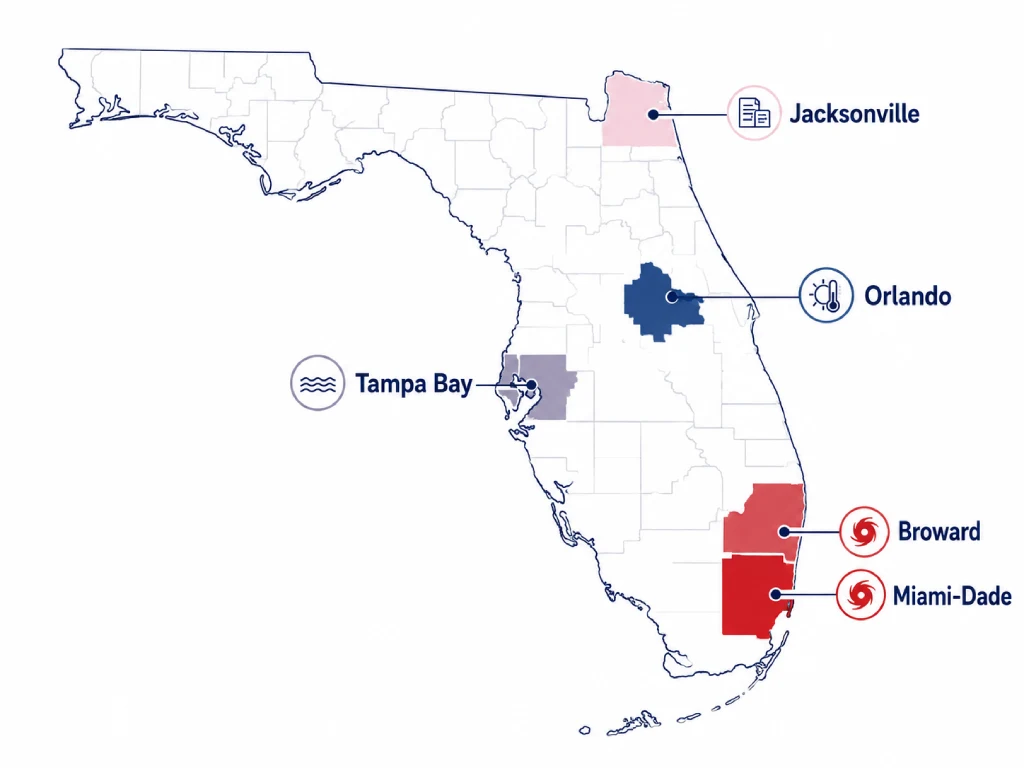
What Regional Risks Should You Watch For Across Florida?
Statewide licensing rules apply the same way everywhere, but what a contractor needs to get right on-site shifts by region. Here's what to check depending on where in Florida you're located.
Region
What to Confirm Before You Sign
Miami-Dade
Required: HVHZ product approval documentation for the outdoor unit and mounting hardware. Recommended: ask whether corrosion-resistant coil coating is appropriate for your property's salt-air exposure.
Broward
Required: HVHZ product approval documentation, plus wind-load rated anchoring for the installation. Recommended: confirm the specific product approval covers your exact equipment and mounting method.
Tampa Bay
Recommended: ask whether corrosion-resistant coating is appropriate for coastal exposure, and confirm condensate drainage is sized correctly for the specific installation.
Jacksonville
Recommended: confirm local permit turnaround times and which county or municipal building department handles your specific address.
Orlando / Central Florida
Recommended: pay close attention to load calculation accuracy given long, humid cooling seasons, since undersizing shows up faster here than in milder climates.
Other coastal counties
Recommended: product approval requirements can differ from the Miami-Dade/Broward HVHZ, so confirm what actually applies to your address rather than assuming those rules apply statewide.
None of this changes how you verify a license or read a contract, those steps are identical statewide. It changes what documentation you should expect a contractor to hand you without being asked twice.
Bottom Line: Protecting Yourself Before You Sign
Many Florida AC installation problems can be traced back to one of two moments: signing under pressure without checking a license, or accepting a number without checking it against a realistic range for the tonnage and efficiency involved. Both are largely preventable with a five-minute DBPR search and a quick comparison against current pricing benchmarks.
Before you sign anything in 2026, confirm the license, get the equipment specifics in writing, and compare at least two or three quotes. Those habits can help you catch many of the scams and shortcuts covered in this guide, and they cost you nothing but a little patience on a hot day.
🇺🇸 Ready to Compare?
Request 2–3 Quotes and Compare What's Actually in Them
Tell us a bit about your home and we'll connect you with contractors in our Florida network. Compare their equipment, permits, warranties, and total installed cost, not just the headline price, and verify each contractor's license status yourself before you sign.
🔒 Free · No pressure · See our compensation disclosure below.
💬 How ACPrices.com Makes Money: ACPrices.com may receive compensation when homeowners request quotes through our contractor network. This does not affect the advice in this guide, and it doesn't change our recommendation to compare multiple contractors and verify any license independently through DBPR before signing, whether or not you find that contractor through us.
Sources & Methodology
Claims in this guide about licensing, permitting, and consumer rights were checked against the following official sources at the time of publication. Rules and fee schedules can change, so verify current details directly before relying on them for a legal or financial decision.
Is it normal to pay a deposit before AC installation in Florida?
A partial deposit, often 10 to 30 percent, is normal to order equipment. Paying the full contract amount upfront, before any work or equipment delivery, is a major red flag.
What's a fair Florida AC install price range in 2026?
ACPrices.com uses a benchmark range of roughly $4,500 to $14,500 for the installation scenarios described in this guide. Actual pricing varies by tonnage, efficiency, equipment, location, installation scope, and permit requirements.
Can I cancel an AC installation contract after signing?
For qualifying home-solicitation sales, such as a contract signed at your home away from the contractor's place of business, Florida law generally allows cancellation until midnight of the third business day. Check whether your transaction qualifies and act quickly.
How do I check if an HVAC contractor is licensed in Florida?
Search the contractor's license number or business name on the Florida DBPR license verification portal and confirm the status reads Current, Active under the correct CAC or RA classification.
What happens if my AC was installed without a permit?
An unpermitted installation can create problems at resale and may not be up to current code. Contact your county building department to confirm permit status and next steps.
Should I choose the cheapest AC quote I receive?
Not automatically. An unusually low quote often means undersized equipment, a skipped permit, or a below-minimum SEER2 unit. Compare equipment specs, not just the bottom line number.